Blog Posts

OTalk

#OTalk 17th August 2021 – CPD in Covid times

This #OTalk is hosted by Dr Nikki Daniels, Professional Development Manager, Professional Development Team, Royal College of Occupational Therapists @NikkiDanielsOT and Anne Keen, Professional Adviser, Professional Practice Enquiries Service, Royal College of Occupational Therapists @annekeen55

Continuing Professional Development (CPD) is an umbrella term for the various learning and development activities we engage in throughout our careers.  These activities are essential to ensure we continue to be safe, effective and ethical practitioners and monitor and improve the quality of our service (Royal College of Occupational Therapists, 2021). Additionally, CPD provides personal fulfilment as we extend our knowledge, skills and capabilities through our individual career development pathways (Interprofessional CPD and Lifelong Learning UK Working Group, 2019).

To maintain our professional registration, we are required to declare that we have continued to meet the HCPC’s standards for continuing professional development (CPD), emphasising the importance of CPD to each of us as a personal and professional activity. As part of a bi-annual re-registration process, 2.5% of occupational therapists will be required to submit their CPD profile to illustrate the activities they have engaged in and evidence that this CPD meets HCPC standards:

  1. Maintain a continuous, up-to-date and accurate record of CPD activities
  2. Demonstrate that CPD activities are a mix of learning activities relevant to current or future practice
  3. Ensure that CPD activities have contributed to the quality of practice and service delivery
  4. Ensure that CPD activities benefit the service user

So, as we enter this professional registration renewal period, many of us are reflecting on the CPD activities we have engaged in over the past two years.  In light of the demands placed on the occupational therapy workforce over the past 18 months, it could be perceived that opportunities to engage in CPD may have been limited. Challenges may also have been encountered in capturing and evidencing how CPD activities have improved the quality of our work and benefited those who use our services. However, conversely, many opportunities have also been presented from which we can learn and develop. 

The Professional Development and Professional Practice teams at RCOT have produced an HCPC hub which provides a range of resources to support those called for audit.  In this week’s #OTalk, the team will help us to reflect on the range of CPD activities that we have engaged in, raise awareness of the types of activities from which we have learnt and developed, and think about how we can capture that learning and its effects.

So, whether you have been recently called for audit, need support to keep your portfolio up to date, or an HCPC registrant previously called for audit who can offer support from your experiences, this week’s #OTalk is an opportunity to explore further how we can all meet the HCPC CPD standards.

Questions

  1. Can you share with us examples of non-formal activities you have engaged in over the past two years which have helped you to learn and develop in your professional role?
  2. Have the events of the past 18 months offered new or different CPD activities which have contributed to your learning and development? Can you share examples?
  3. Can you share with us what works for you? So, what motivates or enables you to engage in specific CPD activities?
  4. Following on from this, what are your top tips to incorporating CPD activities into your working life? Or put another way, what everyday working life activities do you consider to be CPD?
  5. Let’s think now about how we evidence the effects of CPD. Who do you consider to be service users and how have you shown that CPD activities have benefited them?
  6. How can we ensure that CPD activities have contributed to the quality of practice and service delivery and how can we demonstrate or evidence the contribution made?
  7. If you’ve not been called for audit this time around (or even if you have), what are you going to do now in case you are called next time? What are your CPD resolutions? How can RCOT support you with these resolutions?

References:

Royal College of Occupational Therapists (2021) Professional standards for occupational therapy practice, conduct and ethics Available at: https://www.rcot.co.uk/practice-resources/rcot-publications/downloads/rcot-standards-and-ethics [Accessed 09/08/2021]

Interprofessional CPD and Lifelong Learning UK Working Group (2019) Principles for continuing professional development and lifelong learning in health and social care Available at: https://www.rcot.co.uk/practice-resources/rcot-publications/downloads/rcot-standards-and-ethics [Accessed 09/08/2021]

HCPC Hub Available at: https://www.rcot.co.uk/supporting-you-hcpc-cpd-audit

POST CHAT
OTalk

#OTalk – 10th August 2021 – Trauma Informed Care

This #OTalk will be hosted by Deborah Murphy @Murphlemurph

Studies suggest that up to half of all adults living in the UK have experienced adversity or trauma as a child.   Not all of the mental health impacts will meet the diagnostic threshold for PTSD.  It is therefore suggested that professionals need to be well attuned and sensitive to presenting patterns of behaviour, relationships, and thought patterns that indicate an emerging trauma related response.  Traditionally trauma has been understood using a medical model, and its treatment was the responsibility of trauma specific services. The American psychiatric association define trauma as,.

‘Direct personal experience of an event that involves actual or threatened death. or serious injury, or other threat to one’s physical integrity; or witnessing an event that involves death, injury, or a threat to the physical integrity of another’. (APA, 2000).

However, the substance abuse and mental health service administration (SAMHSA) broadened the definition to a less medicalised description of trauma, in recognition of traumas relationship with systemic factors that impact people though the course of their lives.  They assert that,

‘Trauma results from an event, series of events, or set of circumstances that is experienced by an individual as physically or emotionally harmful or life-threatening and that has lasting adverse effects on the individual is functioning and mental, physical, social, emotional, or spiritual well-being’ (SAMHSA, 2014).

Trauma informed care was conceptualised following the SAMHSA led conference ‘Dare to vision’ in 1994.   At this conference, survivors of physical and sexual abuse spoke of the impact of re-traumatisation that frequently occurred in inpatient and residential settings.  They drew attention for the need for all services to operate with an awareness of trauma and its impacts. 

Trauma informed services are not designed specifically to treat trauma related difficulties, instead they seeks to address the barriers that those affected by trauma can experience while accessing the care, support and treatment they require for a healthy life.  Within such a model of care, trauma does not need specific diagnosis, as services are designed with an inbuilt assumption that all who come into contact with the organisation may have been exposed to trauma.

Although the language of adversity, trauma, and trauma informed care are common parlance in many areas of clinical practice, with guidelines emerging recommending universal training of health and social care staff, trauma and trauma informed care is not yet a core component of occupational therapy training.  There is however an argument that if we are not trauma informed, then we risk the potential of being trauma creating. 

This #OTalk will consider the following questions:

  1. The impact of trauma is far reaching.  What is your understanding of trauma, systemic trauma and trauma informed care? how does it manifest in the people whom you come into contact with in your daily practice?
  2. How confident do you feel in your understanding of the principles of trauma informed care, and how did you/ might you develop your knowledge?
  3. How do you feel trauma informed care is applied in your workplace setting?  What do you feel are the main barriers to having a trauma informed approach in your setting?
  4. What specific skills/approaches/interventions do you feel we can bring as Occupational therapists to a trauma informed approach?
  5. For staff to truly listen, bear witness to, and remain present to another’s trauma, it is important that we are adequately supported.  What support systems do you feel we need as OT’s to practice trauma informed care.

References

Duncan, G., (2021).  The future of mental healthcare in prison in the UK:  A National consultation and review.  Centre for mental health, London

Ford, K., Hughes, K., Hardcastle, K., Di Lemma, L., Davies, A., Edwards, S., and Bellis, M (2019.  The evidence base for routine enquiry into adverse childhood experiences: A scoping review. Science direct

Jones and Wesley (2006). Psychological trauma: a historical perspective Psychiatry 5(7) Elselvier. London pp.217-219

Substance Abuse and Mental Health Services Administration (2014).SAMHSA’s Concept of Trauma and Guidance for a Trauma-Informed Approach. HHS Publication. Rockville, MD: Substance Abuse and Mental Health Services Administration

Treisman, K (2018). Becoming a more culturally, adversity, and trauma-informed, and responsive organisation.  Winston Fellowship report.  London

Post Chat
OTalk

#OTalk Tuesday 3rd August 2021 8 – 9pm (British Summer Time) Harnessing the occupational therapy evidence based for the benefit of European citizens

This month’s #OTalk research chat will be hosted by Board members from the Research into Occupational Therapy and Occupational Science (ROTOS) Foundation: Professor Alison Laver-Fawcett @alsionlaverfaw, is Chair of ROTOS and an educator and researcher at York St John University, York, UK @YSJOT; and Sasa Radic, @Sasa_Radic, is Communications Lead for ROTOS, a Croatian occupational therapist and president of the Croatian Association of Occupational Therapists. Sasa will be tweeting from the @_ROTOS_ twitter account. 

The Research into Occupational Therapy and Occupational Science (ROTOS) Foundation https://www.rotosfoundation.eu/ @_ROTOS_ was founded on 11th March 2020, after being developed through an Occupational Therapy Europe standing committee (from 2017). ROTOS now forms one branch of Occupational Therapy Europe Foundation (https://www.oteurope.eu/) along with the Council of Occupational Therapists for the European Countries (COTEC) and the European Network of Occupational Therapy in Higher Education (ENOTHE). The ROTOS Foundation is a registered charity in the Netherlands. The ROTOS Board currently comprises six members.  

ROTOS’s Vision is to improve European citizens’ lives through occupation centred research and science, by having one strong voice for occupational therapy and occupational science research. We aim that knowledge from Occupational Therapy and Occupational Science research will be appropriately used to inform and shape European policy and practice, through the establishment of a strong European profile of Occupational Therapy and Occupational Science researchers, that both strengthens occupation-centred knowledge generation and supports access to this knowledge for the benefit for all Europeans. To achieve this a strategic three-year action plan has been developed. 

  • Strategic aim 1: Establish occupation as powerful knowledge domain 

To use current research and evidence, and supporting development of further research, by bringing together established researchers and encouraging a strong voice regarding Occupational Therapy research at all levels. 

  • Strategic aim 2: Use occupational therapy and occupational science research outcomes for advocacy and to influence policy development.
    To develop research leaders confident in promoting the outcomes of Occupational Therapy, Occupational Science and interdisciplinary occupation-centred research as beneficial to the lives and occupational wellbeing of individuals and communities. 

  • Strategic aim 3: To build strong collaborations to achieve the ROTOS Foundation’s vision. 

To achieve a sustainable ROTOS Foundation and create a strong research community linking researchers to practitioners, educators and other researchers, through facilitating working across boundaries in the European context.

There are several ways colleagues can get involved with ROTOS:

  • Join the ROTOS network
  • Contribute to a ROTOS webinar
  • Support writing documents (evidence base summary, call to maximising the impact of occupational therapy and occupational science research, translating research knowledge into practice). 
  • Mentor occupational therapy and occupational science researchers in Europe
  • Help identify priorities for occupational therapy and occupational science research and pedagogical research in Europe
  • Contribute to leadership for occupational therapy and occupational science research
  • Engage in fundraising activities to support ROTOS projects and actions

We look forward to exploring this vision and aim with others in the OTalk chat, hearing people’s thoughts, ideas and examples of occupational therapy research and occupational science research has influenced policy development, informed guidelines, and led to service development and improvement. In this #OTalk we will seek your ideas and contributions for achieving ROTOS’ vision and aims, and discuss how occupational therapy researchers and occupational science researchers can get involved with ROTOS activities.  

Some Questions to reflect on:

  1. How can we increase the accessibility of the occupational therapy and occupational science evidence base for people with disabilities & health conditions, policy makers, service commissioners & the wider population?
  2. How can we most effectively use occupational therapy and occupational science research to influence policy development?
  3. What are the key components of an effective evidence base summary document?
  1. A few research priority exercises have been done recently, e.g. @thewfot https://wfot.org/resources/wfot-research-priorities & @theRCOT https://www.rcot.co.uk/top-10, do you think there are different OT & OS research priorities across Europe?
  2. What do you think are the key occupational therapy and occupational science research priorities?
  1. What skills, knowledge and attributes make effective occupational therapy and occupational science research leaders? How are these developed?
  2. Have you received or offered mentorship related to occupational therapy and occupational science research? How was this organised? Was it useful?
  3. What should a @_ROTOS_ European occupational therapy & occupational science research mentorship programme provide?
  4. @_ROTOS_ has already delivered a webinar and plans future ones, what would you like to see ROTOS provide webinars about?
  5. @_ROTOS_ is a charity and must raise its own funds, what ideas do you have for effective fundraising activities?

You can contact ROTOS Board members using the form at:

https://www.rotosfoundation.eu/contact-us/ or email Alison at: alison.laver-fawcett@rotos.eu

Post Chat

Don’t forget to use one of our Reflective logs to record what you have learnt. https://otalk.co.uk/reflection-logs/

OTalk

#OTalk Tuesday 27th July @AbleOTUK Launch Event – Choose either the #OTalk chat or join our live Teams event.

This Tuesday is very exciting @OTalk_ are pleased to use its platform to help launch a new OT affiliation group @AbleOTUK, just in time for the end of this years #DisabilityPrideMonth.  Here is what @OTableOTUK have to say…….

We @AbleOTUK are excited about our Launch, there has been lots of work behind the senses and we can’t wait to get started. For our launch we have two options for you to engage in, simultaneously, 8pm Tuesday 27th July.

  • Live Teams Event that will have a slideshow, and members sharing their experiences.  (Requires Booking 100 free spaces available.)
  • A Traditional #OTalk focusing on Accessibility and Disability (Questions below) Both events will be available to watch/read after the launch.

We are a core group of volunteer Occupational Therapists and a patient advocate who run and maintain @AbleOTUK twitter account and soon to be coming website. We hope in the very near future to run some online events, provide useful resources, create supportive networks and work with other stakeholders, please see our terms of reference below, for more detail. You can download the a copy of the groups frame of reference below. (There are three visions available, if your needs are not meet, please let us know and we will endeavour to create the document in a formate that suits your needs.)

July is #DisabilityPrideMonth one of our members @GeorgiaVineOT ask the OT community with disabilities and or health problems, to tweet something they would like the rest of the community to think about. These “Dear OT Community” tweets have been made it to a video

Those with disabilities are the largest & most diverse minority within the worlds population, they represent all abilities, ages, races, ethnicities, religions and Social Economic Background.  In order to grow, as a profession, we must first recognise that there’s a problem. These events are an opportunity to share your experiences and/or learn from others.  Everyone is welcome,  we are really excited about our launch, and can’t wait to hear from the OTalk community.  https://youtu.be/TSeQAO7z1io

Question 1 – What is your understanding of disability and how this might impact a person?

Question 2 – What is your understanding of accessibility and how it might impact a person?

Question 3 – In regards to disability and accessibility, what barriers have you come across, either when working with a client, or for your own needs?

Question 4 – What and how can we as an OT profession, RCOT and AbleOTUK do to remove the barriers?

Post Chat

What a great launch @AbleOTUKwould like to thank OTalk for hosting us, and to everyone that joined in, gave their support and help.

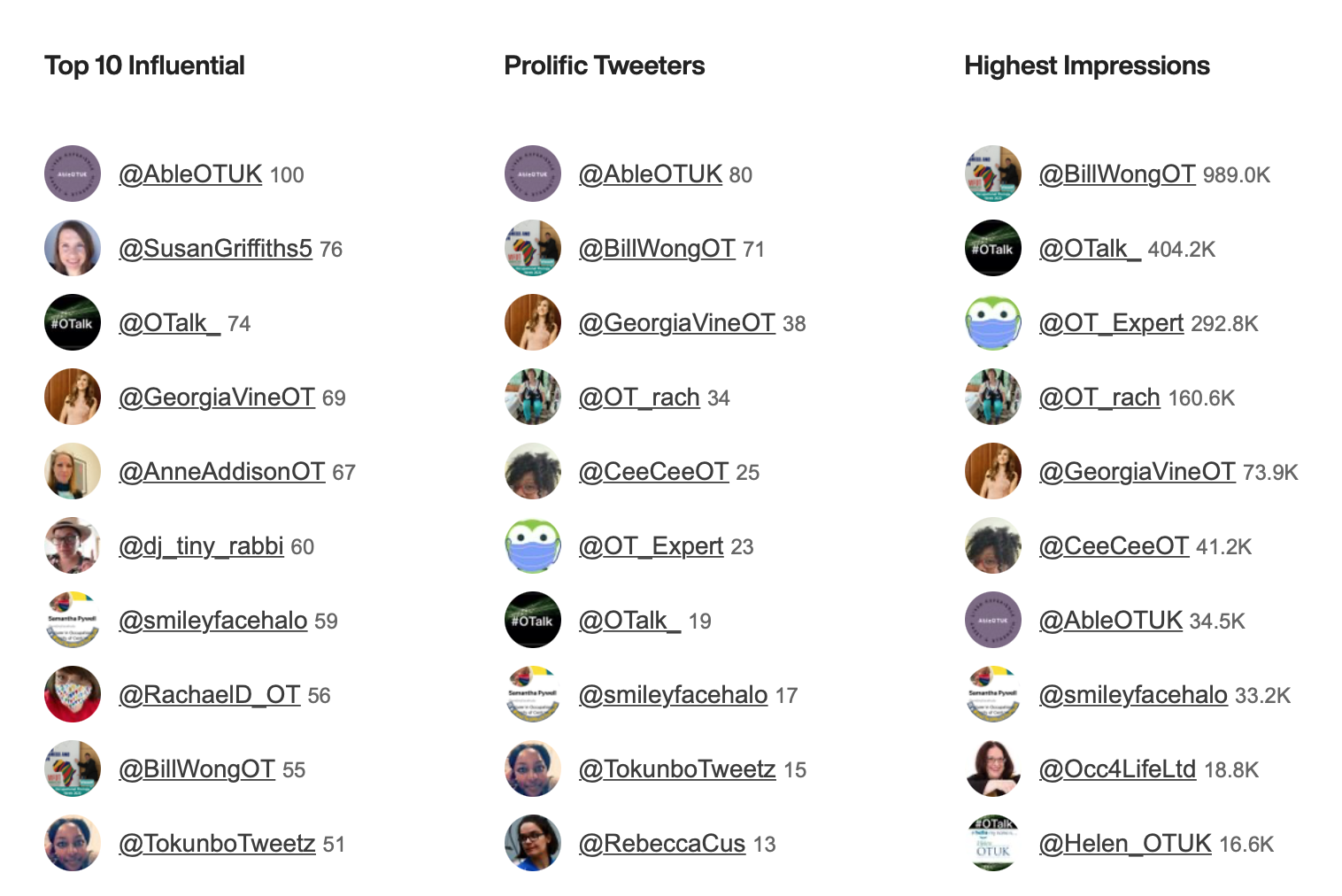
Below is a PDF of the Twitter Transcript, along with statictics showing what engaged and what Impressions where made on twitter.

Under that information, is a link from @AbleOTuk’s Youtube account, with a video of the launch teams event (apologise its not the best there were tech issues so it was filmed on a phone)

If you have any questions, would like to assess support, and or information from AbleOTUK. Please contact them these ways.

We have a closed group on discord, you can request to join.

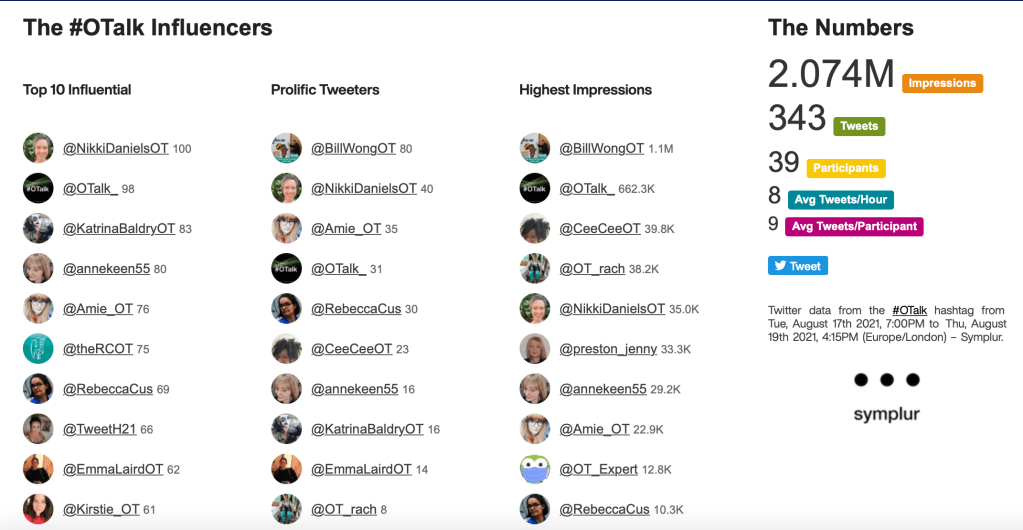
The Numbers

2.258M Impressions
535 Tweets
95 Participants
9 Avg Tweets/Hour
6 Avg Tweets/Participant 

OTalk

#OTalk – 20th July – Sustainable Occupational Therapy Practice

This week’s chat will be hosted by Ben Whittaker from Occupational Therapy Susnet @OTSusnet, AHP lead at the Centre for Sustainable Healthcare @SusHealthcare and a mental health occupational therapist, and Sonia Roschnik, (also tweeting from @OTSusnet) International Climate Policy Director at Healthcare Without Harm @HCWHeurope @HCWHGlobal and a former occupational therapist.   

Sustainable occupational therapy practice means using resources to deliver healthcare today without compromising the health of current or future generations.  The climate emergency is a health emergency, and as a result, addressing climate change has been described as the greatest health opportunity this century.  

The NHS is the largest employer in Britain and responsible for around 4% of our carbon emissions.  The NHS needs to act for the UK to meet its legally binding 2008 Climate Change Act.  Sustainability is written into the NHS constitution and recently, the NHS has made the formal commitment to become net zero by 2040, with the @GreenerNHS programme.  

Sustainability will be integral to the next national AHP strategy.  Many AHPs, including occupational therapists, are professions that utilise sustainable models of care and a shortage of AHPs could be described as a contributing factor to current high carbon care.  

Sustainability is a Master Project for the WFOT.  In 2012, WFOT stated that Occupational therapists need to “re-evaluate practice models and expand clinical reasoning about occupational performance to include sustainable practice.”  In 2018, WFOT published Sustainability Matters which detailed five sustainability guiding principles.  RCOT have stated that these guiding principles need incorporating into UK curricula and cited them in the RCOT professional standards and code of ethics. 

Sustainable Quality Improvement (SusQI) methodology joins carbon reduction to the core aim of providing the best possible healthcare. WFOT’s QUEST strategy includes sustainability as one of the seven quality indicators applicable to all settings for occupational therapy practice.  

In order for occupational therapy practice to be sustainable it needs to address the triple bottom line of social, economic and environmental agendas, which are interdependent.  The examples of social and economic benefits in RCOT’s Improving Lives, Saving Money campaign also reduce carbon and bring environmental benefits.  

Unsustainable human occupations are driving climate change and occupational therapists have a chance to address this outside of traditional healthcare settings. We can work as behaviour change specialists in council sustainability teams or charities by using occupational therapy approaches with a ‘well’ population that want to address sustainable living goals.  For example, by using Green Lifestyle Redesign: https://networks.sustainablehealthcare.org.uk/networks/ot-susnet/creating-sustainable-lifestyle

We look forward to exploring the above areas with others in the OTalk chat, hearing people’s thoughts, ideas and examples of sustainable practice.  

Questions from the WFOT’s Sustainability Guiding Principles: 

Principle 1: Understanding sustainability 

Q1. What skills do you need to learn at this point to help you work more successfully with individuals and communities to help them reflect about sustainability of their actions as they choose and participate in meaningful occupations?

Principle 2: Mitigation of environmental damage due to unsustainable lifestyles

Q2. What could you do as an individual to help reduce the carbon footprint within your practice setting?

Principle 3: Helping service users adapt to the consequences of environmental damage

Q3. How can you help people in the community (individually or in groups) develop skills in and use of their pADLs to advocate for themselves so that they can access resources needed to adapt to the adverse consequences of climate change?

Principle 4: Community sustainability

Q4. What might you include in an education program for small groups in the community about sustainability and its relationship to daily occupational performance?

Principle 5: Developing professional competence

Q5. What kind of educational support do you need in order to become competent in contributing to sustainability in your practice and how should this support be provided?

References

Whittaker B & Roschnik S (2020) A Greener Future. OTnews, 28(11), 24-27 

World Federation of Occupational Therapists (2012) Position statement on environmental sustainability, sustainable practice within occupational therapy. Forrestfield, Au: WFOT.

World Federation of Occupational Therapists (2018) Sustainability Matters: Guiding Principles for Sustainability in Occupational Therapy Practice, Education and Scholarship.  

Websites

CSH Networks (including Occupational Therapy Susnet): https://networks.sustainablehealthcare.org.uk/

Greener NHS: https://www.england.nhs.uk/greenernhs/

Health Care without Harm: https://noharm-europe.org/

Post Chat

Link to Sustainable Occupational Therapy Practice Resource Map

The Numbers

2.506M Impressions
357 Tweets
22 Participants
16 Avg Tweets/Hour
16 Avg Tweets/Participant