OTalk

#OTalk Tuesday 18th October 2022 – Media Club- Putting Death to Imposter Syndrome: More than Just an IDEA host by @BillWongOT

This week, is hosted by Bill Wong – he asks before joining this OTalk discussion, to please watch this TEDx talk by Dr. Douglene Jackson. https://www.ted.com/talks/douglene_jackson_putting_a_death_to_imposter_syndrome_more_than_just_an_idea)

One of the jobs of being a TEDx organizer is to unearth undiscovered and underrepresented perspectives. As I was making a comeback to organize TEDx events again in 2021, I was thinking about how to promote OT with the TEDx platform without breaking its rules. Fortunately, golf is one of my favorite occupations. One of the things I learned from professional golfers is using the rules to their advantage in certain situations. When I mastered my understanding the content diversity guidelines for TEDx organizers, that was when I thought, “Sure, I can’t have an all OT lineup for the TEDx events I organize. However, what if I make an honest effort to invite someone from OT to speak at every TEDx event I organize? Yes, that will make other allied health professions mad if they ever found out that my TEDx events favor OT. I will also have to explain to people why I can’t have an all OT lineup at my events. But, I also know I can’t please everybody.”

Once I identified my strategy in promoting OT through my TEDx events, I used the same strategy as other TEDx organizers when they consider who to send out invites. I asked myself the following questions-

1. What has already been published within the last month? (This is an important question because if an idea I am considering is already published, I may either have to stop exploring the topic or be mindful of that in the process of coaching the speaker I have invited.)

2. What underrepresented perspectives or undiscovered ideas from OT that the public should be aware of?

3. Who is/are the best OT practitioner(s) to invite on the TEDx stage to share one of the underrepresented perspectives or undiscovered ideas? Are they OK with working with tight timelines (since TEDx events typically are) and limited operating windows (since that’s the nature of the TEDx event license types I go for nowadays)?

Fortunately, I generally try to update my knowledge of OT TED and TEDx talks that have existed at least a few times a year. So, as I was planning Dr. Douglene Jackson’s talk in 2021, I thought about the following things. First, up until Dr. Jackson’s talk was published, we were at least 90% confident that there was no TED or TEDx talk by a black occupational therapy practitioner or student. Second, I believe that if I produced this talk by Dr. Jackson, it will be a lasting artifact for prospective black OT students to realize that they can have successful OT careers. Third, I believe it is important to set an example to the OT profession about what proactive advocacy looks like. I felt compelled to not repeat the same mistakes as our predecessors. Finally, justice, equity, diversity, and inclusion has been a popular topic in recent years. I believe it is important to step up and show OT can be a core community pillar in this issue. 

As for the talk production, Dr. Jackson’s talk is actually one of the first talks where I took on the direct responsibility of coaching speakers. I was in imposter syndrome mode because I was trying to find my coaching style while knowing that I am not necessarily an expert in areas that my speakers will speak on. So, I fell back on what I learned during my training as an occupational therapist- being client-centered! The only times I have interjected are- a) making sure the audience can understand the material well; b) providing suggestions on how to make my speakers’ points stronger; c) when I need citations from speakers about their claims. 

Since producing this talk and having it published, I showed it to 3 groups of my students. They all told me, “We never in our wildest dreams would think of watching a TEDx talk produced by one of our instructors. Moreover, this is such an unconventional way of how we advocate for our profession. You teach us something that no other OT/OTA instructor in the world can.” I also had some academics told me, “You were the brainchild for this talk? Not only organizing TEDx events is an unchartered territory for the rest of us, how can you find time to do this when you are already so busy?” I just said, “It is our duty to protect the OT profession. We not only need to share the word about our values to friends and families, we also need to learn about avenues to share it to the public. We have the necessary tools. But, we don’t use them in that context.”

Discussion Questions-

  1. Should OT be champions of justice, equity, diversity, and inclusion? Why or why not?
  2. What are your efforts to promote justice, equity, diversity, and inclusion?
  3. What are some strategies we can help in addressing diversity within OT?
  4. Please share your reflections for this talk.
  5. Feel free to provide constructive comments for this talk.

POST CHAT

Host:  Bill Wong @BillWongOT

Support on OTalk Account:  Sam Pywell @smileyfacehalo

Evidence your CPD. If you joined in this chat you can download the below transcript as evidence for your CPD, but remember the HCPC are interested in what you have learnt.  So why not complete one of our reflection logs to evidence your learning?

HCPC Standards for CPD.

  • Maintain a continuous, up-to-date and accurate record of their CPD activities.
  • Demonstrate that their CPD activities are a mixture of learning activities relevant to current or future practice.
  • Seek to ensure that their CPD has contributed to the quality of their practice and service delivery.
  • Seek to ensure that their CPD benefits the service user.
  • Upon request, present a written profile (which must be their own work and supported by evidence) explaining how they have met the Standards for CPD.
OTalk

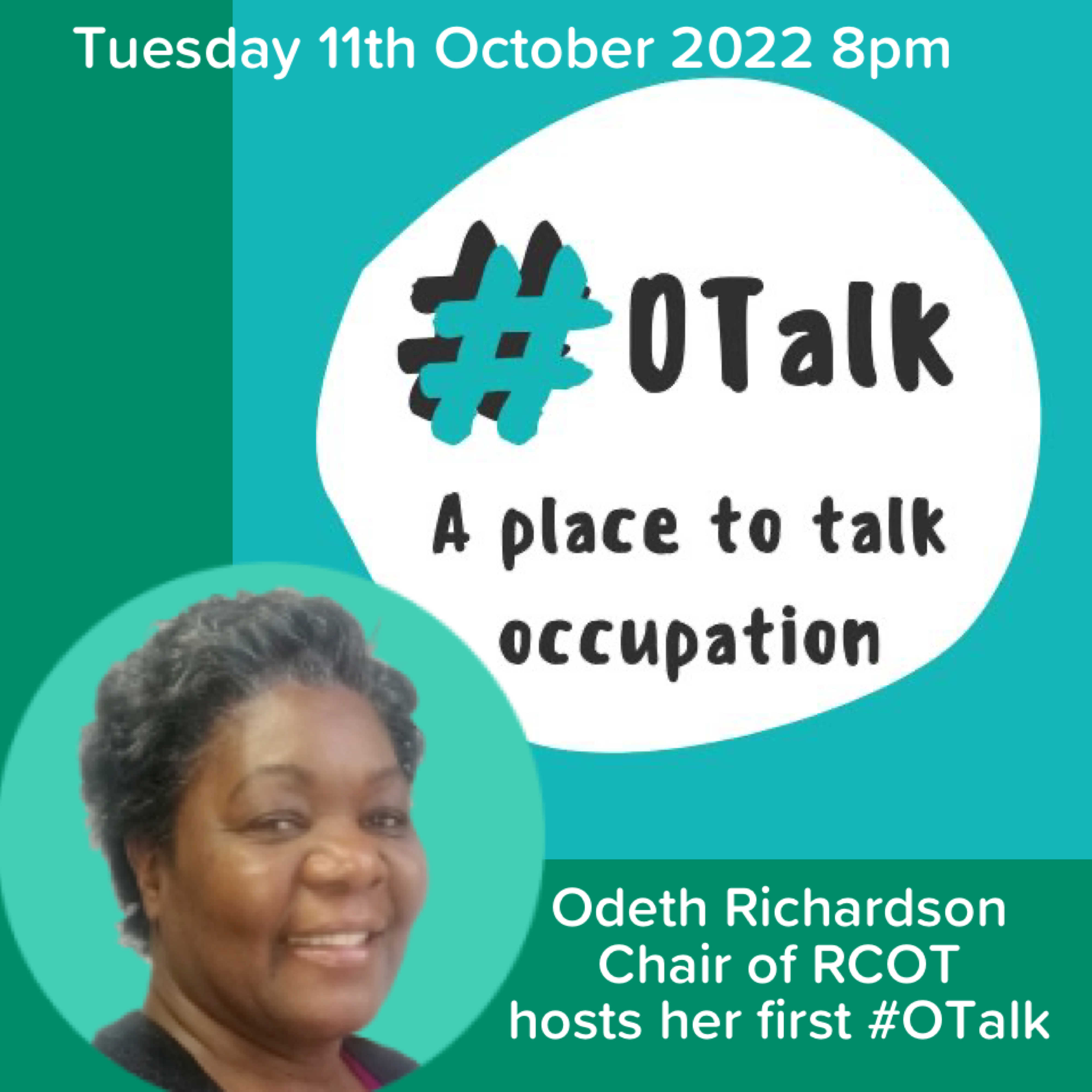
#OTalk – 11th October 2022 @theRCOT new Chair @OdethRichardson hosts her first #OTalk

We are so pleased to welcome RCOT new Chair of council Odeth Richardson as she hosts her first OTalk – She wants to hear from you this is your opportunity to engage with a person who is in a positions of influence.

Here is what Odeth has to say;

One of my election promises is to re-engage the membership as it was felt some Occupational Therapists were disconnected from the professional body. The past few years have been pretty challenging for all of us and recovery from this will take time. I know priorities have changed during the pandemic (mine certainly have) and so I wanted to reach out to the membership to try and understand what matters to them. Are we meeting your needs at the RCOT?

Two way communication is important and we would love to hear from you about the things that we are not getting right. How can these be improved? It’s equally important that we know the things that are working well. Engagement will differ for individuals and so we need a variety of ways that will be available to our members.

At our last council meeting we spent some time thinking about the following questions.

What does meaningful or good engagement from our members look like? 

If we manage engagement well, what will be different? 

How do we best measure, track and analyse meaningful engagement? 

This #OTalk session will help us to gain valuable insight from you our members and will support us in developing an Engagement strategy that will better reflect your needs.

Read more about Odeth here

POST CHAT

Host:  Odeth Richardson @OdethRichardson

Support on OTalk Account: Helen @Helen_OTUK

Evidence your CPD. If you joined in this chat you can download the below transcript as evidence for your CPD, but remember the HCPC are interested in what you have learnt.  So why not complete one of our reflection logs to evidence your learning?

HCPC Standards for CPD.

  • Maintain a continuous, up-to-date and accurate record of their CPD activities.
  • Demonstrate that their CPD activities are a mixture of learning activities relevant to current or future practice.
  • Seek to ensure that their CPD has contributed to the quality of their practice and service delivery.
  • Seek to ensure that their CPD benefits the service user.
  • Upon request, present a written profile (which must be their own work and supported by evidence) explaining how they have met the Standards for CPD.
OTalk

#OTalk Research – Tuesday 4th October 2022 – Finding the Gap! hosted by @bevaturtle

This #OTalk is hosted by Beverley Turtle (@bevaturtle)

This #OTalk is going to cover an important step in the research process, finding the gap. While it is hard to define what the “research gap” is (Nyanchoka 2019), it is seen as an area where there is missing or insufficient evidence to answer a research question. The gap could be in knowledge available, the sample under investigation or the type of research method used. All research projects must address a gap to ensure the generation of new knowledge and contribute to the evidence-base. Furthermore, while a gap may easily, or not so easily, be developed, the research must be worthwhile and important to relevant stakeholders.

It is also important to be mindful that the identification of a gap may not be restricted to research, with audits providing a way to identify “gaps” and avenues for quality improvement in clinical practice (Royal College of Occupational Therapists 2019).  Finding the gap may seem like an insurmountable task, however this #OTalk provides an opportunity to think about what constitutes a research gap and help break down a necessary step in research development. 

Questions

  1. What is your understanding of a “research gap”?
  2. What methods have you used to identify a “research gap”?
  3. What are the gaps you have found in your department, and has this led to research?
  4. How do you make the leap between identifying a research gap to a research question?
  5. What tips do you have for those working to identify the gap in their area?

References

Nyanchoka, L., Tudur-Smith, C., Iversen, V., Tricco, A.C. and Porcher, R., 2019. A scoping review describes methods used to identify, prioritize and display gaps in health research. Journal of Clinical Epidemiology, 109, pp.99-110.

Royal College of Occupational Therapists, (2019) Royal College of Occupational Therapists Research and Development Strategy 2019-2024. London: RCOT. 

POST CHAT

Host:  Beverley Turtle (@bevaturtle)

Evidence your CPD. If you joined in this chat you can download the below transcript as evidence for your CPD, but remember the HCPC are interested in what you have learnt.  So why not complete one of our reflection logs to evidence your learning?

HCPC Standards for CPD.

  • Maintain a continuous, up-to-date and accurate record of their CPD activities.
  • Demonstrate that their CPD activities are a mixture of learning activities relevant to current or future practice.
  • Seek to ensure that their CPD has contributed to the quality of their practice and service delivery.
  • Seek to ensure that their CPD benefits the service user.
  • Upon request, present a written profile (which must be their own work and supported by evidence) explaining how they have met the Standards for CPD.
OTalk

#OTalk – 20th September 2022: How can Occupational Therapists best assess, treat and support self-management of hidden impairments after TIA and minor stroke? Hosted by @JenniferNCrow

This week’s chat will be hosted by Jennifer Crow (@JenniferNCrow); HEE/NIHR Integrated Clinical Academic Doctoral Research Fellow and Clinical Specialist Occupational Therapist in Stroke.

People admitted to a Hyperacute Stroke Unit with a confirmed stroke or TIA and who are physically independent on the ward and ‘pass’ a cognitive screen, typically have a very short inpatient stay. They are thought to have made a full recovery and deemed too good for existing post-discharge stroke pathways and so are discharged home with no onward referrals except for the stroke six-month review and routine medical follow-up appointments.

These stroke survivors report unmet information needs and feeling abandoned on discharge (1, 2). Critically, hidden impairments not apparent in hospital become evident after discharge. If unaddressed these effect participation, return to work, relationships, quality of life and well-being (3-6). Even when a full clinical recovery appears to have occurred, cognitive impairment is often found (7-10). Psychological changes, particularly anxiety and depression are often reported (3, 11-15). Longitudinal studies show that problems with mood, fatigue and cognition persist, reducing participation and well being even years after a so called ‘minor’ stroke. Stroke survivors seeking support and attempting to access follow-up care describe being bounced between primary care and stroke services. There is often disagreement amongst the professional as to who should be managing ongoing mood and adjustment issues as well as fatigue and cognition (16, 17).

Join Jennifer and colleagues from the RCOT SSNP Stoke Forum (@RCOT_NP) to explore this important topic in more detail. We will be discussing the questions below and hope to learn from services where there are new and innovative practices addressing the needs of this specific stroke survivor group.

Question 1 – Assessing hidden impairments within 24 to 48 hours of admission to a HASU is challenging – in what ways are your MDT’s trying to do this?

Question 2 – What follow-up pathways exist within your services for this stroke survivor group and what is the role of the Occupational Therapist in these services?

Question 3 – Support with self-management and navigating post-stroke pathways is key to managing the ongoing effects of the stroke – what techniques or interventions are people using to empower stroke survivors and their families and when are they introduced?

Question 4 – What about stroke survivors that are not admitted to hospital eg those seen in TIA clinics or those diagnosed and discharged from the emergency department? What if any support or guidance are provided to these people within your services?

REFERENCES:

Pindus DM, Mullis R, Lim L, Wellwood I, Rundell AV, Abd Aziz NA, et al. Stroke survivors’ and informal caregivers’ experiences of primary care and community healthcare services – A systematic review and meta-ethnography. PLoS One. 2018;13(2):e0192533.

Crow J. A 2-week stroke review identifies unmet needs in patients discharged home from a hyperacute stroke unit. British Journal of Neuroscience Nursing. 2018;14(1):29-35.

Verbraak ME, Hoeksma AF, Lindeboom R, Kwa VI. Subtle problems in activities of daily living after a transient ischemic attack or an apparently fully recovered non-disabling stroke. J Stroke Cerebrovasc Dis. 2012;21(2):124-30.

Edwards DF, Hahn M, Baum C, Dromerick AW. The impact of mild stroke on meaningful activity and life satisfaction. J Stroke Cerebrovasc Dis. 2006;15(4):151-7.

Sangha RS, Caprio FZ, Askew R, Corado C, Bernstein R, Curran Y, et al. Quality of life in patients with TIA and minor ischemic stroke. Neurology. 2015;85(22):1957-63.

Carlsson GE, Moller A, Blomstrand C. Managing an everyday life of uncertainty–a qualitative study of coping in persons with mild stroke. Disabil Rehabil. 2009;31(10):773-82.

Jokinen H, Melkas S, Ylikoski R, Pohjasvaara T, Kaste M, Erkinjuntti T, et al. Post-stroke cognitive impairment is common even after successful clinical recovery. Eur J Neurol. 2015;22(9):1288-94.

Fens M, van Heugten CM, Beusmans GH, Limburg M, Haeren R, Kaemingk A, et al. Not as transient: patients with transient ischaemic attack or minor stroke experience cognitive and communication problems; an exploratory study. Eur J Gen Pract. 2013;19(1):11-6.

Pendlebury ST, Wadling S, Silver LE, Mehta Z, Rothwell PM. Transient cognitive impairment in TIA and minor stroke. Stroke. 2011;42(11):3116-21.

Wolf TJ, Barbee AR, White D. Executive dysfunction immediately after mild stroke. OTJR (Thorofare N J). 2011;31(1):S23-9.

Altieri M, Maestrini I, Mercurio A, Troisi P, Sgarlata E, Rea V, et al. Depression after minor stroke: prevalence and predictors. Eur J Neurol. 2012;19(3):517-21.

Terrill AL, Schwartz JK, Belagaje SR. Best Practices for The Interdisciplinary Rehabilitation Team: A Review of Mental Health Issues in Mild Stroke Survivors. Stroke Res Treat. 2018;2018:6187328.

Sackley CM, Mant J, McManus RJ, Humphreys G, Sharp L, Mares K, et al. Functional and emotional outcomes after transient ischemic attack: A 12-month prospective controlled cohort study. Int J Stroke. 2019;14(5):522-9.

Kellett N, Drummond AER, Palmer T, Munshi S, Lincoln NB. Impact of transient ischaemic attack and minor stroke on daily life. International Journal of Therapy and Rehabilitation. 2014;21(7):318-23.

Alenljung M, Ranada ÅL, Liedberg GM. Struggling with everyday life after mild stroke with cognitive impairments – The experiences of working age women. British Journal of Occupational Therapy. 2018;82(4):227-34.

Lim L, Mant J, Mullis R, Roland M. When is referral from primary care to specialist services appropriate for survivors of stroke? A modified RAND-appropriateness consensus study. BMC Fam Pract. 2020;21(1):66.

Tang EYH, Price C, Stephan BCM, Robinson L, Exley C. Gaps in care for patients with memory deficits after stroke: views of healthcare providers. BMC Health Serv Res. 2017;17(1):634-.

POST CHAT

Host:  @JenniferNCrow

Support on OTalk Account: @paulwilkinson94

Evidence your CPD. If you joined in this chat you can download the below transcript as evidence for your CPD, but remember the HCPC are interested in what you have learnt.  So why not complete one of our reflection logs to evidence your learning?

HCPC Standards for CPD.

  • Maintain a continuous, up-to-date and accurate record of their CPD activities.
  • Demonstrate that their CPD activities are a mixture of learning activities relevant to current or future practice.
  • Seek to ensure that their CPD has contributed to the quality of their practice and service delivery.
  • Seek to ensure that their CPD benefits the service user.
  • Upon request, present a written profile (which must be their own work and supported by evidence) explaining how they have met the Standards for CPD.

OTalk

#OTalk Tuesday 13th September #DeafAwarenessMonth  Hosted by @SusanGriffiths5

In the UK, there are 10-11 million people who are deaf or have a hearing loss, that is 1 in every 6 people! Over 50,000 of these are children and young people. It is estimated that by 2035 there will be 15.6 million people in the UK with hearing loss.  

Due to ableism or rather audism (discrimination against individuals who are deaf or have a hearing loss), deaf people experience inequalities in every aspect of society including education, health & social care, employment, and many more. The COVID-19 pandemic has further exposed and deepened these existing inequalities due to the lack of accessible public health information and face masks.

As Occupational Therapists, we are uniquely positioned to provide support for deaf people or people with a hearing loss to live their best lives. So as part of deaf awareness month, I would like to invite you all to a discussion where we can explore the barriers and challenges experienced by the hearing loss community and what we can do to support them.  

  1. What is your understanding of and experiences of working with patients who are deaf or have hearing loss?  
  2. What are the barriers and challenges that deaf people or people with hearing loss face? 
  3. What are the barriers and challenges for Occupational Therapists in communicating with and supporting deaf people or people with a hearing loss? 
  4. What role can occupational therapists play in tackling audism and how can we ensure our services are accessible to anyone with a hearing loss?  

Watch out for pop-up polls and random ‘Did you know?’ facts about the deaf and hearing loss community.

POST CHAT

Host:  @SusanGriffiths5

Support on OTalk Account: Rachel @OT_rach

Evidence your CPD. If you joined in this chat you can download the below transcript as evidence for your CPD, but remember the HCPC are interested in what you have learnt.  So why not complete one of our reflection logs to evidence your learning?

HCPC Standards for CPD.

  • Maintain a continuous, up-to-date and accurate record of their CPD activities.
  • Demonstrate that their CPD activities are a mixture of learning activities relevant to current or future practice.
  • Seek to ensure that their CPD has contributed to the quality of their practice and service delivery.
  • Seek to ensure that their CPD benefits the service user.
  • Upon request, present a written profile (which must be their own work and supported by evidence) explaining how they have met the Standards for CPD.