OTalk

#OTalk Tuesday 3rd August 2021 8 – 9pm (British Summer Time) Harnessing the occupational therapy evidence based for the benefit of European citizens

This month’s #OTalk research chat will be hosted by Board members from the Research into Occupational Therapy and Occupational Science (ROTOS) Foundation: Professor Alison Laver-Fawcett @alsionlaverfaw, is Chair of ROTOS and an educator and researcher at York St John University, York, UK @YSJOT; and Sasa Radic, @Sasa_Radic, is Communications Lead for ROTOS, a Croatian occupational therapist and president of the Croatian Association of Occupational Therapists. Sasa will be tweeting from the @_ROTOS_ twitter account. 
The Research into Occupational Therapy and Occupational Science (ROTOS) Foundation https://www.rotosfoundation.eu/ @_ROTOS_ was founded on 11th March 2020, after being developed through an Occupational Therapy Europe standing committee (from 2017). ROTOS now forms one branch of Occupational Therapy Europe Foundation (https://www.oteurope.eu/) along with the Council of Occupational Therapists for the European Countries (COTEC) and the European Network of Occupational Therapy in Higher Education (ENOTHE). The ROTOS Foundation is a registered charity in the Netherlands. The ROTOS Board currently comprises six members.  

ROTOS’s Vision is to improve European citizens’ lives through occupation centred research and science, by having one strong voice for occupational therapy and occupational science research. We aim that knowledge from Occupational Therapy and Occupational Science research will be appropriately used to inform and shape European policy and practice, through the establishment of a strong European profile of Occupational Therapy and Occupational Science researchers, that both strengthens occupation-centred knowledge generation and supports access to this knowledge for the benefit for all Europeans. To achieve this a strategic three-year action plan has been developed. 

  • Strategic aim 1: Establish occupation as powerful knowledge domain 

To use current research and evidence, and supporting development of further research, by bringing together established researchers and encouraging a strong voice regarding Occupational Therapy research at all levels. 

  • Strategic aim 2: Use occupational therapy and occupational science research outcomes for advocacy and to influence policy development.
    To develop research leaders confident in promoting the outcomes of Occupational Therapy, Occupational Science and interdisciplinary occupation-centred research as beneficial to the lives and occupational wellbeing of individuals and communities. 

  • Strategic aim 3: To build strong collaborations to achieve the ROTOS Foundation’s vision. 

To achieve a sustainable ROTOS Foundation and create a strong research community linking researchers to practitioners, educators and other researchers, through facilitating working across boundaries in the European context.

There are several ways colleagues can get involved with ROTOS:

  • Join the ROTOS network
  • Contribute to a ROTOS webinar
  • Support writing documents (evidence base summary, call to maximising the impact of occupational therapy and occupational science research, translating research knowledge into practice). 
  • Mentor occupational therapy and occupational science researchers in Europe
  • Help identify priorities for occupational therapy and occupational science research and pedagogical research in Europe
  • Contribute to leadership for occupational therapy and occupational science research
  • Engage in fundraising activities to support ROTOS projects and actions

We look forward to exploring this vision and aim with others in the OTalk chat, hearing people’s thoughts, ideas and examples of occupational therapy research and occupational science research has influenced policy development, informed guidelines, and led to service development and improvement. In this #OTalk we will seek your ideas and contributions for achieving ROTOS’ vision and aims, and discuss how occupational therapy researchers and occupational science researchers can get involved with ROTOS activities.  

Some Questions to reflect on:

  1. How can we increase the accessibility of the occupational therapy and occupational science evidence base for people with disabilities & health conditions, policy makers, service commissioners & the wider population?
  2. How can we most effectively use occupational therapy and occupational science research to influence policy development?
  3. What are the key components of an effective evidence base summary document?
  1. A few research priority exercises have been done recently, e.g. @thewfot https://wfot.org/resources/wfot-research-priorities & @theRCOT https://www.rcot.co.uk/top-10, do you think there are different OT & OS research priorities across Europe?
  2. What do you think are the key occupational therapy and occupational science research priorities?
  1. What skills, knowledge and attributes make effective occupational therapy and occupational science research leaders? How are these developed?
  2. Have you received or offered mentorship related to occupational therapy and occupational science research? How was this organised? Was it useful?
  3. What should a @_ROTOS_ European occupational therapy & occupational science research mentorship programme provide?
  4. @_ROTOS_ has already delivered a webinar and plans future ones, what would you like to see ROTOS provide webinars about?
  5. @_ROTOS_ is a charity and must raise its own funds, what ideas do you have for effective fundraising activities?

You can contact ROTOS Board members using the form at:

https://www.rotosfoundation.eu/contact-us/ or email Alison at: alison.laver-fawcett@rotos.eu

Post Chat

Don’t forget to use one of our Reflective logs to record what you have learnt. https://otalk.co.uk/reflection-logs/

OTalk

#OTalk Tuesday 27th July @AbleOTUK Launch Event – Choose either the #OTalk chat or join our live Teams event.

This Tuesday is very exciting @OTalk_ are pleased to use its platform to help launch a new OT affiliation group @AbleOTUK, just in time for the end of this years #DisabilityPrideMonth.  Here is what @OTableOTUK have to say…….

We @AbleOTUK are excited about our Launch, there has been lots of work behind the senses and we can’t wait to get started. For our launch we have two options for you to engage in, simultaneously, 8pm Tuesday 27th July.

  • Live Teams Event that will have a slideshow, and members sharing their experiences.  (Requires Booking 100 free spaces available.)
  • A Traditional #OTalk focusing on Accessibility and Disability (Questions below) Both events will be available to watch/read after the launch.

We are a core group of volunteer Occupational Therapists and a patient advocate who run and maintain @AbleOTUK twitter account and soon to be coming website. We hope in the very near future to run some online events, provide useful resources, create supportive networks and work with other stakeholders, please see our terms of reference below, for more detail. You can download the a copy of the groups frame of reference below. (There are three visions available, if your needs are not meet, please let us know and we will endeavour to create the document in a formate that suits your needs.)

July is #DisabilityPrideMonth one of our members @GeorgiaVineOT ask the OT community with disabilities and or health problems, to tweet something they would like the rest of the community to think about. These “Dear OT Community” tweets have been made it to a video

Those with disabilities are the largest & most diverse minority within the worlds population, they represent all abilities, ages, races, ethnicities, religions and Social Economic Background.  In order to grow, as a profession, we must first recognise that there’s a problem. These events are an opportunity to share your experiences and/or learn from others.  Everyone is welcome,  we are really excited about our launch, and can’t wait to hear from the OTalk community.  https://youtu.be/TSeQAO7z1io

Question 1 – What is your understanding of disability and how this might impact a person?

Question 2 – What is your understanding of accessibility and how it might impact a person?

Question 3 – In regards to disability and accessibility, what barriers have you come across, either when working with a client, or for your own needs?

Question 4 – What and how can we as an OT profession, RCOT and AbleOTUK do to remove the barriers?

Post Chat

What a great launch @AbleOTUKwould like to thank OTalk for hosting us, and to everyone that joined in, gave their support and help.

Below is a PDF of the Twitter Transcript, along with statictics showing what engaged and what Impressions where made on twitter.

Under that information, is a link from @AbleOTuk’s Youtube account, with a video of the launch teams event (apologise its not the best there were tech issues so it was filmed on a phone)

If you have any questions, would like to assess support, and or information from AbleOTUK. Please contact them these ways.

We have a closed group on discord, you can request to join.

The Numbers

2.258M Impressions
535 Tweets
95 Participants
9 Avg Tweets/Hour
6 Avg Tweets/Participant 

OTalk

#OTalk 10th Nov 2020 – Finding your Professional Development/CPD mentor-

Finding your Professional Development/CPD mentor- By: Bill Wong, OTD/OTR/L (@BillWongOT)

Behind many successful OT practitioners, they either have their own CPD mentors or mentoring teams. For example, I once overheard that Charles Christensen supported Michael Iwama’s OT journey. I also overheard that Barbara Kornblau (former AOTA president) supported Shawn Phipps’ OT journey. (Shawn is one of the members of my CPD mentoring team.) I am sure there are countless stories of others in OT land as well.

In my own OT journey so far, I had experience with a singular CPD mentor and a CPD mentoring team. My first CPD mentor was the late Terry Olivas De La O. (Those of you who participated in #otalk in its earlier days may remember who she was. But for those of you who didn’t participate in #otalk in its early days, I will fill you in a bit about her. Terry was a certified occupational therapy assistant in the USA. She was highlighted in the 2012 Slagle Lecture by Karen Jacobs. She was also amongst the 1% of certified occupational therapy assistants who received the Roster of Honor designation in the USA, which is equivalent to a fellow for that position in the UK for occupational therapists. She was known for her passion in anti-bullying, as well as getting the word about #valueofOT out to the general public. Unfortunately, she passed away in early 2014 due to a host of health issues.) After Terry passed away, I spent two months looking for her replacement. I ended up with Michael Iwama, Barbara Kornblau, and Shawn Phipps as my CPD mentoring team.

What led me to a team approach vs. a singular mentor? I actually borrowed the concept from Major League Baseball (MLB), as I am a baseball fan. Since the early 2010’s, many successful MLB teams started to implement a team approach with its hitting and pitching departments. (For those of you who don’t follow baseball, hitting and pitching are two of the most important elements of baseball.) Therefore, I thought, “If successful MLB teams can make a team approach work, why can’t I do that for my CPD?” 6 years into having this approach, I would say it has worked out pretty well for me. The primary benefit for me- sometimes I need to hear certain things explained to me in another way so that I can maximize my professional potential.

I will switch to a Q & A format for the rest of the blog.

Q: When is it a good time to find a CPD mentor or mentoring team?

A: It depends on you. My own suggestion is ASAP. My reasoning is- If your mentor(s) already have rapport with you, they will be more likely to give you direct constructive advice.

Q: Why do you want a CPD mentor/mentoring team?

A: Early on in my OT journey, I realized that I have a lot of potential to make a difference in the OT world. However, I need people to provide clarity on the steps to help me reach my potential. Fast forward to today, I want my mentors to be my accountability partners for my CPD goals.

Q: What qualities do you want from your mentors?

A: For me personally, I look for compatibility and competence. Compatibility is important because I want to hear advice by people I want to hear from. Competence is important because I don’t want to waste time and effort on doing things that are not constructive or relevant to me. In addition, there are times I also want to know if things I want at the time are really to my best interests.

Q: How do you go about finding your mentors?

A: For my first couple years in my OT journey, I did a lot of window shopping. After all, I am an introvert. I needed time to figure out a list of people who would fit my criteria, as I started my OT journey without really knowing anyone in OT well. Then, when I found Terry, I popped the question when I met her in person for the first time about a year after connecting on Facebook. At that time, because I was fairly new to the profession, being local was also an important criteria. After all, we met several times during our two years of mentor-mentee relationship together. As for Barbara, Michael, and Shawn, I settled on them because I tried to replicate what I had with Terry. However, geography wise, I no longer needed a mentor that is geographically close to me (although Shawn is actually so) because Terry did such a good job with me.

Of course, there can also be some quick and easy ways, too. Sometimes there are formal mentorship programs. For example, earlier this decade, AOTA has the Emerging Leaders Development Program. Since then, some state associations in the USA copied the same blueprint. Recently, COTAD has launched its minority mentorship program. (I am not in tune of what’s available in countries outside of USA, however.)

Q: What else have you really learned?

A: A mentor-mentee relationship should be a collaborative process. The mentor should not be forcing on his/her agenda to the mentee. Instead, the mentor can suggest things for the mentee to do while keeping in mind of his/her interests. Meanwhile, the mentee should be an active participant in the relationship. This includes taking charge of his/her development, making appointments to chat with his/her mentor, and doing as much homework as he/she can before asking mentor for advice. Another thing- if you have no preferences geography wise, you will have a bigger pool of potential mentors to choose from.

Q: Can I change mentors over the course of my career?

A: Of course. In some formal mentoring programs, you will have to be with your assigned mentor for a certain period of time. After that time is over, it is up to you to decide whether you want to continue the relationship or not off the program. Meanwhile, some of my mentees stopped asking me for advice when they felt like they no longer needed me.

Discussion Questions

  1. Do you have a CPD mentor or mentoring team? If you have one, what qualities are you looking for?
  2. Do you have CPD mentees? If so, what qualities are you looking for?
  3. If you have a choice, do you prefer a formal or informal mentorship arrangement? Why?
  4. If you have a choice of anyone in OT to be your mentor/part of your mentoring team, who are they? Why?

Post Chat 

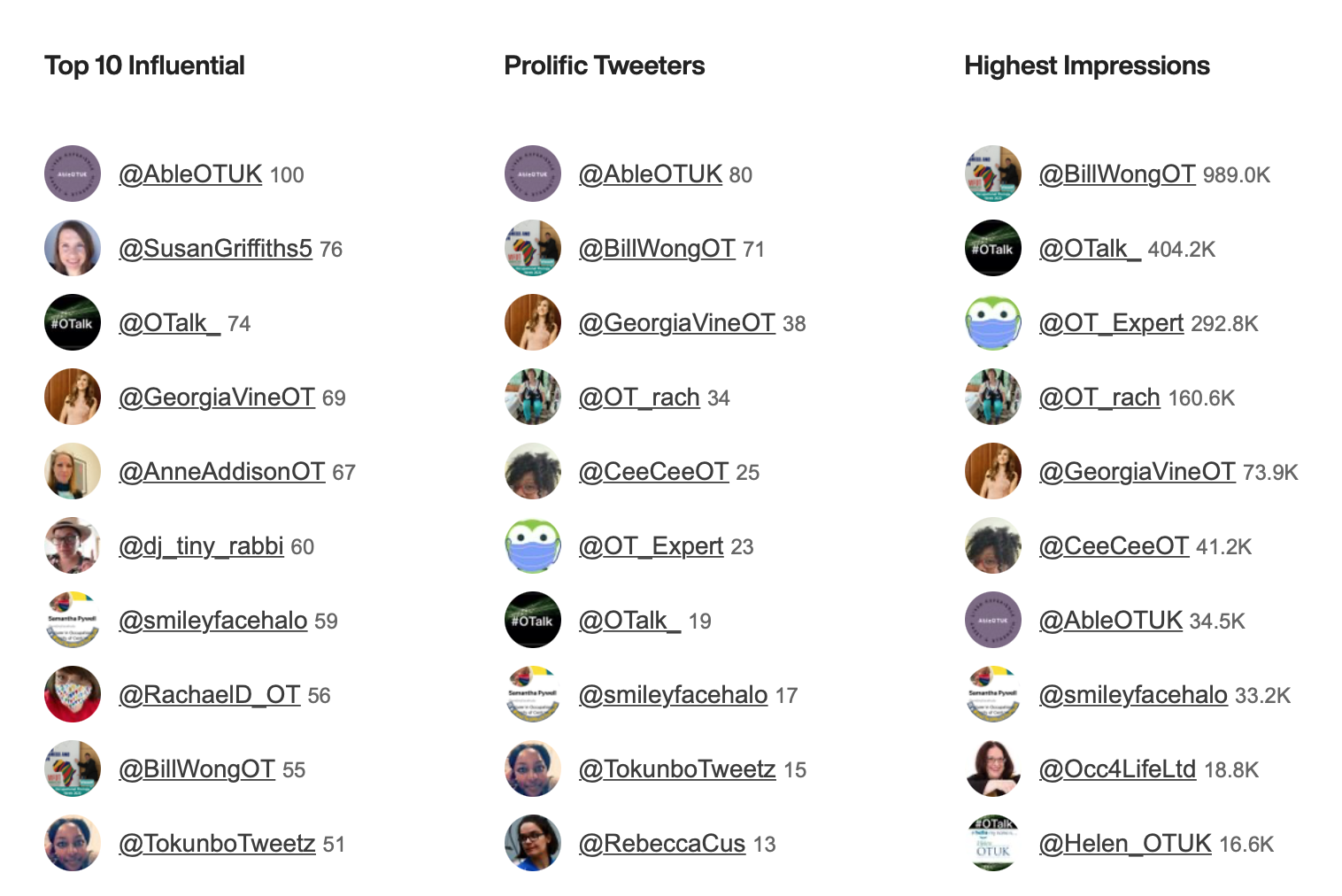
The Numbers

2.335M Impressions
235 Tweets
28 Participants
Avg Tweets/Hour
Avg Tweets/Participant

#OTalk Participants

Online transcript 10th Nov 2020 

OTalk

#OTalk 28th July 2020 – Recovery Through Activity

This weeks OTalk will be hosted by Jess Powell @JessOTpowell. 

Seen as an ideal pre discharge intervention as it helps individuals to connect with their local community, engage in activity in a supportive environment and to learn new skills that they can continue to use after being discharged from mental health services.

Recovery through activity is based on the Model of Human Occupation and is fully endorsed by Royal College of Occupational Therapists. The intervention comprises 12 sessions delivered once a week over 12 weeks, encompassing activities across social, leisure, work and spiritual areas of life .Participants are encouraged to explore new activities and utilise these as a basis to build their confidence, overcome personal barriers and develop new interests. 

In the recent draft Nice Guidelines reference was made to a lack of evidence to support key interventions to support the recovery for people with mental health problems. 

The guiding principle is that it is possible for people to regain a meaningful life despite managing a long term mental health condition. 

This intervention would contribute to the evidence base appertaining to this principle.

Question 1 :Have you used recovery through activity in your setting? If not why not? 

Question 2 :how can we show case, case formulation within MDT to encompass recovery through activity 

Question 3: How should we measure the success recovery through activity? 

 Question 4: How can we make recovery through activity a Nice recognised intervention 

OTalk

#OTalk 16th June 2020 – Leadership? What me!

This week Natalie Jones @natlouj and Dee Christie @OTinretirement will be hosting this what they had to say. 

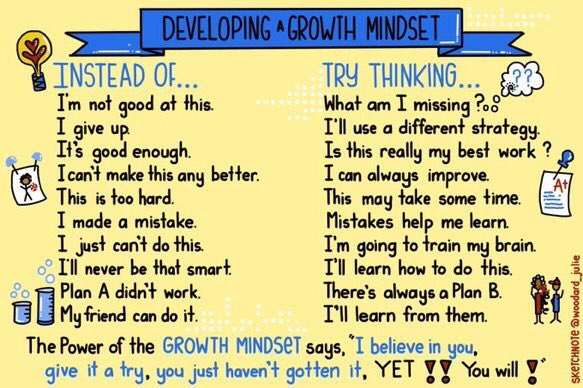
growth mindset

In 2018 Karin Orman RCOT’s Lead Professional Advisor posted a blog about Leadership in Occupational Therapy, challenging us ‘to think differently about how we grow leadership within the profession and to start thinking about ourselves as leaders.’ Karin hits on an issue which is important to me. “We may have, in many areas of practice, lost our traditional management structure but that does not have to mean we lose leadership within the profession”. 

I recently wrote an article about this in OTnews (Jones 2019) describing my voyage into professional leadership. This challenge from Karin resonates with my experience of therapy management structures. Over the last ten years we have moved towards integrated teams and allied health professional leadership has taken root. Which means single profession line management is no longer the ‘norm,’ you are more than likely to be managed and led by someone from another professional background and this brings both challenges and new opportunities. Occupational Therapists that don’t have a professional led talk about ‘not having a voice’, or the ‘OT voice is not loud enough’.  This makes it more important to think about and reflect on opportunities to lead and influence, regardless of the organisational structures you work in.

It’s no accident that the 3rd pillar of the RCOT Career Development Framework is leadership. It starts at entry level where newly qualified OTs can act as role models to promote the profession and find ways to lead by sharing their unique contribution to occupational therapy. Right through to level nine where executive leadership is described as ‘Lead and influence the political and economic

climate, locally, nationally and internationally, which impacts on service delivery’.  The last column in the framework is titled ‘mind-set’. It’s this word that I would like us to reflect on in today’s #OTalk. 

What is a leadership mindset? Do you have one? You might recognize the traits in yourself or others? It’s interesting to reflect firstly on ‘what does a good leadership mind-set look like?’ You will have positive roles models that have influenced your career, you will have also experienced the converse and perhaps can describe what this looks and feels like. It’s worth taking some time to explore what qualities and values you would like to lead with? Once you have identified these you can then think about creating opportunities for yourself to develop your skills and knowledge aligned to your leadership aspirations, thereby creating ‘the leadership mind-set’. 

All too often I have observed excellent Occupational Therapists at all levels in their career, that have a lack of self and professional confidence. Despite the apparent evidence of competence, the imposter syndrome (IS) hits.  Chris Lake describes imposter syndrome (IS) in his blog on leadership and self-doubt. https://www.leadershipacademy.nhs.uk/blog/leadership-doubt-and-humility/

“You’ll remain convinced that you do not deserve the success you’ve achieved, dismissing this as luck or fortuitous timing”. Psychologists might describe the phenomenon as ‘failing to internalise your accomplishments, unable to believe that you yourself are deserving of the position you’ve achieved’. How often have you brushed off a complement? Chris offers some tips for when IS strikes, ‘believe that it’s normal and look around the department at those you admire, and know they’ll experience this too’. 

If you identify with imposter syndrome, how do you build personal and professional confidence so that you feel able to take leadership opportunities when they come along? What tips do you have to share with others about how you have overcome the nagging and disabling self-doubt? If you were mentoring yourself on leadership mind-sets and building self-confidence ‘what would you tell yourself’? If you’re not able to hold up the mirror and do some self-reflection, what about getting a leadership mentor?  A mentor with the experience, skills and knowledge to provide you with constructive feedback and a friendly listening ear. They don’t need to be from the same profession as you. A mentor is someone who will nurture you as a leader, help you see different perspectives and at times help you wrestle with the imposter syndrome monster who lives under the bed. I have had several mentors and role models which haven’t been Occupational Therapists, however they have brought to the relationship many other skills, qualities and experiences that were valuable and supported my leadership development. 

Perhaps you are already on the leadership journey and can share with the #OTalk community some examples of ways in which you have developed as a leader? What strategies have you tried and tested in your leadership journey so far? 

What opportunities are there for you to experience leadership in your role. Novel and new opportunities open you up to situations and people you would normally not get exposure to. What about trying a ‘shadow board’ where you emulate an executive board with peers using the same papers and have your own ‘mini’ board to experience what the conversations might be like and explore new points of view? These experiences could add richness to your leadership development, gaining new skills and knowledge. 

Occupational Therapists are natural problem solvers and with a dash of creativity I’m sure you can contribute ideas for others about how to develop learning opportunities and environments, which will be added value to the leadership voyage. So, if we put our collective brains together, can we come up with some new and novel activities for continuing professional development, to enhance leadership skills and knowledge?

There have never been more opportunities for Occupational Therapists to move into leadership roles. From leading a Band 5 peer support group, to pioneering in a new and emerging roles, to AHP Director roles in the NHS and Principle OT roles in Social Care. Stuart Palma, Head of Allied Health Professions (professional leadership) at NHS England and NHS Improvement produced some recommends that the NHS starts to explore having Chief AHP within their organisations, creating greater visibility at board level. There are already OTs taking up these positions. https://improvement.nhs.uk/resources/investing-chief-allied-health-professionals/  we must be ready!

So why is ‘mind-set important in leadership? A growth leadership mind-set is a belief that you can change, develop and improve your leadership skills. Research has shown that those with a growth ‘mind-set’ are mentally prepared to take on challenges, adapt to feedback and adopt effective problem-solving’.  As a leader I am continually learning and motivated towards self-improvement. Mastering leadership skills to create a toolbox which helps with mental preparedness when engaging with new and difficult situations. I am opening minded about taking opportunities that don’t always come with the ‘OT’ job title. Stepping out of the professional comfort zone is a risk, but it can work out to be the best risk you ever took. Last year I took an opportunity to work in an integrated care system workforce hub, to support workforce innovation and development This was completely different to anything I’d ever done before but I found my self-utilising every skill in the tool box labelled ‘leadership’. I managed to influence the development of Occupational Therapy roles in primary care, which resulted in a primary care network employing an OT for a frailty project. A ‘small change’ which I hope will have a ‘big impact’ and ripple effects for years to come. 

Experience of leadership coaching has taught me that taking time to reflect and explore my own leadership mind-set is a good starting point for a developing leader. Opportunities for OTs to be ‘loud and proud’, have their voice heard and be present in the room are abundant but we need to first of all create ‘a leadership mind-set,’ to be able to grasp and seek out these opportunities.

This #OTalk is in collaboration with Dee Christie Chair of the Elizabeth Casson Trust. https://elizabethcasson.org.uk/about-us/ The trusts strategic intensions include helping to develop leaders in occupational therapy with the capability of taking the profession forwards within the context in which it needs to operate. The Elizabeth Casson trust considers leadership within the profession to be the ability to envision, articulate and clearly demonstrate by example the scope and benefits of occupational therapy to individuals and society as a whole thereby positively promulgating the profession to as wide an audience as possible”.

Questions 

  1. what does good leadership ‘mind-set’ look like? 
  2. How do you build personal and professional confidence so that you feel able to take leadership opportunities when they come along?
  3. What strategies have helped you develop as a leader? 
  4. What novel activities have you used as part of your continuing professional development to enhance your leadership skills and knowledge? 

Why is leadership such a hot topic for occupational therapists right now? Karin Orman 23rd of April 2018 https://www.rcot.co.uk/news/why-leadership-such-hot-topic-occupational-therapists-right-now 

Jones, N (2019) The Voyages of Professional Leadership. OTnews 27(11): 22-24.

 Chief Allied Health Professions Officer’s Team (2017) AHPs into Action. Using Allied Health Professions to transform health, care and wellbeing. Available at https://www.england.nhs.uk/wp-content/uploads/2017/01/ahp-action-transform-hlth.pdf (accessed 26 March 2019).
Google Scholar

Faculty of Medical Leadership and Management (2018). Barriers and enablers for clinicians moving into senior leadership roles. Available at https://www.gov.uk/government/publications/clinicians-moving-into-senior-leadership-barriers-and-enablers (accessed 7 January 2019).
Google Scholar

Royal College of Occupational Therapists (2017) Career Development Framework: Guiding Principles for Occupational Therapy. London: Royal College of Occupational Therapists. Available at www.rcot.co.uk/careerdevelopmentframework (accessed 27 February 2019)
Google Scholar