OTalk

#OTalk – Tuesday 12th July 2022 – Learning Styles: common sense or a common fallacy?

This #OTalk will be hosted by @smileyfacehalo and @preston_jenny 

Learning styles (Kolb et al, 1984) have traditionally been considered as a key construct particularly in the preparation of students for practice education.  Traditionally students and practice educators have completed questionnaires to help identify their preferred learning styles with the ambition of incorporating these preferences within the learning experience and in some cases even matching practice educators and students on their preferences.  This process led to an understanding that we each learn differently and therefore require different learning experiences.

Advances in theory and evidence are now challenging these perspectives to the extent that some theorists believe that learning styles are nothing more than an imaginary fallacy and do not exist (https://www.youtube.com/watch?v=855Now8h5Rs).  This may feel contentious and challenge the familiar yet there is a need for us to consider alternative perspectives to ensure that we co-create the best learning opportunities for our future workforce.

During this chat we would like to explore the concept of learning preferences and what this means for students particularly in preparation for placements through the following questions:

1.    Are we still teaching students about learning styles and are we still asking students about their preferred learning styles on placement?

2.   Does this pigeon-hole students into one learning style?

3.  Do you use any other mechanisms to talk about and understand student learning preferences?

4.   What might practice educators ask students, and what information should students bring to placement about their learning preferences and needs?

5.  How do you incorporate this within the learning experience?

6.  What changes are required within the profession to enable an approach that focuses on learning needs and preferences instead of learning styles?

References

Kolb, D. A., Rubin, I. M., & McIntyre, J. M. (1984). Organizational psychology: readings on human behavior in organizations. Englewood Cliffs, NJ: Prentice-Hall

POST CHAT

Host:  @smileyfacehalo and @preston_jenny 

Support on OTalk Account: @smileyfacehalo and @preston_jenny 

Evidence your CPD. If you joined in this chat you can download the below transcript as evidence for your CPD, but remember the HCPC are interested in what you have learnt.  So why not complete one of our reflection logs to evidence your learning?

HCPC Standards for CPD.

  • Maintain a continuous, up-to-date and accurate record of their CPD activities.
  • Demonstrate that their CPD activities are a mixture of learning activities relevant to current or future practice.
  • Seek to ensure that their CPD has contributed to the quality of their practice and service delivery.
  • Seek to ensure that their CPD benefits the service user.
  • Upon request, present a written profile (which must be their own work and supported by evidence) explaining how they have met the Standards for CPD.
OTalk

#OTalk Research Chat – Tuesday 5th July 2022 – Quality Improvement (QI) versus Research – which approach for which Occupational Therapy question?

This #OTalk Research Chat will be hosted by Anya de longh @anyadei with Beverley Turtle @bevaturtle on the #OTalk account

Quality improvement (QI) and research both contribute to our knowledge and understanding and are a key aspect of occupational therapy practice. While providing different routes to healthcare improvement, I am struck by their complementary principles and the opportunities they both pose for skill development.  However there is much debate about the differences in their methodologies and approaches too.  So, I felt it would be a good topic for a #OTalk, to hear from other occupational therapists, researchers, and improvers about how they see these two approaches and use them in their practice. 

From my experience, QI often feels more accessible, and something that you can really get your teeth into. While those skills necessary for QI lend themselves well to research and can lead to the development of research questions, making that step from a QI project to a research project can feel like such a large leap! 

While we may be aware of the differences between QI and research, how confident are we in which is better suited to a particular situation? And as ever, how do we translate both into practice? 

I don’t have all the answers, but I know that the hive mind and brilliance of the occupational therapists joining #OTalk will help! But equally, if you are unfamiliar with the topic like me, come and join anyway and learn with me! 

If it helps, here are a few useful links about the differences and strengths of each approach: 

– A short (less than 5 min!) video from the Chief Quality Office at ELFT on the difference between quality improvement and research

https://qi.elft.nhs.uk/resource/qi-vs-research/

– For those of you who prefer a colourful diagram, or written prose, try Fig 1. In this BMJ paper… (Backhouse & Ogunlayi, 2020) 

https://www.bmj.com/content/368/bmj.m865

The questions we will be discussing during this #OTalk are:

1. What do you understand as the difference between QI and research? 

2. Why does this difference matter?! 

3. What areas might you find QI more helpful than research approaches in your clinical/professional practice? 

4. What areas might you find research more helpful than QI approaches in your clinical/professional practice?

5. What QI developments have you led on, or been part of, and has this led to research? 

Post Chat

Host:  Anya De Longh @anyadei

Support on OTalk Account: Beverley Turtle @bevaturtle

Evidence your CPD. If you joined in this chat you can download the below transcript as evidence for your CPD, but remember the HCPC are interested in what you have learnt.  So why not complete one of our reflection logs to evidence your learning?

HCPC Standards for CPD.

  • Maintain a continuous, up-to-date and accurate record of their CPD activities.
  • Demonstrate that their CPD activities are a mixture of learning activities relevant to current or future practice.
  • Seek to ensure that their CPD has contributed to the quality of their practice and service delivery.
  • Seek to ensure that their CPD benefits the service user.
  • Upon request, present a written profile (which must be their own work and supported by evidence) explaining how they have met the Standards for CPD.
OTalk

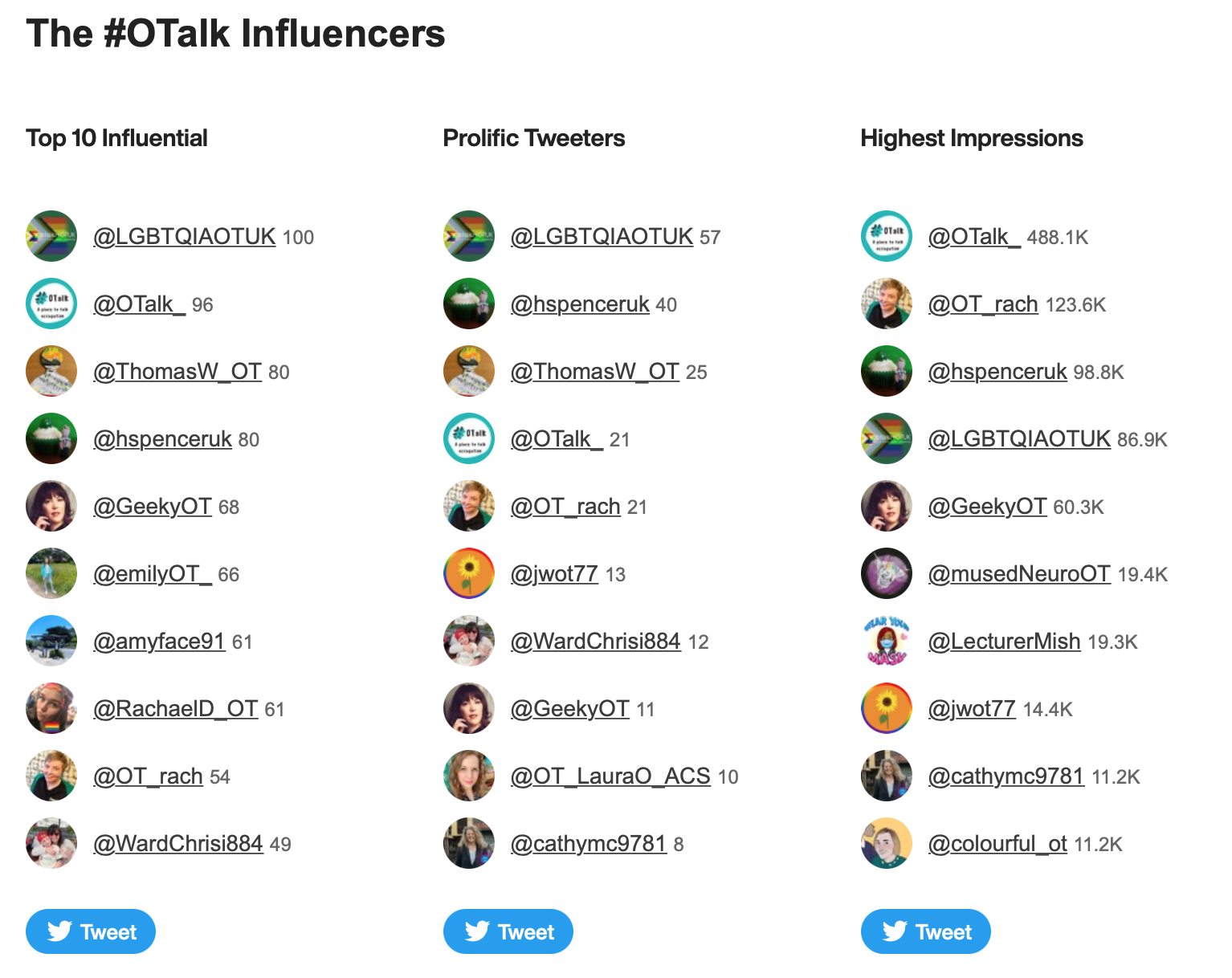
#OTalk – Tuesday 28th June – Pride month 🌈 – Through Pride Comes Progress

This #OTalk is hosted by @LGBTQIAOTUK

As Pride month draws to a close, what better time to explore the all year round commitments we can make in support of the LGBTQIA+ community. Whilst it’s great to see the display of rainbows and progress flags increase during Pride month, they very quickly seem to disappear again once July hits. There are very simple changes that we can all make to show solidarity with the LGBTQIA+ community.

Yet, as a profession, we still seem to behind the times. One of the simplest things that we can all do is to include our pronouns in our display names, email signatures etc. However, it did not go unnoticed that the inclusion of pronouns were severely lacking at RCOT annual conference this year. Although we will never recommend a blanket approach to the use of pronouns (it can be very complex and triggering for those who are questioning things in regards to their gender identity), for most people it would be a very simple, yet effective action. So, what’s stopping us?

Questions that will be discussed during the #OTalk.

1. Pride month: What is it? What does it mean to you?

2. What steps have you taken to show solidarity with the LGBTQIA+ community?

3. What, if anything, holds you back with respect to conversation and/or positive action with respect to LGBTQIA+ identities?

4. LGBTQIA+ inclusion in health and social care: What more can we be doing?

Post Chat

Host:  @LGBTQIAOTUK

Support on OTalk Account: @Ruth_Hawley 

Evidence your CPD. If you joined in this chat you can download the below transcript as evidence for your CPD, but remember the HCPC are interested in what you have learnt.  So why not complete one of our reflection logs to evidence your learning?

HCPC Standards for CPD.

  • Maintain a continuous, up-to-date and accurate record of their CPD activities.
  • Demonstrate that their CPD activities are a mixture of learning activities relevant to current or future practice.
  • Seek to ensure that their CPD has contributed to the quality of their practice and service delivery.
  • Seek to ensure that their CPD benefits the service user.
  • Upon request, present a written profile (which must be their own work and supported by evidence) explaining how they have met the Standards for CPD.
OTalk

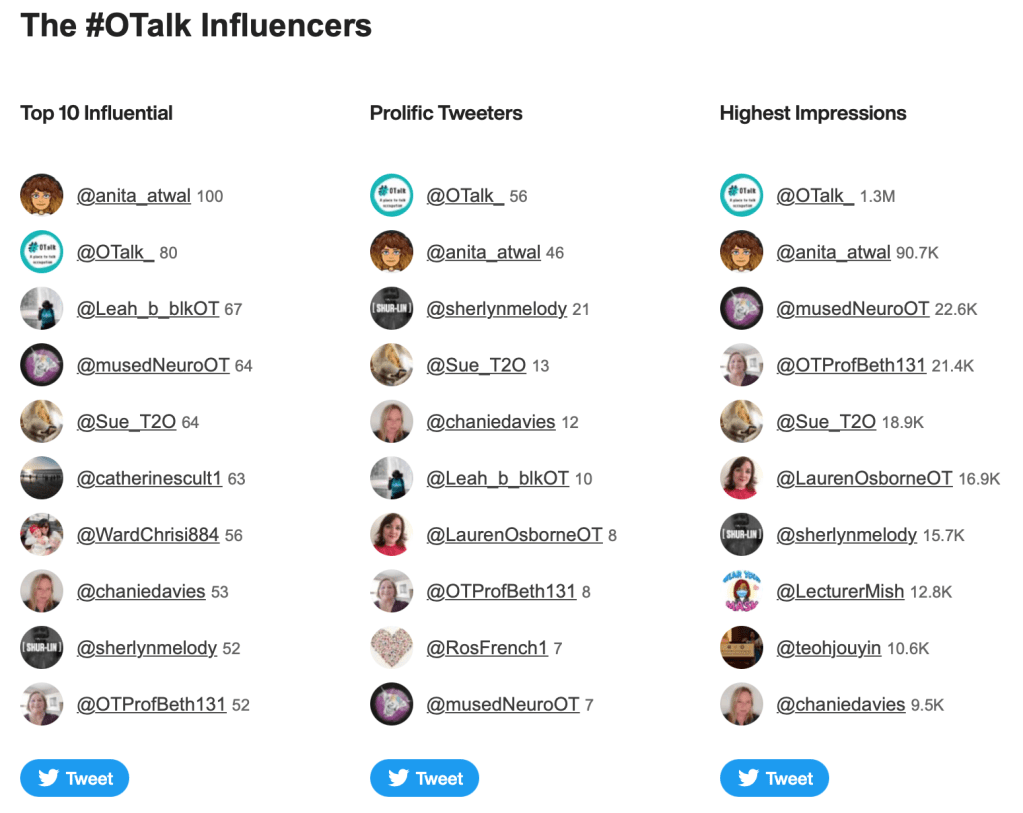
#OTalk – Tuesday 21 June 2022 – BME OT Mentorship: What we know

This #OTalk is being facilitated by Dr Anita Atwal

One of the NHS People Plan’s aims is to create an environment where people from diverse backgrounds can work in an environment that is compassionate and inclusive. This is a core aim because data from the NHS Workforce Race Equality Standard data has clearly shown that BAME staff are poorly represented at senior levels, have measurably worse day to day experiences of life in NHS organisations, and have more obstacles to progressing in their careers. 

We need to explore in more depth issues facing BAME OTs and mechanisms to support career progression and Mentorship is suggested as a mechanism to facilitate personal and professional goals in a safe space. However, building trust may become more challenging when mentoring persons who are from a minority heritage. Mentoring is a tool that is frequently used to support career success, However, there is no consensus on what good mentoring should look like

As far as we are aware, no studies have examined the mentoring process, on outcomes such as career success for BAME Occupational Therapists or Allied Health Professionals. There is limited but emerging evidence that for mentors and mentees, the mentoring relationship is less successful when their beliefs, values, or interests were dissimilar or when the mentor and mentee match was imposed by an outside agency as opposed to resulting from an organic relationship.

The focus of this OTalk is to explore diversity in mentoring using the following questions:

  1. Why did you have mentoring?
  2. How were you and your mentor matched?
  3. Did you achieve the outcome you wanted?
  4. Is it important that the mentor and mentee are of the same race?
  5. Is it important that the mentor and mentee are of the same gender?
  6. Have you ever spoken about cultural and racial nuances?

POST CHAT 

Host:  Dr Anita Atwal

Support on OTalk Account: @colourfulot

Evidence your CPD. If you joined in this chat you can download the below transcript as evidence for your CPD, but remember the HCPC are interested in what you have learnt.  So why not complete one of our reflection logs to evidence your learning?

HCPC Standards for CPD.

  • Maintain a continuous, up-to-date and accurate record of their CPD activities.
  • Demonstrate that their CPD activities are a mixture of learning activities relevant to current or future practice.
  • Seek to ensure that their CPD has contributed to the quality of their practice and service delivery.
  • Seek to ensure that their CPD benefits the service user.
  • Upon request, present a written profile (which must be their own work and supported by evidence) explaining how they have met the Standards for CPD.
OTalk

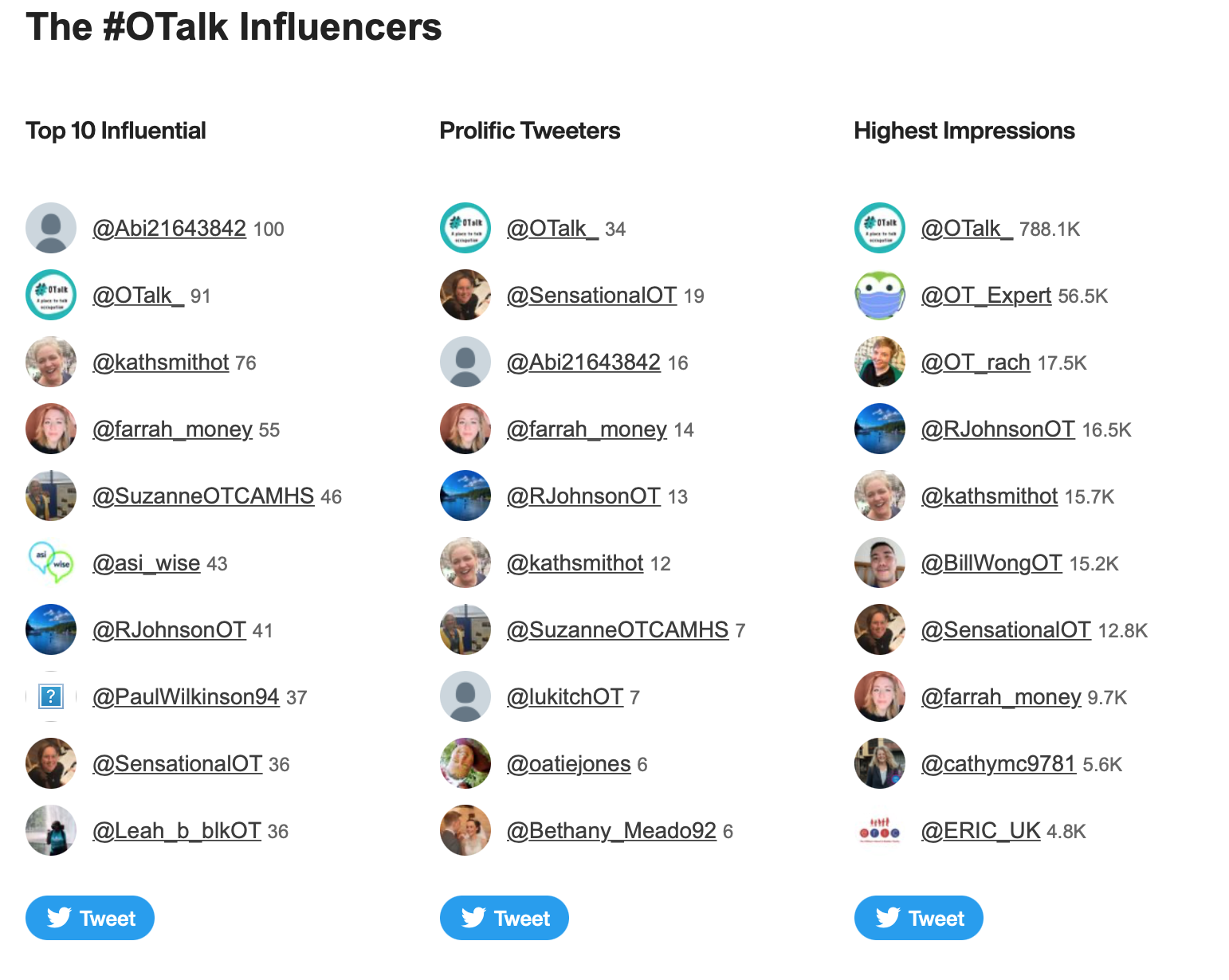
#OTalk – Tuesday 14th June – What is the role of Sensory Integration in Occupational Therapy?

This #OTalk is being hosted by Abigail Matthews @Abi21643842 supported by @PaulWilkinson94

The concept of “sensory integration” refers to the processing, integration, and organisation of sensory information from the body and the environment. It is how we experience, interpret and respond to the sensory information that we receive (Bundy & Lane, 2020). Our understanding of sensory integration is based on the work of Dr Occupational Therapist Dr A Jean Ayres (60s and 70s), and grounded in neuroscience.

Ayres defined sensory integration as “The neurological process that organises sensation from one’s own body and from the environment and makes it possible to use the body effectively with the environment.” (Ayres, 1972). It is based on neuroplasticity and the idea that our neurons and neural networks can change and adapt to new sensory messages, damage or dysfunction (Britannica Academic, 2022). It is assumed that this can occur from early childhood to later life, supporting our ability to adapt and maintain function within the context of our individual environment.

The Sensory Integration (SI) frame of reference helps us understand the interaction between the sensory systems including auditory, vestibular, proprioceptive, tactile, and visual systems. This helps us make sense of how children learn and play by using adaptive responses to integrate information and survive constantly changing sensory environments (Schaaf et al, 2010). This supports successful engagement in daily occupations, from washing and eating to managing more complex social behaviours and relationships.

An SI intervention includes therapeutic equipment to provide sensory opportunities, often with multiple sensations (eg. tactile, vestibular, and proprioceptive). Sensations are provided in a structured environment, graded to a greater or lesser intensity depending on the needs of each child. Sensory integrative abilities include sensory modulation, sensory discrimination, postural-ocular control, praxis, bilateral integration, and sequencing (Schaaf et al, 2010).

The intervention will differ depending on the identified sensory integration need, for example sensory modulation of the vestibular system (eg. swinging or rocking) may be used as a way to regulate other sensory systems. While developing skills through sensory discrimination may be used to improve skilled activity, for example tactile based interventions (eg. sensory bins) can support recognition of objects such as buttons for dressing. The outcome of successful sensory integration is the participation in daily life activities and will enhance fulfilment of the children’s roles and occupational needs.

References

Ayres A. J. (1972). Sensory Integration and Learning Disorders. Los Angeles, CA, Western Psychological Services.

Britannica Academic (2022) “Neuroplasticity.” Britannica Academic, Encyclopædia Britannica, 3 Sep. 2020. academic-eb-com.hallam.idm.oclc.org/levels/collegiate/article/neuroplasticity/442801. Accessed 3 Feb. 2022

Bundy, A. & Lane, S.J. (2020) Sensory Integration theory and practice. 3rd ed. Philadelphia: F.A. Davis.

Schaaf, R. C., Schoen, S. A., Roley, S. S., Lane, S. J., Koomar, J., & May-Benson, T. A. (2010). A frame of reference for sensory integration. In P. Kramer & J. Hinojosa (Eds.), Frames of reference for pediatric occupational therapy (3rd ed., pp. 99-186). Philadelphia: Lippincott Williams & Wilkins.

Questions for discussion during the OTalk:

What is your knowledge of sensory integration practice?

What is the role of sensory informed approaches for OT practice?

How can Occupational Therapists use sensory informed approaches in practice?

What are the barriers to implementing this approach and how can we overcome these?

What resources can we draw upon?

Post Chat

Host:  Abigail Matthews @Abi21643842

Support on OTalk Account:  @PaulWilkinson94

Evidence your CPD. If you joined in this chat you can download the below transcript as evidence for your CPD, but remember the HCPC are interested in what you have learnt.  So why not complete one of our reflection logs to evidence your learning?

HCPC Standards for CPD.

  • Maintain a continuous, up-to-date and accurate record of their CPD activities.
  • Demonstrate that their CPD activities are a mixture of learning activities relevant to current or future practice.
  • Seek to ensure that their CPD has contributed to the quality of their practice and service delivery.
  • Seek to ensure that their CPD benefits the service user.
  • Upon request, present a written profile (which must be their own work and supported by evidence) explaining how they have met the Standards for CPD.