OTalk

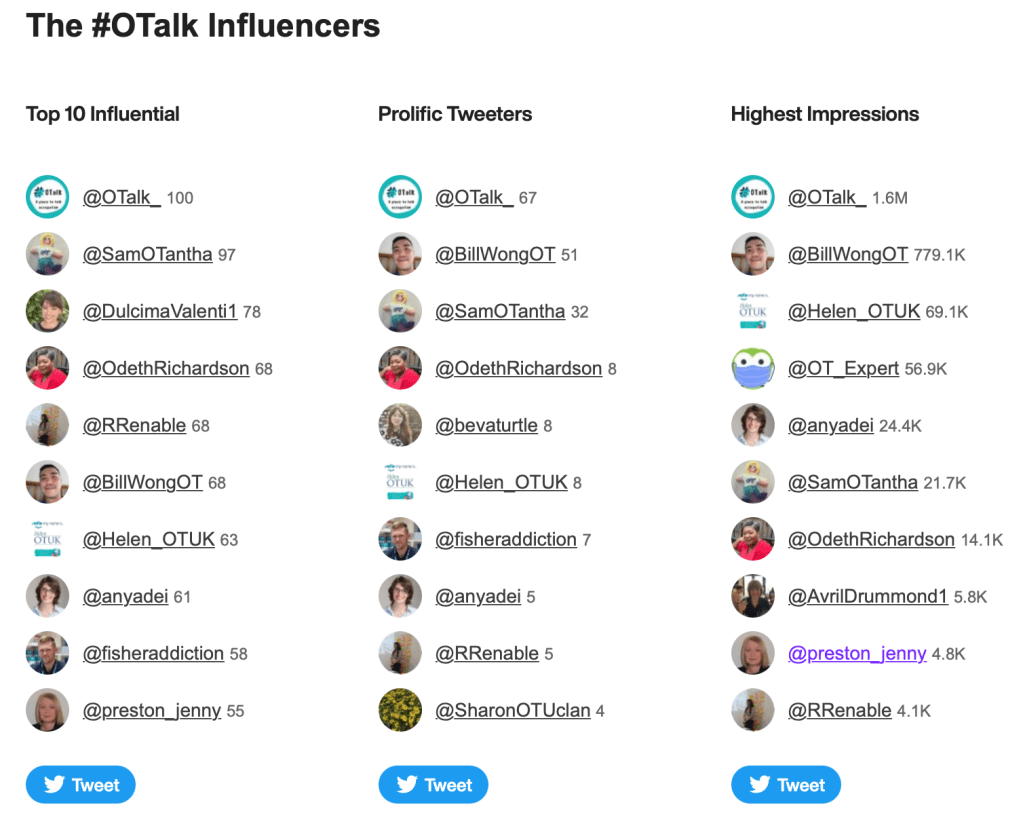
#OTalk Tuesday 16th August 2022 – The role of occupational therapy in substance misuse. Hosted by @fisheraddiction

This week #OTalk is hosted by Jon Fisher @fisheraddiction, here is what he has to say. If your new to OTalk find out here how to join in live on twitter every Tuesday 8pm Supported by Carolina.

The inclusion of occupational therapy intervention for people with addiction first appeared in the 1950’s in the ‘Clinical trial of occupational therapy in the treatment of alcohol addiction’ (Hossack, 1952). More recently, the concept of ‘addiction as occupation’ has been explored more thoroughly by Wasmuth, Crabtree & Scott (2014). They argued that by framing addiction through an occupational perspective, it can highlight barriers to recovery and treatment retention. This in turn could form the basis of occupation-focused intervention as a novel perspective in contemporary treatment services. 

By acknowledging addiction as an occupation and then focusing on this occupation’s gains and harms, occupational therapists may be in a position to gain trust of clients and help them to make adjustments to their occupational lives that are personally beneficial.’ (Wasmuth, Crabtree & Scott, 2014). 

The professional assumption is that engagement in meaningful occupation promotes health and wellbeing (Yerxa, 1998). However, Twinley (2021) has argued the need to ‘illuminate the dark side of occupation’, challenging this assumption that all engagement is healthy. Twinley argues that by fully exploring the individual meaning behind occupations that can also be detrimental to health, we can gain new insights and move closer to truly holistic care. 

In a scoping review, the most commonly described interventions included those that promote leisure; included skills training to facilitate activities of daily living; vocation based and those aimed at re-establishing community based sober routines (Ryan & Boland, 2021). It is by fostering a sense of competence through occupational participant that Patel, Scott and Bradshaw (2021) argue is the distinct value occupational therapy brings to promoting lasting recovery and reducing harm. 

With the UK’s ageing population (ONS, 2020) and an increasingly complex service landscape, evidence has shown it is the ageing ‘baby boomer’ generation who are at increasing risk from alcohol use. By drinking at the same level in their 40’s and beyond, this increases the risk of the harms associated with alcohol (Drink Wise, Age Well, 2021). Alcohol Related Brain Damage (ARBD) is increasingly recognised in services, with those in their 40’s and 50’s as the higher risk group (Royal College of Psychiatry, 2014). Changes in functional abilities arising from altered cognition fall well within the domain of occupational therapy with compensatory or rehabilitative interventions that promote occupational performance. 

Careful consideration is encouraged when addressing substance use in older adults (Royal College of Psychiatrists, 2018) in what ‘Our Invisible Addicts’ report describes as a ‘constellation of risks’. It argues for similar interpretation of risks and benefits of and individuals substance use on their physical and mental wellbeing; something that the concept of ‘addiction as occupation’ can support. 

There is a shortage of research concerning neurodiversity and substance use. Addictions UK (2020) found in their literature review that the studies available tended to focus on adult males who have had contact with the criminal justice system.  The National Autistic Society (2022) describes how someone with autism may use or become reliant on substances due to the stress arising from masking in order to ‘fit in’. They make a series of recommendations to ensure services are accessible. It is clear further understanding and changes are needed across the board.

In order to promote practice in this area and foster joint understanding, The Occupational Therapy and Substance Misuse Network has formed covering the UK and Ireland. The network has linked with over 30 occupational therapists working in substance use and related services. These include a diverse range of settings including specialist community services, inpatient detox and residential rehabilitation, homelessness, adult social care, community and liaison mental health services encompassing NHS, local authority and private sector services. 

QUESTIONS FOR OTALK:

  1. What brings you to OTalk about occupational therapy in substance use?
  2. What value does the occupational therapy role bring to substance use settings? 
  3. Outside of specialist substance use services, where do occupational therapists come into contact with service users experiencing substance and addiction related harms?
  4. What role can occupational therapists play in tackling stigma associated with substance use and addiction?
  5. How can occupational therapy ensure that substance use services/treatment is accessible to everyone?

REFERENCES:

Addictions UK (2020) Towards better and more joined up policy & practice for people with addictions & neurodiversity conditions Our journey so far… Available from: Towards better and more joined up policy & practice for people with addictions & neurodiversity conditions (addictionsnortheast.com)

Amorelli, C.R. (2016). Psychosocial Occupational Therapy Interventions for Substance-Use Disorders: A Narrative Review. Occupational Therapy in Mental Health, 32(2), pp.167–184

Drink Wise, Age Well (2021) 2015 – 2021: Evaluation of the Drink Wise, Age Well programme. Availabel online: evaluation-report-2015-2020.pdf (drinkwiseagewell.org.uk)

Hossack, J. R (1952) Clinical trial of occupational therapy in the treatment of alcohol addiction. American Journal of Occupational Therapy. 6(6): 265-6. 

National Autistic Society (2021) Addiction. Available online: Addiction (autism.org.uk)

Patel, R., Scott, S.L. and Bradshaw, M. (2021). Individuals With Substance-Related Disorders: Lived Experiences and Perceptions of Daily Life. The American Journal of Occupational Therapy, 75(Supplement_2), p.7512510233p1-7512510233p1. 

Rojo-Mota, G., Pedrero-Pérez, E.J. and Huertas-Hoyas, E. (2017). Systematic Review of Occupational Therapy in the Treatment of Addiction: Models, Practice, and Qualitative and Quantitative Research. American Journal of Occupational Therapy, [online] 71(5), p.7105100030p1. Available at: https://ajot.aota.org/article.aspx?articleid=2646442

Royal College of Psychiatrists (2018) Our Invisible Addict. Available from: Our Invisible Addicts (2nd edition, CR211 Mar 2018) (rcpsych.ac.uk)

Royal College of Psychiatrist (2014) Alcohol and brain damage in adults: With reference to high risk groups. Available online: college-report-cr185.pdf (rcpsych.ac.uk)

Twinley, R. (2021). Illuminating the dark side of occupation : international perspectives from occupational therapy and occupational science. Abingdon, Oxon ; New York, Ny: Routledge.

Yerxa, E.J. (1998). Health and the Human Spirit for Occupation. American Journal of Occupational Therapy, 52(6), pp.412–418. doi:10.5014/ajot.52.6.412.

POST CHAT

Host:   Jon Fisher @fisheraddiction

Support on OTalk Account: Carolina.

Evidence your CPD. If you joined in this chat you can download the below transcript as evidence for your CPD, but remember the HCPC are interested in what you have learnt.  So why not complete one of our reflection logs to evidence your learning?

HCPC Standards for CPD.

  • Maintain a continuous, up-to-date and accurate record of their CPD activities.
  • Demonstrate that their CPD activities are a mixture of learning activities relevant to current or future practice.
  • Seek to ensure that their CPD has contributed to the quality of their practice and service delivery.
  • Seek to ensure that their CPD benefits the service user.
  • Upon request, present a written profile (which must be their own work and supported by evidence) explaining how they have met the Standards for CPD.
OTalk

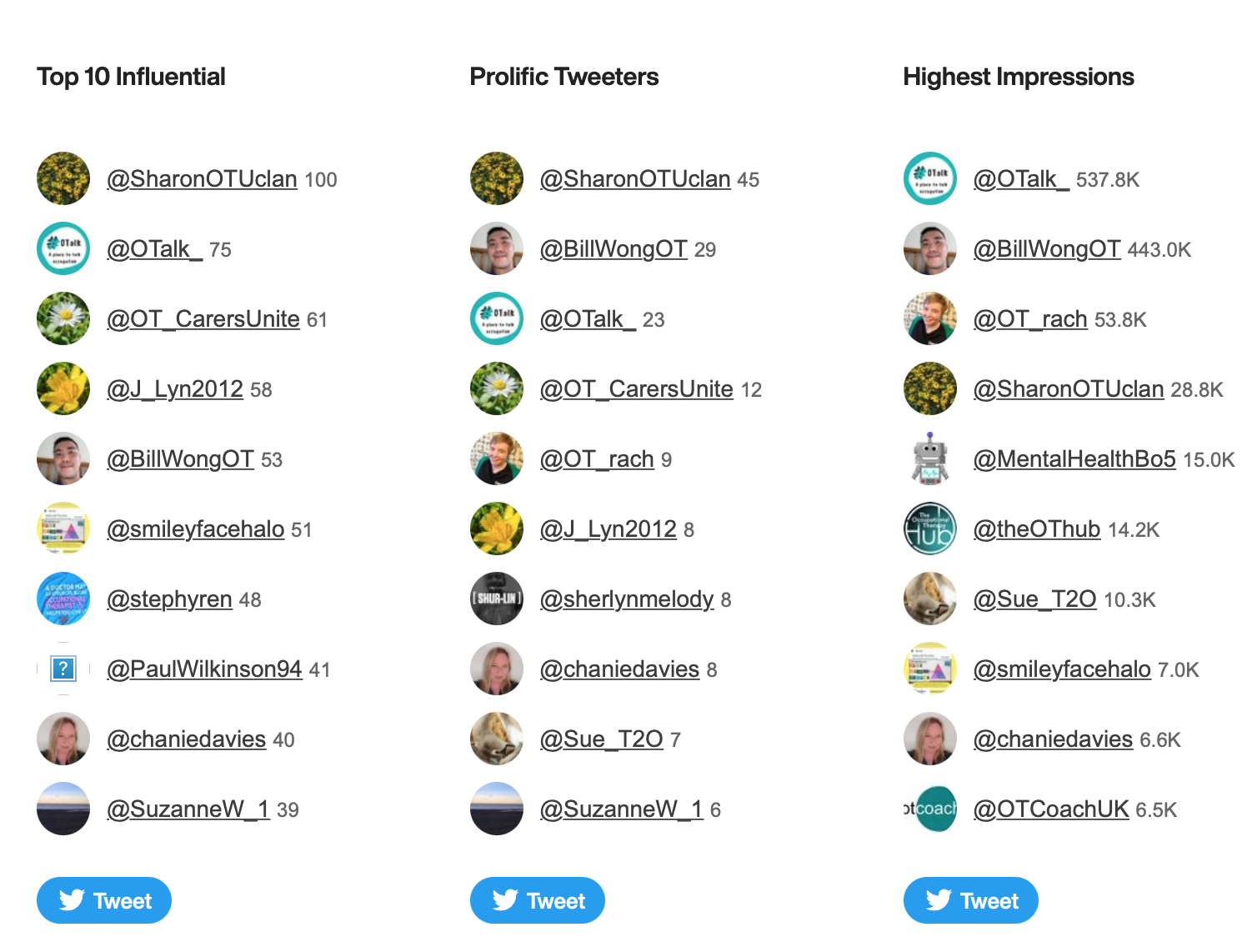
#OTalk – Tuesday 9th August – Occupational Therapy and the carer role. Hosted by @SharonOTUClan

This chat will be hosted by Sharon Hardman @SharonOTUClan.

During my Occupational Therapy (OT) pre-registration training my Dad, who lives in a different country, had a stroke.  I am next of kin to my Dad.  Suddenly, from the moment my Dad had his stroke, I acquired a whole new role.  This involved being next of kin to a parent who had a stroke and navigating different health and social care systems in a different language.  This has been a huge learning curve personally and professionally and I believe that this has had a positive influence my OT practice.

I have a newfound understanding of the informal carer role, that is the most challenging job I have ever done.  A carer is defined as “anyone, including children and adults who looks after a family member, partner or friend who needs help because of their illness, frailty, disability, a mental health problem or an addiction and cannot cope without their support. The care they give is unpaid.” (NHS, 2022).

Across the UK today 6.5 million people are carers, supporting a loved one who is older, disabled or seriously ill. (Carers UK website, 2022).  According to Carers UK (2022) that’s 1 in 8 adults who care, unpaid, for family and friends.  Our loved ones are living longer with illness or disability, and more and more of us are looking after them. Whether round-the-clock or for a few hours a week, in our own home or for someone at the other end of an online conversation – caring can have a huge effect on people’s lives and plans.  Carers are holding families together, enabling loved ones to get the most out of life, making an enormous contribution to society and saving the economy billions of pounds.

Yet many carers are stretched to the limit – juggling care with work and family life, or even struggling with poor health. Caring can present many challenges in many forms from filling in forms, navigating the maze of health and care services and coping with the pressures of caring.

I wanted to create an #OTalk that enabled the OT community to share their experiences of being carers (in the past or currently) and promote further discussion in this area.

The questions that I would like you to consider are:

  1. Carers UK (2022) estimated that over a quarter (26%) of all workers were juggling work and care. Staying in work is a major challenge for the 3 million working carers.  Do you feel that your employer understands your role as a carer and what support do they provide?
  1. Carer’s physical and mental health is often impacted by their caring role. What support do you have to look after your own health and wellbeing? 
  1. What are your thoughts on carer assessments?
  1. Do you use any Digital technology such online health appointments, apps, environmental monitoring such as doorbell videoing systems, remote monitoring such as falls alarms, Zoom, Skype, WhatsApp and voice assisted devices like Amazon?  What is the impact of digital technology on your caring role?
  1. How does your caring role (in the past or currently) influence your professional practice? 

Post Chat

Host:  Sharon Hardman @SharonOTUClan

Support on OTalk Account: @paulwilkinson94

Evidence your CPD. If you joined in this chat you can download the below transcript as evidence for your CPD, but remember the HCPC are interested in what you have learnt.  So why not complete one of our reflection logs to evidence your learning?

HCPC Standards for CPD.

  • Maintain a continuous, up-to-date and accurate record of their CPD activities.
  • Demonstrate that their CPD activities are a mixture of learning activities relevant to current or future practice.
  • Seek to ensure that their CPD has contributed to the quality of their practice and service delivery.
  • Seek to ensure that their CPD benefits the service user.
  • Upon request, present a written profile (which must be their own work and supported by evidence) explaining how they have met the Standards for CPD.
OTalk

#OTalk Research Tuesday 2nd Aug 2022 – What next for the newly qualified OT? Transferring research skills from university into clinical practice.  

This week’s #OTalk research will be hosted by @SamOTantha with @preston_jenny on the #OTalk account.

Firstly, the #OTalk research team wish to congratulate all the newly graduated occupational therapists (NQOT) out there! I imagine the last thing on your mind right now is research,especially after many late nights and the stresses of completing dissertation projects or similar! However, with many NQOTs starting work and beginning their new adventure in clinical practice we want to explore how research and evidence-basedpractice (EBP) skills learnt and developed in university can begin to be applied.  Research engagement is a core component of clinical practice and a HCPC requirement. Therefore, it isnever too early to think about how we can implement these skills!

For this week’s chat we invite everyone to join and share their advice and tips for NQOT’s on how they can engage in research and EBP within their new posts and welcome them to the #OTalk research community.  We would also love to hear from some newly graduated occupational therapists on their plans for research engagement, and allow space for reflections using the following questions:

1- Do you think it’s important to consider research as a core component of the role of a NQOT? 

2- Do you think the skills that you have learnt at university regarding research and EBP will enable you to engage in research opportunities within clinical practice?

3- What areas of development would you benefit from and how could you develop these skills? 

4- What types of research or EBP opportunities could a NQOT engage in?  

5- How can we all support NQOT’s to engage to research and EBP?  

6- What tips and advice would you offer to a NQOT who is unsure of how to engage in research and EBP? 

Post Chat

Host: @SamOTantha

Support on OTalk Account: Jenny @Preston_jenny

Evidence your CPD. If you joined in this chat you can download the below transcript as evidence for your CPD, but remember the HCPC are interested in what you have learnt.  So why not complete one of our reflection logs to evidence your learning?

HCPC Standards for CPD.

  • Maintain a continuous, up-to-date and accurate record of their CPD activities.
  • Demonstrate that their CPD activities are a mixture of learning activities relevant to current or future practice.
  • Seek to ensure that their CPD has contributed to the quality of their practice and service delivery.
  • Seek to ensure that their CPD benefits the service user.
  • Upon request, present a written profile (which must be their own work and supported by evidence) explaining how they have met the Standards for CPD.
OTalk

Tuesday 26th July 2022 -Celebrating Disability Pride Month become an Ally hosted by @AbleOTUK

Two members of the AbleOTUK team, Georgia Vine @GeorgiaVineOT and Natalie Hicks @nataliehixy

Ann Magill designed a disability pride month flag. Its black background represents the colour of mourning for those who have suffered from ableist violence, and also rebellion and protest. The 5 colours represent the variety of needs and experiences.

It’s been a whole year since the launch of AbleOTUK which took place 27th July 2021, during Disability Pride Month. This year for Disability Pride Month @AbleOTUK have been sharing ways to be an ally and reflecting on what we have achieved this past year.  

The main aim of AbleOTUK is to provide a voice and safe space for Occupational Therapy Practitioners, Students, Researchers and Educators, who have lived experience of disability or long term health conditions. Yet a big part of what we do is educating others about ableism within occupational therapy and how collectively we can dismantle this.  You can find out more by visiting our website

It is really important to us as an affinity group that we think more about our allies and what allyship means. Throughout July we have shared examples of what allyship looks like on our social media platforms using the hashtag #BeAnAbleOTUKAlly

We thought what better way to round the month by reflecting on what we have all learnt this year from AbleOTUK? Join us as we all reflect on our learning and the positive changes made to not just highlight ableism but to get recognised as an affinity group. We will highlight the fact that occupational therapists have disabilities too and the utter joy it is to be a part of the disabled community this Disability Pride Month! 

Going forward we will look onto the year ahead and what lies ahead for AbleOTUK by asking the profession what they need from us. 

Definition of Ableism – Discrimination and social prejudice against people with disabilities based on the belief that typical abilities are superior. At its heart, ableism is rooted in the assumption that disabled people require ‘fixing’ and defines people by their disability. 

Definition of Ally and Allyship – Someone who helps and supports other people who are part of a group that is treated badly or unfairly, although they are not themselves a member of this group.  Cambridge English dictionary.  

Questions:

  1. What have you learnt this year about ableism?
  2. What positive changes have you and your organisation made this year to address ableism? 
  3. What would you like to see from AbleOTUK this next year?
  4. What are your goals for next year to address ableism?In an ideal world, what would you like to see from the profession moving forward?

Reference

Campbell, K. F. (2009). Contours of Ableism. Palgrave Macmillan: London. [Online.] Retrieved from https://doi.org/10.1057/9780230245181_2

Palacios, M. R. (2017). Internalised Ableism. The Other Side of Ableism. [Online.] Retrieved from https://cripstory.wordpress.com/2017/07/06/the-other-side-of-ableism/ 

Scope. (n.d.). Disablism and Ableism. [Online.] Retrieved from https://www.scope.org.uk/about-us/disablism/

Ableism 101: What it is, what it looks like, and what we can do to to fix it (online) retrieved from https://www.accessliving.org/newsroom/blog/ableism-101/

Celebrating Disability Pride Month https://www.afb.org/blog/entry/celebrating-disability-pride-month

https://www.capability.scot/news/341-disability-pride-month

Post Chat

Host:  @AbleOTUK team, Georgia Vine @GeorgiaVineOT and Natalie Hicks @nataliehixy

Support on OTalk Account: @OT_Rach

Evidence your CPD. If you joined in this chat you can download the below transcript as evidence for your CPD, but remember the HCPC are interested in what you have learnt.  So why not complete one of our reflection logs to evidence your learning?

HCPC Standards for CPD.

  • Maintain a continuous, up-to-date and accurate record of their CPD activities.
  • Demonstrate that their CPD activities are a mixture of learning activities relevant to current or future practice.
  • Seek to ensure that their CPD has contributed to the quality of their practice and service delivery.
  • Seek to ensure that their CPD benefits the service user.
  • Upon request, present a written profile (which must be their own work and supported by evidence) explaining how they have met the Standards for CPD.
OTalk

#OTalk 19th July 2022 Media Club- Labor Trafficking, Global Warming, and Taking Action

This week Bill Wong @BillWongOT is host
“For this weeks discussion, please watch this TEDx talk before you participate in this discussion. https://www.youtube.com/watch?v=VvhhC8SUvqA

Hello everyone,
Apologies to a long hiatus due to the fact that I have to teach a class during this time in the US. So, I will make up for it by hosting today’s topic.
Media club has not been a format we have used in a while. So, I decided to do a blast from the past, but with a twist. The twist is- this is a talk I produced in November 2021 for my TEDxCountdown event. So, you all will get a chance to interact with the producer of an actual TEDx talk.
When I got my TEDxCountdown event license for 2021 last spring, I simply just wanted to produce quality content with the intent of showing an example of what OT students and practitioners can do on the climate change issue. If some of the talks ended up fitting for discussion within the OT community, that would be a bonus.
I got to know Alicia a little bit through attending each other’s TED Circles since COVID. When she learned that I am a TEDx organizer, she approached me with this topic. That struck a light bulb in my head. I then remembered that I had my students write a global issues paper, with climate change and human trafficking as 2 of the issues they have written in the past. So, I thought, “If I curate this well, maybe I can use it to surprise my students.”
Then, when I used it for my first week of class 3 weeks after my TEDxCountdown event, my students pretty much told me that they had never envisioned human trafficking and climate change would intersect as such. Of course, they probably were shocked that their instructor was the brainchild of it all. 
In terms of my reflection of this talk, I would say it was quite a liberating experience. I used my client centered skills by letting Alicia be the expert. I was in the background in terms of getting her to communicate her message effectively. Through this approach, I was able to learn things that would probably surprise live and online TEDx audiences. Of course, leading by example that OT can be a core pillar for climate change and sustainability issue is also cool, too.

Reflection questions
1. Before watching this talk, how aware are you in terms of OT’s role in climate change and sustainability?
2. Before watching this talk, have you ever thought about climate change and potential intersectionalities with other issues in the world?
3. After watching this talk, what struck you the most?
4. What are some action steps you will take on climate change and sustainability issue?”
Best,

Bill Wong, OTD, OTR/L (He/Him/His)

Post Chat

Host:  Bill Wong @BillWongOT

Support on OTalk Account: Helen

Evidence your CPD. If you joined in this chat you can download the below transcript as evidence for your CPD, but remember the HCPC are interested in what you have learnt.  So why not complete one of our reflection logs to evidence your learning?

HCPC Standards for CPD.

  • Maintain a continuous, up-to-date and accurate record of their CPD activities.
  • Demonstrate that their CPD activities are a mixture of learning activities relevant to current or future practice.
  • Seek to ensure that their CPD has contributed to the quality of their practice and service delivery.
  • Seek to ensure that their CPD benefits the service user.
  • Upon request, present a written profile (which must be their own work and supported by evidence) explaining how they have met the Standards for CPD.