OTalk

#OTalk Tuesday 31st May 2022 – Getting the best out of a virtual conference.

Conference season is upon us once again, however not all conferences have returned to physical events, some adopting a hybrid model whilst others have retained the virtual model.

With such a range of offerings it can be difficult to decide which to attend? What offers the most value for money? Is travel and being away from home not possible? Is the conference only available virtually? Whatever the reason many people will be attending virtual conferences this coming year… and beyond.

To prepare us for this developing style of conference this chat will look to explore the communities’ experiences, garner resources and share ways we can “get the best out of virtual conferences”. As a UK based chat, many of the community may also be attending #RCOT2022 which is a fully virtual conference.

We thought an old school #OTalkTeaParty would be a good idea, so grab a slice of cake and a cuppa….. (other treats and drinks are permissible)

Some tips found on Twitter to get the thoughts flowing:

Do check out the replies to these tweets too.

Before we get to it, feel free to share you #OTalkTeaParty treats of choice.

Questions: (Subject to change if requested)

  1. Are you planning on attending any virtual conferences in 2022?
  2. How many virtual conferences have you attended before?
  3. What did you find most beneficial from attending a virtual conference?
  4. What did you find least beneficial form attending a virtual conference?
  5. What is your top tip for attending a virtual conference?
  6. Do you have any tools that you have found useful when attending a virtual conference?
  7. and finally…. do you have any further questions you would like posing to the chat?

We look forward to chatting all things virtual conference with the community…

If you have any questions you would like including do tweet us @OTalk_

POST CHAT

Host:  Helen @helenotuk

Support on OTalk Account: Rachel @OT_rach

Evidence your CPD. If you joined in this chat you can download the below transcript as evidence for your CPD, but remember the HCPC are interested in what you have learnt.  So why not complete one of our reflection logs to evidence your learning?

HCPC Standards for CPD.

  • Maintain a continuous, up-to-date and accurate record of their CPD activities.
  • Demonstrate that their CPD activities are a mixture of learning activities relevant to current or future practice.
  • Seek to ensure that their CPD has contributed to the quality of their practice and service delivery.
  • Seek to ensure that their CPD benefits the service user.
  • Upon request, present a written profile (which must be their own work and supported by evidence) explaining how they have met the Standards for CPD.
OTalk

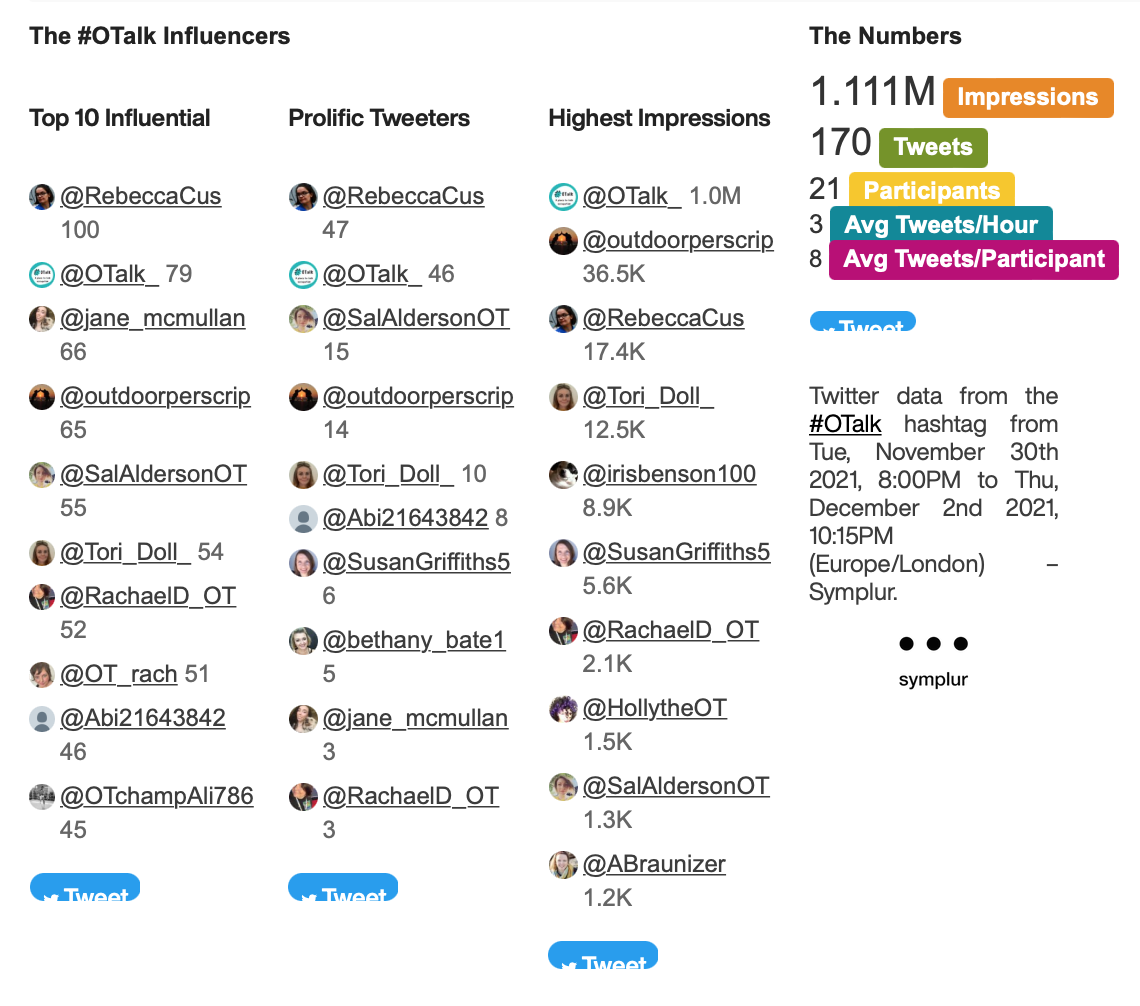
#OTalk – 30th November 2021 – Creating a Sensory Friendly Environment

This weeks chat will be hosted by Rebecca Cusworth @RebeccaCus.

Sensory integration is when our body and brain organises sensations which tell us about ourself and the environment (ASI Wise 2021). The senses including touch, vision, hearing, smell, taste, vestibular, proprioception, and introception (ASI Wise 2021). We receive sensory input from our sensory receptors, we process the sensory information, and then we generate a response to this (Miller 2006). An example of this process might be:

James is swinging on a swing. 
He is enjoying the sensation of moving through the air, the weightlessness at the top of the swing, and the heaviness when he is closest to the ground. He can hear the wind whistling in his ears and can see the ground moving along beneath him. While he swings, James holds onto the chains which he can smell are metal. James can tell he is becoming hungry so he waits until the next upward swing before jumping through the air. 

As all of us are sensory beings, we all have preferences for what we enjoy and dislike. For example, another person may feel motion-sick or afraid when swinging on a swing. When we are in our own homes, we might choose to dim the lights, to light scented candles, surround ourselves with comfy blankets, and eat food which makes us feel good (e.g., chocolate). 

When we are unwell, stressed, or in different environments (such as hospital, a friend’s house, workplace), we are less inclined to use our preferences to make ourselves feel better. 

This #OTalk chat aims to initiate the conversation about how we can create a sensory-friendly environment for ourselves and our patients. As occupational therapists, we are well placed to promote improvements in our services. 

Questions:

1. What is your understanding of sensory friendly environments?

2. What needs to change in your workplace to make it more sensory friendly for patients?

3. What needs to change to make your environment more sensory friendly for staff?

4. What do you feel would be challenging about putting this in place?

5. What support do you feel would be beneficial from RCOT or your Trust?

POST CHAT

Host:  Rebecca Cusworth @RebeccaCus.

Support on OTalk Account: Rachel @OT_Rach

Evidence your CPD. If you joined in this chat you can download the below transcript as evidence for your CPD, but remember the HCPC are interested in what you have learnt.  So why not complete one of our reflection logs to evidence your learning?

HCPC Standards for CPD.

  • Maintain a continuous, up-to-date and accurate record of their CPD activities.
  • Demonstrate that their CPD activities are a mixture of learning activities relevant to current or future practice.
  • Seek to ensure that their CPD has contributed to the quality of their practice and service delivery.
  • Seek to ensure that their CPD benefits the service user.
  • Upon request, present a written profile (which must be their own work and supported by evidence) explaining how they have met the Standards for CPD.
OTalk

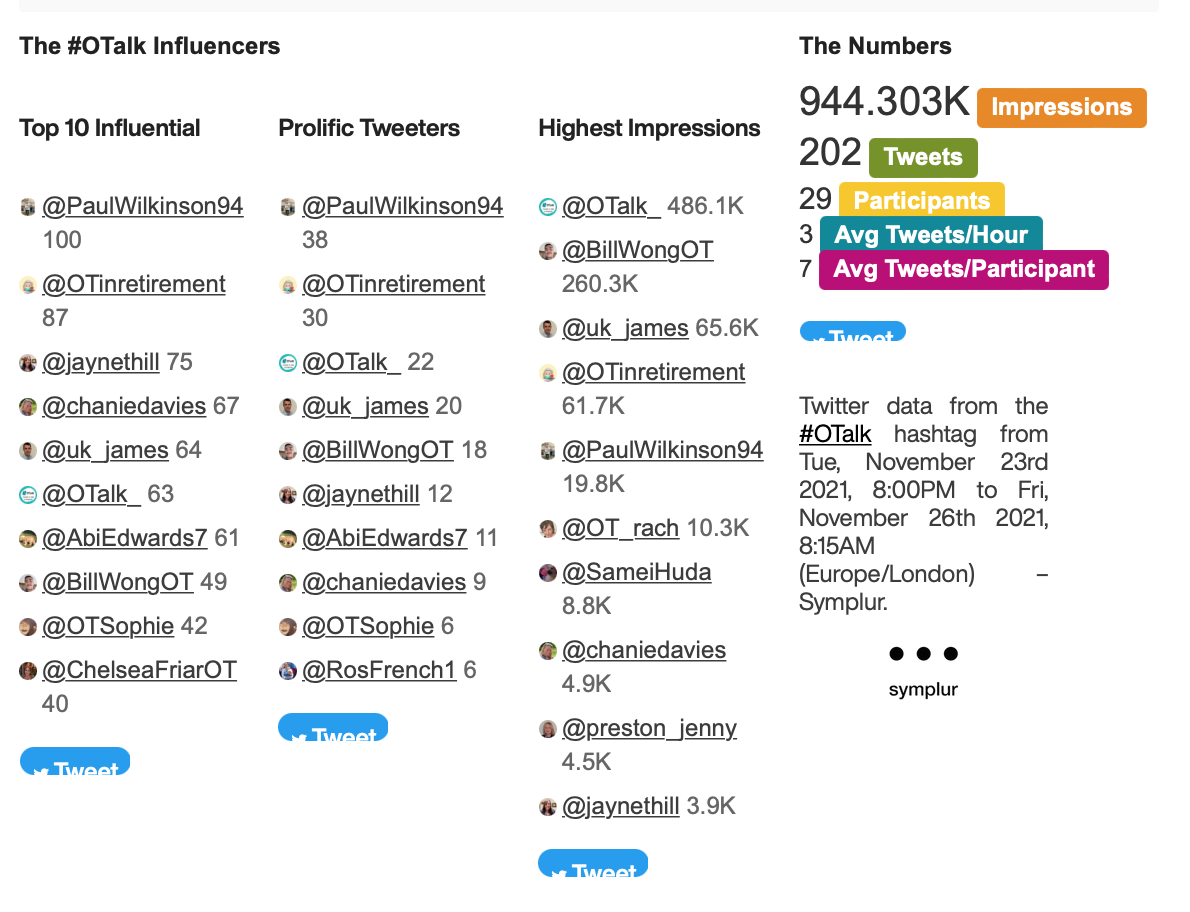
#OTalk – 23rd November 2021 – Occupational Therapy and Intermediate Care.

This weeks chat will be hosted by  Paul Wilkinson @Paulwilkinson94 who is a rotational occupational therapist currently working for South Tees Hospitals NHS Foundation Trust. 

It is evident that hospitals across the country are experiencing heightened demands and challenges during these unprecedented times. Whilst the National Health Service across the United Kingdom continues to strive to meet individual patient needs, it also continues to do battle and cope with the pressures from COVID-19, staff shortages, and increased hospital admissions. Consequently, the above factors mean hospital beds are in more of a demand than arguably ever before. 

Nationally it is recognised that the longer individuals remain in hospital the greater the risk of deconditioning and being diagnosed with hospital acquired infections can occur particular among the elderly and vulnerable. As occupational therapists we recognise that individuals thrive and recover often more effectively within their own environments. However, during a time of uncertainty it could be argued we are forced to consider discharge planning from the acute settings earlier than ever before, meaning often individuals are medically optimised but not fully from a therapy perspective. 

It seems to make hospital beds more accessible intermediate care settings and wider community settings are being utilised to bridge the clinical pathway for older individuals transitioning from the hospital to home more than ever before. According to The National Institute for Health and Care Excellence (2018) intermediate care services provide support for a short time to help individuals recover and increase independence. The service is often provided by a combination of health and social care professionals including occupational therapists. The Royal College of Occupational Therapists (2016) suggest occupational therapists working within intermediate care settings can help ensure smooth transition into the community.  

In April this year I was fortunate enough to rotate into an intermediate care setting based in the Northeast of England. Several months later working as an occupational therapist within this setting it became clear to myself through interaction with service users, relatives, and wider professionals the understanding of the role and purpose of an intermediate care setting and how occupational therapy fits into this setting was blurred and limited. This led me to further want to extend my understanding and gain insight amongst the occupational therapy community through #OTalk with the following questions:

  1. How would you best describe the purpose of an intermediate care setting? 
  2. Why do you think the purpose and understanding of intermediate care if often misunderstood? 
  3. What challenges do you think present to an occupational therapist working within an intermediate care setting? 
  4. What do you think are the benefits of an occupational therapist working within an intermediate care setting? 
  5. How do you think the role and purpose of an intermate care setting could be made clearer?  

POST CHAT

Host:  Paul Wilkinson @Paulwilkinson94

Support on OTalk Account: @kirstieot

Evidence your CPD. If you joined in this chat you can download the below transcript as evidence for your CPD, but remember the HCPC are interested in what you have learnt.  So why not complete one of our reflection logs to evidence your learning?

HCPC Standards for CPD.

  • Maintain a continuous, up-to-date and accurate record of their CPD activities.
  • Demonstrate that their CPD activities are a mixture of learning activities relevant to current or future practice.
  • Seek to ensure that their CPD has contributed to the quality of their practice and service delivery.
  • Seek to ensure that their CPD benefits the service user.
  • Upon request, present a written profile (which must be their own work and supported by evidence) explaining how they have met the Standards for CPD.
OTalk

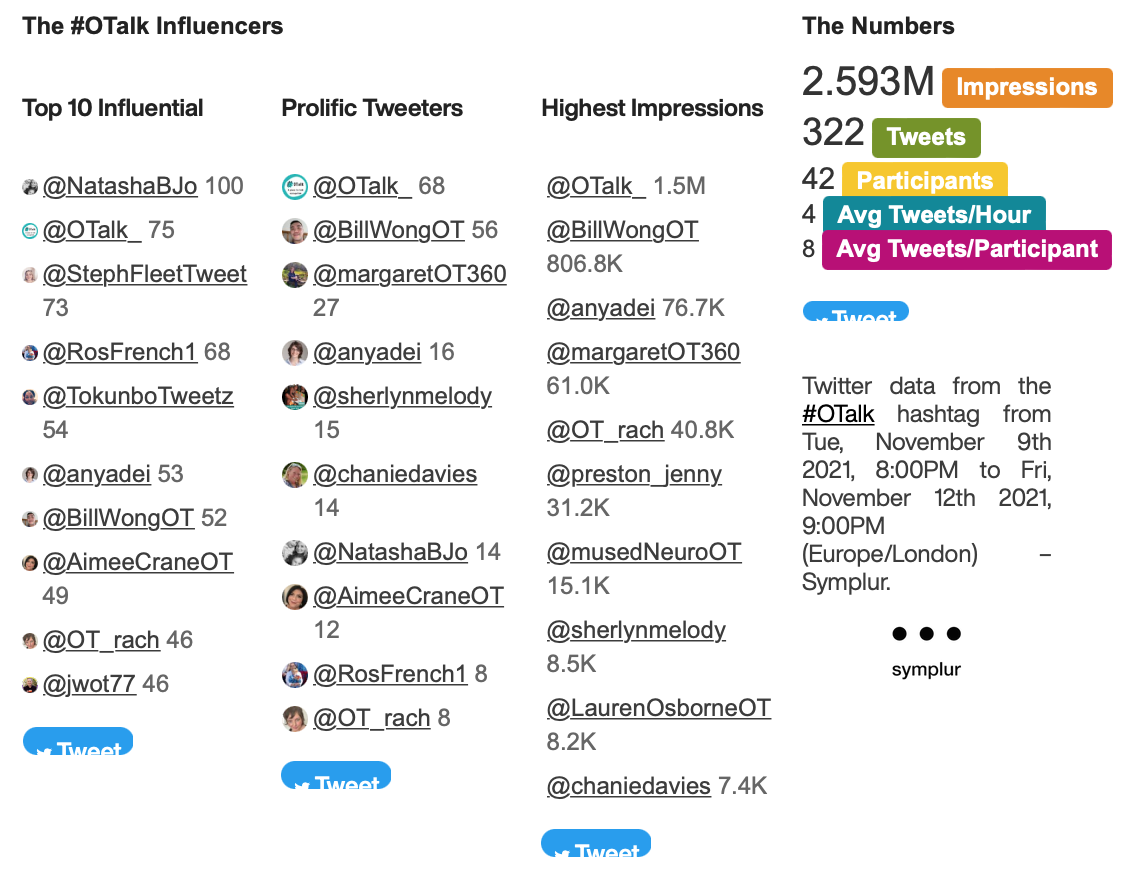
#OTalk – 9th Nov 2021 – Are you being the OT you dreamed you’d be? 

This weeks chat will be hosted by Natasha Bruce-Jones, @NatashaBJo Clinical Director, Think Therapy 1st

As the anniversary of my second decade as a qualified OT draws to a close I’m lead to reflect on my ‘why’. Why did I choose OT? What did I envisage my job to look and feel like every day? I can easily recall: the diversity of approaches and the ability to ‘do with’ rather than ‘do for’. Whilst enjoying delivering therapy with arts, crafts and leisure I was often amazed that this was actually classed as work at all! But having used my scholarly dissertation to confirm that even two decades ago there was a low uptake in these activities as a therapy method, I’m pulled again to reflect on how things have changed in OT practises today under the ever-growing pressures of statutory authorities, and restrictions of red tape and budget tightening. 

I’ve worked in emergency, acute, community, education, and most recently in private practise. I have felt pressured to meet targets more than meet people’s expectations; to meet deadlines more than meet people’s real goals; to save money more than provide ‘quality of life’ focused treatment. I have watched OT emerge to address the needs of the setting rather than the needs of the client, have felt pressure to become a Consultant OT and mould myself into the medical model to be recognised, and ultimately decided to leave roles for fear of not being allowed to actually practise OT in my OT role. I was fortunate enough to find the freedom of private practise as my saviour, but friends and colleagues have felt so dismayed at the limits in their roles that they have tragically left the profession altogether! 

When I joined private practice, my fire was reignited. I was reminded how amazing, inspiring, creative and interactive OT can be, and how boundaried, restricted and distracted from my ‘change the world’ student vision statutory roles had forced me to become. Now my therapy days consist of kite flying, metal detecting, velodrome cycling, mountaineering, open water swimming, boxing, knitting, refurbishing house boats, learning Spanish – the list goes on, and I love it. The biggest win however will always be hearing the unreserved thanks and surprise from clients at the magnitude of effect true OT can have on their entire lives. 

This poses me to ask the rest of the OT community about your experiences and draw you to think about what your role potential could be. 

  • What is it about your OT role that prevents you realising your full OT potential? 
  • How can OTs truly provide client led services if working within the ‘top down’ management systems of local authorities and NHS?  
  • How can OTs refuse to allow role or service changes that reduce their scope and impact? 
  • Is OTs use of terms like ‘prescibing’ and ‘consultant’  a sign of OTs feeling a need for medical recognition and contributing to an already blurry public understanding ? 
  • What is the most fun you’ve had delivering your OT in the last year? 

POST CHAT

Host:  This weeks chat will be hosted by Natasha Bruce-Jones, @NatashaBJo Clinical Director, Think Therapy 1st

Support on OTalk Account: @colourfulot

Evidence your CPD. If you joined in this chat you can download the below transcript as evidence for your CPD, but remember the HCPC are interested in what you have learnt.  So why not complete one of our reflection logs to evidence your learning?

HCPC Standards for CPD.

  • Maintain a continuous, up-to-date and accurate record of their CPD activities.
  • Demonstrate that their CPD activities are a mixture of learning activities relevant to current or future practice.
  • Seek to ensure that their CPD has contributed to the quality of their practice and service delivery.
  • Seek to ensure that their CPD benefits the service user.
  • Upon request, present a written profile (which must be their own work and supported by evidence) explaining how they have met the Standards for CPD.

CPD, Equality, Exploring the Role of Occupational Therapy, OTalk

#OTalk OT Week Special Twitter Chat #OTsForEquity WEDNESDAY 3rd November 2021 8pm – Hosted by @theRCOT

As part of #OTalk’s 10th Birthday celebrations we are supporting the Royal College of Occupational Therapists during #OTWeek. The theme of this year’s OT Week is #OTsForEquity.

Tonight’s Twitter chat is hosted by Karin Orman, RCOT Assistant Director – Professional Practice and Genevieve Smyth, Professional Advisor RCOT. The chat will shine a light on the role occupational therapists can and do play in achieving health equity and is just one of many activities taking place across OT Week to address this important topic. 

Health equity is one of RCOT’s priorities for the coming year and if we are to meet the needs of those we support, we need to build on existing innovation and best practice. 

 #OTalk in Occupational Therapy Week offers the opportunity to collectively put our thinking hats on to explore what we mean by health equity and share ideas for further actions. This conversation and our ideas platform will inform RCOT’s action plan to achieve health equity. 

As occupational therapists you already do a lot towards creating health equity, but is there more you could do? Is there best practice that you’d like to share with others? Do you have an idea that would overcome some of blocks that you and others face within your team or organisation to achieving health equity amongst your service users?  

There is strength in numbers! Do you have an idea that would use the power of our community and have an impact on health equity? If you do, please share it with us. 

We’re ready to take action to strive for health equity across the UK. This is the start of our campaign, we’re already putting pressure on government, healthcare leaders and commissioners to act.  But we want to hear your ideas on what we could be doing that will make the greatest impact. We know we can’t do this alone. We’re calling on the government to provide a long-term strategy. We’d like to hear from you what we specifically we should be asking for? What resources do you need? What areas need funding so that you can improve and expand health care provision across all areas of society. 

This is what we would like you to consider and discuss.

Questions

  1. What does health equity mean to you and those who use your services?
  1. What as occupational therapists can we do as individuals, within our teams and organisations to create health equity?
  1. What as a profession can we do collectively to create health equity?
  1. How would you like to RCOT lead on the healthy equity agenda? What would you like to see RCOT do as a professional body to support members create health equity and to influence external agendas?
  1. What should we be asking governments to do to create health equity? What should governments do that that will help us as occupational therapists to do more to create health equity? 

Join #OTalk and #OTsForEquity on Wednesday night at 8.00pm (UK) to share your views and ideas.

POST CHAT

Host:   Karin Orman, RCOT Assistant Director – Professional Practice @RCOT__Karin Genevieve Smyth, Professional Advisor RCOT @RCOT_Gen @theRCOT

Support on OTalk Account:  @preston_jenny

Evidence your CPD. If you joined in this chat you can download the below transcript as evidence for your CPD, but remember the HCPC are interested in what you have learnt.  So why not complete one of our reflection logs to evidence your learning?

HCPC Standards for CPD.

  • Maintain a continuous, up-to-date and accurate record of their CPD activities.
  • Demonstrate that their CPD activities are a mixture of learning activities relevant to current or future practice.
  • Seek to ensure that their CPD has contributed to the quality of their practice and service delivery.
  • Seek to ensure that their CPD benefits the service user.
  • Upon request, present a written profile (which must be their own work and supported by evidence) explaining how they have met the Standards for CPD.