OTalk

#OTalk 17th August 2021 – CPD in Covid times

This #OTalk is hosted by Dr Nikki Daniels, Professional Development Manager, Professional Development Team, Royal College of Occupational Therapists @NikkiDanielsOT and Anne Keen, Professional Adviser, Professional Practice Enquiries Service, Royal College of Occupational Therapists @annekeen55

Continuing Professional Development (CPD) is an umbrella term for the various learning and development activities we engage in throughout our careers.  These activities are essential to ensure we continue to be safe, effective and ethical practitioners and monitor and improve the quality of our service (Royal College of Occupational Therapists, 2021). Additionally, CPD provides personal fulfilment as we extend our knowledge, skills and capabilities through our individual career development pathways (Interprofessional CPD and Lifelong Learning UK Working Group, 2019).

To maintain our professional registration, we are required to declare that we have continued to meet the HCPC’s standards for continuing professional development (CPD), emphasising the importance of CPD to each of us as a personal and professional activity. As part of a bi-annual re-registration process, 2.5% of occupational therapists will be required to submit their CPD profile to illustrate the activities they have engaged in and evidence that this CPD meets HCPC standards:

  1. Maintain a continuous, up-to-date and accurate record of CPD activities
  2. Demonstrate that CPD activities are a mix of learning activities relevant to current or future practice
  3. Ensure that CPD activities have contributed to the quality of practice and service delivery
  4. Ensure that CPD activities benefit the service user

So, as we enter this professional registration renewal period, many of us are reflecting on the CPD activities we have engaged in over the past two years.  In light of the demands placed on the occupational therapy workforce over the past 18 months, it could be perceived that opportunities to engage in CPD may have been limited. Challenges may also have been encountered in capturing and evidencing how CPD activities have improved the quality of our work and benefited those who use our services. However, conversely, many opportunities have also been presented from which we can learn and develop. 

The Professional Development and Professional Practice teams at RCOT have produced an HCPC hub which provides a range of resources to support those called for audit.  In this week’s #OTalk, the team will help us to reflect on the range of CPD activities that we have engaged in, raise awareness of the types of activities from which we have learnt and developed, and think about how we can capture that learning and its effects.

So, whether you have been recently called for audit, need support to keep your portfolio up to date, or an HCPC registrant previously called for audit who can offer support from your experiences, this week’s #OTalk is an opportunity to explore further how we can all meet the HCPC CPD standards.

Questions

  1. Can you share with us examples of non-formal activities you have engaged in over the past two years which have helped you to learn and develop in your professional role?
  2. Have the events of the past 18 months offered new or different CPD activities which have contributed to your learning and development? Can you share examples?
  3. Can you share with us what works for you? So, what motivates or enables you to engage in specific CPD activities?
  4. Following on from this, what are your top tips to incorporating CPD activities into your working life? Or put another way, what everyday working life activities do you consider to be CPD?
  5. Let’s think now about how we evidence the effects of CPD. Who do you consider to be service users and how have you shown that CPD activities have benefited them?
  6. How can we ensure that CPD activities have contributed to the quality of practice and service delivery and how can we demonstrate or evidence the contribution made?
  7. If you’ve not been called for audit this time around (or even if you have), what are you going to do now in case you are called next time? What are your CPD resolutions? How can RCOT support you with these resolutions?

References:

Royal College of Occupational Therapists (2021) Professional standards for occupational therapy practice, conduct and ethics Available at: https://www.rcot.co.uk/practice-resources/rcot-publications/downloads/rcot-standards-and-ethics [Accessed 09/08/2021]

Interprofessional CPD and Lifelong Learning UK Working Group (2019) Principles for continuing professional development and lifelong learning in health and social care Available at: https://www.rcot.co.uk/practice-resources/rcot-publications/downloads/rcot-standards-and-ethics [Accessed 09/08/2021]

HCPC Hub Available at: https://www.rcot.co.uk/supporting-you-hcpc-cpd-audit

POST CHAT
OTalk

#OTalk – 10th August 2021 – Trauma Informed Care

This #OTalk will be hosted by Deborah Murphy @Murphlemurph

Studies suggest that up to half of all adults living in the UK have experienced adversity or trauma as a child.   Not all of the mental health impacts will meet the diagnostic threshold for PTSD.  It is therefore suggested that professionals need to be well attuned and sensitive to presenting patterns of behaviour, relationships, and thought patterns that indicate an emerging trauma related response.  Traditionally trauma has been understood using a medical model, and its treatment was the responsibility of trauma specific services. The American psychiatric association define trauma as,.

‘Direct personal experience of an event that involves actual or threatened death. or serious injury, or other threat to one’s physical integrity; or witnessing an event that involves death, injury, or a threat to the physical integrity of another’. (APA, 2000).

However, the substance abuse and mental health service administration (SAMHSA) broadened the definition to a less medicalised description of trauma, in recognition of traumas relationship with systemic factors that impact people though the course of their lives.  They assert that,

‘Trauma results from an event, series of events, or set of circumstances that is experienced by an individual as physically or emotionally harmful or life-threatening and that has lasting adverse effects on the individual is functioning and mental, physical, social, emotional, or spiritual well-being’ (SAMHSA, 2014).

Trauma informed care was conceptualised following the SAMHSA led conference ‘Dare to vision’ in 1994.   At this conference, survivors of physical and sexual abuse spoke of the impact of re-traumatisation that frequently occurred in inpatient and residential settings.  They drew attention for the need for all services to operate with an awareness of trauma and its impacts. 

Trauma informed services are not designed specifically to treat trauma related difficulties, instead they seeks to address the barriers that those affected by trauma can experience while accessing the care, support and treatment they require for a healthy life.  Within such a model of care, trauma does not need specific diagnosis, as services are designed with an inbuilt assumption that all who come into contact with the organisation may have been exposed to trauma.

Although the language of adversity, trauma, and trauma informed care are common parlance in many areas of clinical practice, with guidelines emerging recommending universal training of health and social care staff, trauma and trauma informed care is not yet a core component of occupational therapy training.  There is however an argument that if we are not trauma informed, then we risk the potential of being trauma creating. 

This #OTalk will consider the following questions:

  1. The impact of trauma is far reaching.  What is your understanding of trauma, systemic trauma and trauma informed care? how does it manifest in the people whom you come into contact with in your daily practice?
  2. How confident do you feel in your understanding of the principles of trauma informed care, and how did you/ might you develop your knowledge?
  3. How do you feel trauma informed care is applied in your workplace setting?  What do you feel are the main barriers to having a trauma informed approach in your setting?
  4. What specific skills/approaches/interventions do you feel we can bring as Occupational therapists to a trauma informed approach?
  5. For staff to truly listen, bear witness to, and remain present to another’s trauma, it is important that we are adequately supported.  What support systems do you feel we need as OT’s to practice trauma informed care.

References

Duncan, G., (2021).  The future of mental healthcare in prison in the UK:  A National consultation and review.  Centre for mental health, London

Ford, K., Hughes, K., Hardcastle, K., Di Lemma, L., Davies, A., Edwards, S., and Bellis, M (2019.  The evidence base for routine enquiry into adverse childhood experiences: A scoping review. Science direct

Jones and Wesley (2006). Psychological trauma: a historical perspective Psychiatry 5(7) Elselvier. London pp.217-219

Substance Abuse and Mental Health Services Administration (2014).SAMHSA’s Concept of Trauma and Guidance for a Trauma-Informed Approach. HHS Publication. Rockville, MD: Substance Abuse and Mental Health Services Administration

Treisman, K (2018). Becoming a more culturally, adversity, and trauma-informed, and responsive organisation.  Winston Fellowship report.  London

Post Chat
OTalk

#OTalk – 20th July – Sustainable Occupational Therapy Practice

This week’s chat will be hosted by Ben Whittaker from Occupational Therapy Susnet @OTSusnet, AHP lead at the Centre for Sustainable Healthcare @SusHealthcare and a mental health occupational therapist, and Sonia Roschnik, (also tweeting from @OTSusnet) International Climate Policy Director at Healthcare Without Harm @HCWHeurope @HCWHGlobal and a former occupational therapist.   

Sustainable occupational therapy practice means using resources to deliver healthcare today without compromising the health of current or future generations.  The climate emergency is a health emergency, and as a result, addressing climate change has been described as the greatest health opportunity this century.  

The NHS is the largest employer in Britain and responsible for around 4% of our carbon emissions.  The NHS needs to act for the UK to meet its legally binding 2008 Climate Change Act.  Sustainability is written into the NHS constitution and recently, the NHS has made the formal commitment to become net zero by 2040, with the @GreenerNHS programme.  

Sustainability will be integral to the next national AHP strategy.  Many AHPs, including occupational therapists, are professions that utilise sustainable models of care and a shortage of AHPs could be described as a contributing factor to current high carbon care.  

Sustainability is a Master Project for the WFOT.  In 2012, WFOT stated that Occupational therapists need to “re-evaluate practice models and expand clinical reasoning about occupational performance to include sustainable practice.”  In 2018, WFOT published Sustainability Matters which detailed five sustainability guiding principles.  RCOT have stated that these guiding principles need incorporating into UK curricula and cited them in the RCOT professional standards and code of ethics. 

Sustainable Quality Improvement (SusQI) methodology joins carbon reduction to the core aim of providing the best possible healthcare. WFOT’s QUEST strategy includes sustainability as one of the seven quality indicators applicable to all settings for occupational therapy practice.  

In order for occupational therapy practice to be sustainable it needs to address the triple bottom line of social, economic and environmental agendas, which are interdependent.  The examples of social and economic benefits in RCOT’s Improving Lives, Saving Money campaign also reduce carbon and bring environmental benefits.  

Unsustainable human occupations are driving climate change and occupational therapists have a chance to address this outside of traditional healthcare settings. We can work as behaviour change specialists in council sustainability teams or charities by using occupational therapy approaches with a ‘well’ population that want to address sustainable living goals.  For example, by using Green Lifestyle Redesign: https://networks.sustainablehealthcare.org.uk/networks/ot-susnet/creating-sustainable-lifestyle

We look forward to exploring the above areas with others in the OTalk chat, hearing people’s thoughts, ideas and examples of sustainable practice.  

Questions from the WFOT’s Sustainability Guiding Principles: 

Principle 1: Understanding sustainability 

Q1. What skills do you need to learn at this point to help you work more successfully with individuals and communities to help them reflect about sustainability of their actions as they choose and participate in meaningful occupations?

Principle 2: Mitigation of environmental damage due to unsustainable lifestyles

Q2. What could you do as an individual to help reduce the carbon footprint within your practice setting?

Principle 3: Helping service users adapt to the consequences of environmental damage

Q3. How can you help people in the community (individually or in groups) develop skills in and use of their pADLs to advocate for themselves so that they can access resources needed to adapt to the adverse consequences of climate change?

Principle 4: Community sustainability

Q4. What might you include in an education program for small groups in the community about sustainability and its relationship to daily occupational performance?

Principle 5: Developing professional competence

Q5. What kind of educational support do you need in order to become competent in contributing to sustainability in your practice and how should this support be provided?

References

Whittaker B & Roschnik S (2020) A Greener Future. OTnews, 28(11), 24-27 

World Federation of Occupational Therapists (2012) Position statement on environmental sustainability, sustainable practice within occupational therapy. Forrestfield, Au: WFOT.

World Federation of Occupational Therapists (2018) Sustainability Matters: Guiding Principles for Sustainability in Occupational Therapy Practice, Education and Scholarship.  

Websites

CSH Networks (including Occupational Therapy Susnet): https://networks.sustainablehealthcare.org.uk/

Greener NHS: https://www.england.nhs.uk/greenernhs/

Health Care without Harm: https://noharm-europe.org/

Post Chat

Link to Sustainable Occupational Therapy Practice Resource Map

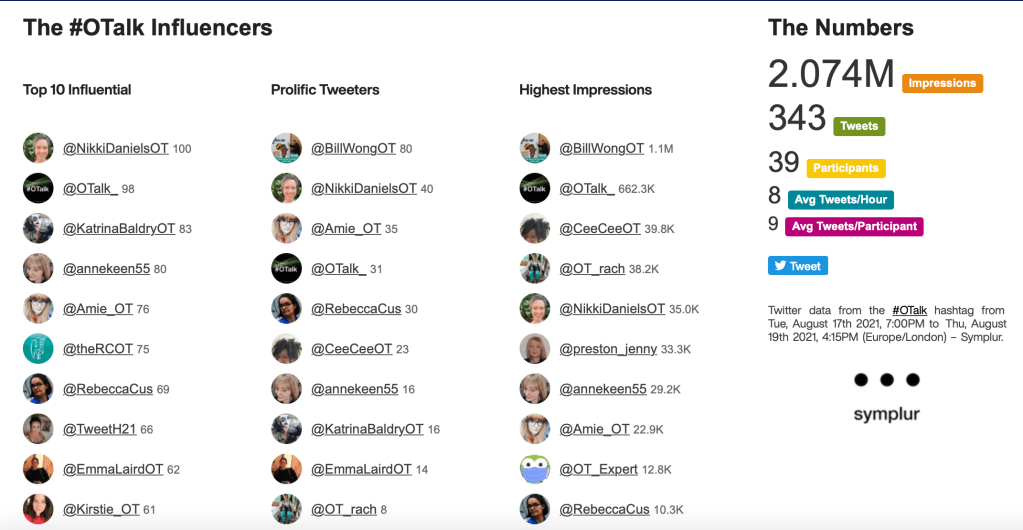
The Numbers

2.506M Impressions
357 Tweets
22 Participants
16 Avg Tweets/Hour
16 Avg Tweets/Participant

OTalk

#OTalk – 13th July 2021 – #RCOT2021 Reflections

This #OTalk will discuss and reflect on the recent #RCOT2021 conference and will be hosted by @Kirstie_OT.

#RCOT2021has recently taken place over 30 June & 1st July. RCOT’s 44th annual conference, the first held virtually on an online platform, was attended by over 1500 people from across the UK and internationally, with representatives from some other countries OT professional bodies and from WFOT (@thewfot). The conference had 4 themes, chosen by members –

Equality, diversity and inclusion.

The impact of occupational therapy.

New ways of working.

Rehabilitation and recovery.

There were 80 abstracts/sessions and posters, 18 topic specific chat rooms, 10 RCOT insight sessions, 8 round table networking sessions, and seven keynote plenary sessions with nearly all the sessions available on demand for the next 6 months.

In his opening welcome to the conference @SteveGFord , CEO of @theRCOT, encouraged delegates to enjoy, debate, discuss, learn and grow as individuals and as a profession. Even if you didn’t go, there was opportunity to see or hear about some of the content and discussion reflected in tweets or what colleagues may have shared with you. So, let reflect together on it.

The questions we will be considering are

  1. Did you attend #RCOT2021? What influenced your choice?
  2. From what you saw of it/ heard of it/ contributed to it what was something that you gained?
  3. Conference had 4 official themes – from your experience of it so far was there anything that was the biggest focus?
  4. How will you apply what you gained from #RCOT2021?
  5. #RCOT2021 content will be available for 6 months (and tickets are still available to buy up to end of July), how will you use this resource?

Post Chat

The Numbers

1.990M Impressions

338 Tweets

45 Participants

14 Avg Tweets/Hour

8 Avg Tweets/Participant 

OTalk

#OTalk research chat – 6th July 2021 – “The Dream Team: what makes an excellent research team?”

This #OTalk research chat will be hosted by @REfLECTS_Study and @AlisonA13414330, with @preston_jenny on the #OTalk account.

Twitter handles for the Dream Team: 

@REfLECTS_Study, @YvonneCodd, @StapletonTadhg, @bevaturtle, @PatriciaMac16, @LoureneAbbi, @Feemo15, @AlisonA13414330

Twitter handles for the even Dreamier Team:

@CamilaQuel, @geo_fish93, @dr_epower, @traboccant

Recently, we had the absolute privilege of hosting a one-week, virtual, stroke bootcamp event for Allied Health Professionals from all over the UK and Ireland. The concept for the bootcamp arose from the preparatory training activities we had undertaken in preparation for delivery of our randomised controlled trial in mirror box therapy with sub-acute stroke patients – the @REfLECTS_Study.  We had benefitted from this training and were of the opinion that a similar intensive and immersive training programme would benefit other therapists working in the area of stroke rehabilitation.

Whilst we received many very positive comments throughout the week about the content of the bootcamp, we were not really prepared for the exceedingly complimentary comments about our @REfLECTS_Study team, including being labelled a ‘dream team’.  

This has led to much reflection about what makes a ‘dream team’ and whether we are deserving of that title? 

Our large team of 18 members comprises clinical and healthcare support staff, academics, researchers, technical and business support staff. The team began to develop 10 years ago and have been working together since then; firstly on a small scale pilot study and subsequently growing into a multi-centre, cross jurisdictional, RCT study team.  

We know our team ‘works’ but we hadn’t really stopped to considered why it works so well. 

When we carried out some debriefs after the event, the unanimous comment from all of the team members we spoke to was that the feeling of belonging to part of the team was considered important but that the support and encouragement team members had given each other during the week was truly valued. This included pushing each other out of comfort zones and challenging each other to embrace new activities.   This was commonplace as we were in a wholly new environment – delivering training in a TV studio and presenting live to camera. During the week of the bootcamp the team cohesiveness was evident with each individual drawing upon their own unique set of knowledge and skills to perform to the highest level. This cohesiveness was somehow transmitted across the virtual environment to the trainees at the other end side of the virtual screen. 

However, we also noted in our debriefing session that another team we were working with during the bootcamp gave us a tantalising glimpse into a further level of collegiality with respect to supporting individual research learning and performance. In fact, we began to somewhat jealously wish that we belonged to that team!  The team from @UTSPhysio, led by Dr David Kennedy (@traboccant) were conducting a series of focus groups on unilateral neglect during the week. As local collaborators, one of our team members joined each focus group session. We noted that at the end of each group, the team members actively sought feedback on their individual performance from the other team members in an attempt to develop their own skills, no matter how junior or senior their perceived position in the team.  In response, the other team members would gently suggest changes in approach or enhancements to individual performance which were all warmly and eagerly received. 

At risk of losing some of my own team members to Australia, as lead of the @REfLECTS_Study group, it has propelled me into reflecting upon what makes a (clinically focused) research team excellent? 

Questions to debate during the OTalk hour:

  1. What are your experiences of working within (or alongside) a clinical research team? 
  2. What factors do you think facilitate clinical research team cohesion? 
  3. What barriers can be encountered by working within a clinical research team and how can they be overcome? 
  4. What actions do you think the team leader can take to support each team member enhance their own performance within the team? 
  5. What actions can the individual team member take to develop their team performance? 
  6. Thinking of a (clinical or research) team that you have been part of, what one aspect do you feel was the key to overall team excellence? 

POST CHAT

The Numbers

1.852M Impressions

219 Tweets

30 Participants

9 Avg Tweets/Hour

7 Avg Tweets/Participant