OTalk

#OTalk Research Chat- Tuesday 3rd May 2022 – Using Social Media to Share and Engage with Research

Have you been trying to figure out how to share your research with the people who can actually put the information into practice?

Are you an OT that wants to support research or find research that applies to your current caseload?

This week’s #OTalk, supported by @SamOTantha, is hosted by Katie Caspero (@otgraphically), Founder of OT Graphically, Infographic Creator, and Occupational Therapist. Katie helps healthcare professionals stay up to date by taking research and putting it into easy to read graphics. This helps therapists and their clients to understand and implement what the evidence says.

Katie will use her experience of using infographics and social media to help us to think about sharing and accessing research using social media platforms. 

Questions

  1. What social media platforms or formats have you found the most useful for sharing research with stakeholders and/or accessing research as a research consumer?
  2. In what ways have you found that social media has supported sharing, finding, and/or using research?
  3. As a researcher, what is the most helpful way for you to share your research and make it accessible for a wide audience through social media? As a research user what have you found helpful in making research accessible?
  4. Have you faced any challenges or barriers in using social media to access or share research?
  5. What are your top tips as a researcher or as a research user to engage with research via social media to both share and stay up to date?

Post Chat

Host:  Katie Caspero (@otgraphically), Founder of OT Graphically

Support on OTalk Account: @SamOTantha,

Evidence your CPD. If you joined in this chat you can download the below transcript as evidence for your CPD, but remember the HCPC are interested in what you have learnt.  So why not complete one of our reflection logs to evidence your learning?

HCPC Standards for CPD.

  • Maintain a continuous, up-to-date and accurate record of their CPD activities.
  • Demonstrate that their CPD activities are a mixture of learning activities relevant to current or future practice.
  • Seek to ensure that their CPD has contributed to the quality of their practice and service delivery.
  • Seek to ensure that their CPD benefits the service user.
  • Upon request, present a written profile (which must be their own work and supported by evidence) explaining how they have met the Standards for CPD.

OTalk

#OTalk 26th April 2022 – Outcome Measures used by occupational therapists in forensic and justice-based settings.

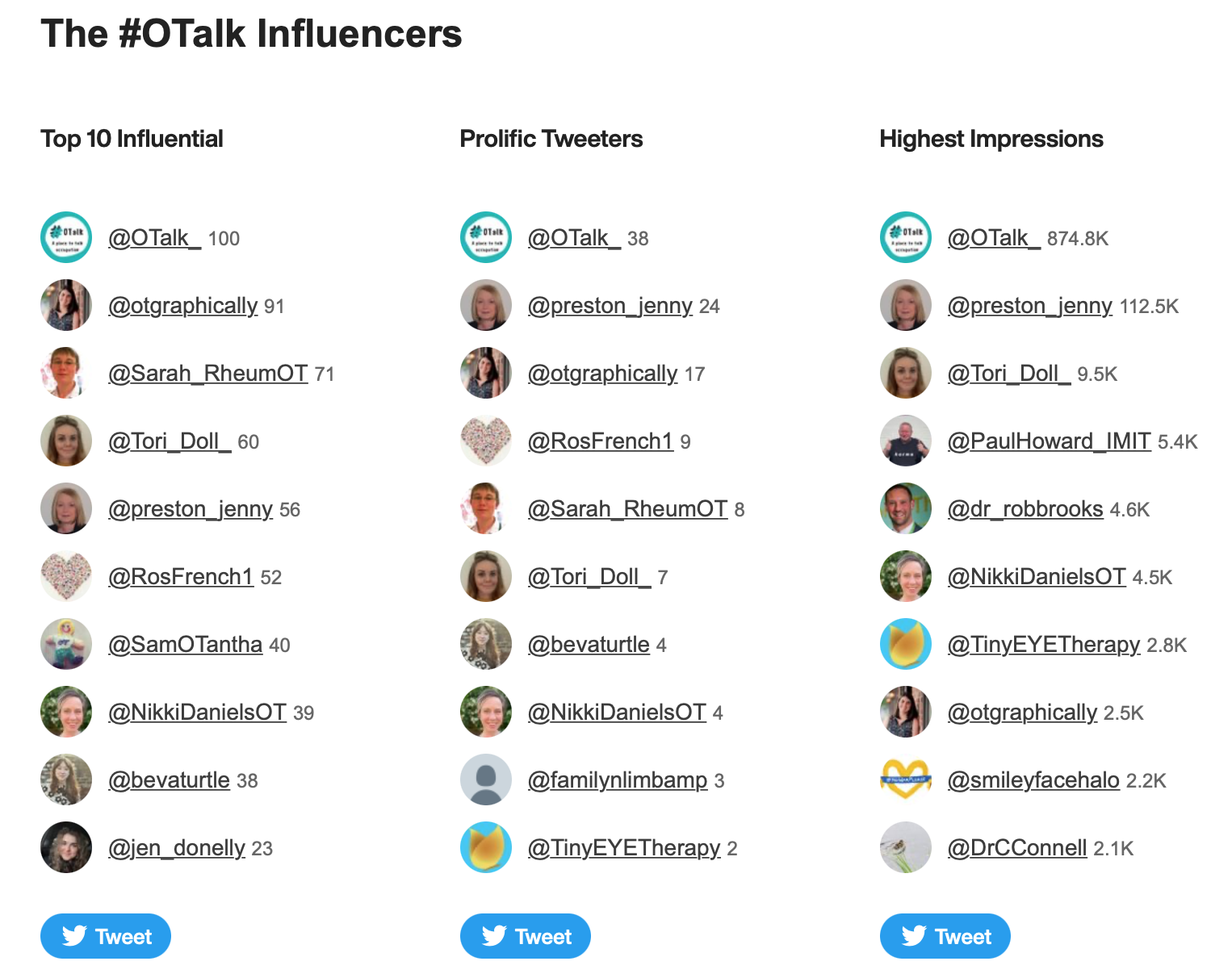
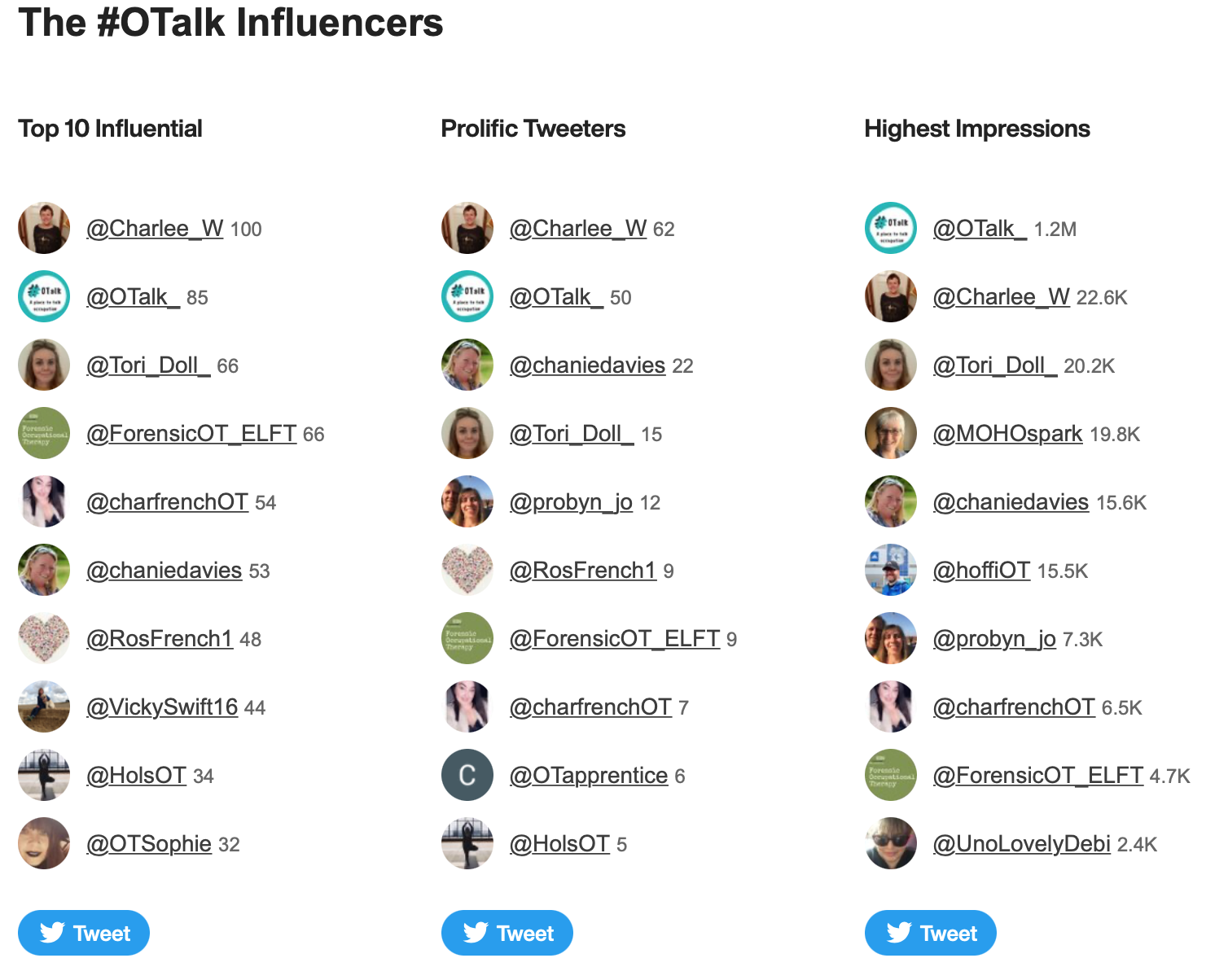
This #OTalk based on outcome measures is hosted by Charlotte Wise (@charlee_w), occupational therapist working in a female prison.  I am keen to develop the role of occupational therapy in the prison environment and recognise the positive impacts of occupational therapy can offer to these marginalised service users.

It is recommended that occupational therapists should be measuring and recording outcomes of interventions conducted with service users to provide evidence of the effectiveness of work which we are completing.  By evidencing intervention effectiveness, occupational therapists can assist with service development and clinical audits.

In conversations with peers, it is evident that finding standardised outcome measures to use can be difficult, especially in forensic or justice services. Outcome measures are then sporadically used meaning there is minimal evidence of the effectiveness of occupational therapy in the different service areas.

I am keen to use #OTalk to discuss with a variety of different professionals, what outcome measures are being used, the process of selecting and using outcome measures, the benefits of standardised and non-standardised outcomes and how helpful they are in measuring quality or effectiveness of intervention

References

College of Occupational Therapists (2015) Measuring Outcomes. Accessed online on 16th April 2022 at Research-Briefing-Measuring-Outcomes-Nov2015.pdf (rcot.co.uk)

Royal College of Speech and Language Therapists (2019) Outcome Measures Checklist.  Accessed online on 16th April 2022 at selecting-outcome-measures.pdf (rcslt.org)

Questions

  1. Introduction – areas of practice are individuals currently working? In practice, are you currently using outcome measures to measure effectiveness of interventions?
  2. What is your understanding of an outcome measure?
  3. In practice, what outcome measures are being used? Are they occupational therapy specific?
  4. What are the barriers of using outcome measures in practice?
  5. What can be done to make the outcome measures more accessible, user friendly, useable in practice?

POST CHAT

Host:  Charlotte Wise (@charlee_w)

Support on OTalk Account: Sam @smileyfacehalo

Evidence your CPD. If you joined in this chat you can download the below transcript as evidence for your CPD, but remember the HCPC are interested in what you have learnt.  So why not complete one of our reflection logs to evidence your learning?

HCPC Standards for CPD.

  • Maintain a continuous, up-to-date and accurate record of their CPD activities.
  • Demonstrate that their CPD activities are a mixture of learning activities relevant to current or future practice.
  • Seek to ensure that their CPD has contributed to the quality of their practice and service delivery.
  • Seek to ensure that their CPD benefits the service user.
  • Upon request, present a written profile (which must be their own work and supported by evidence) explaining how they have met the Standards for CPD.
OTalk

#OTalk – 19th April 2022 – Psychological care after stroke (also relevant to other neuro conditions).

This #OTalk is being hosted by Louise Clark (@louiseclark15), Consultant Occupational Therapist- Stroke rehab. Assoc. Director SSNAP, RCOT stroke forum & intercollegiate stroke working party member.

Psychologists are an essential part of the MDT across the stroke pathway, however the recent SSNAP post acute organisational audit shows significant workforce challenges in inpatient and community services with very few services meeting the minimum recommended staffing levels for psychologists.

The stepped care model recommends an MDT approach to delivering psychological care after stroke, with Occupational Therapists well placed to be involved in assessment and delivering interventions for cognition and mood, for those at level one and two of the stepped care model.

This OTalk explores the challenges and opportunities for joint working between psychology and occupational therapy to optimise psychological care after stroke, exploring boundaries and understanding of each other’s roles and training.  Come and join us to continue the discussion started at the recent UK stroke forum, with members of the RCOT stroke forum and the British Psychological Society.

The following questions will be explored;

1. What are the challenges in delivering comprehensive psychological care after stroke?
2. What are our similarities and differences between the professions when thinking about mood and cognition? (practice, training, approach)
3. How should we work together from assessment to intervention to make the best of resources and skills to deliver what the patient needs?
4. If you could do one thing in your workplace to improve working between OT and Psychology, what would it be?

Post Chat

Host:  Louise Clark (@louiseclark15)

Support on OTalk Account: Sam Pywell (@smileyfacehalo) 

Evidence your CPD. If you joined in this chat you can download the below transcript as evidence for your CPD, but remember the HCPC are interested in what you have learnt.  So why not complete one of our reflection logs to evidence your learning?

HCPC Standards for CPD.

  • Maintain a continuous, up-to-date and accurate record of their CPD activities.
  • Demonstrate that their CPD activities are a mixture of learning activities relevant to current or future practice.
  • Seek to ensure that their CPD has contributed to the quality of their practice and service delivery.
  • Seek to ensure that their CPD benefits the service user.
  • Upon request, present a written profile (which must be their own work and supported by evidence) explaining how they have met the Standards for CPD.
OTalk

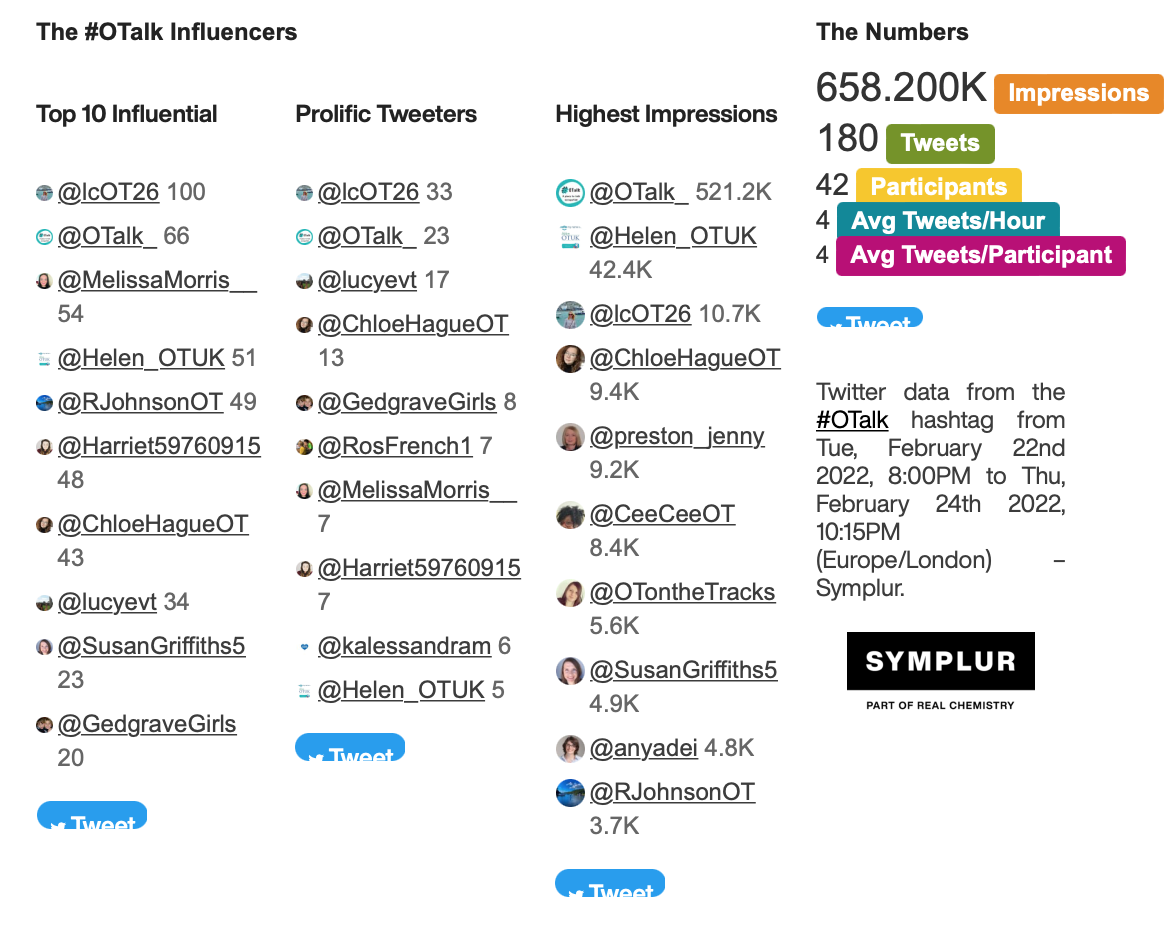
#OTalk – Tuesday 22nd Feb 2022 – Access to mainstream services for adults with learning disabilities

This #OTalk is being hosted by Lois Connelly.

How accessible are mainstream services? 

Even though mainstream services are starting to improve on being more accessible and inclusive, there is still a long way to go to ensure all adults with learning disabilities can access services. I am an Occupational Therapist working in a community learning disabilities team, and my team are currently supporting adults with learning disabilities to access COVID vaccinations and additional support. This is vital to health, yet some services are still not adapting processes in order to be more accessible. But why? 

During this OTalk, we will: 

  • Look at how adults with learning disabilities are perceived now and whether there is more understanding.  
  • Explore the current barriers for adults with learning disabilities to access mainstream health appointments 
  • Explore ways mainstream services can create reasonable adjustments in order for EVERYONE to access every service. 
  • Look at the Occupational Therapy role within all of this and share stories/scenario’s where you have felt you have made a reasonable adjustment for someone with a learning disability or condition etc.  

The questions will be:

1) How does society perceive adults with learning disabilities? Has this changed? 

2) What are the current barriers for adults with learning disabilities to access mainstream services? 

3) What reasonable adjustments could be put in place for adults with learning disabilities to access services? 

4) Please share a time where you have adapted your practice for someone with a learning disability or condition; OR reflect on a situation where you could have done this. 

Post chat

Host:  Lois Connelly.

Support on OTalk Account: HelenOTUK

Evidence your CPD. If you joined in this chat you can download the below transcript as evidence for your CPD, but remember the HCPC are interested in what you have learnt.  So why not complete one of our reflection logs to evidence your learning?

HCPC Standards for CPD.

  • Maintain a continuous, up-to-date and accurate record of their CPD activities.
  • Demonstrate that their CPD activities are a mixture of learning activities relevant to current or future practice.
  • Seek to ensure that their CPD has contributed to the quality of their practice and service delivery.
  • Seek to ensure that their CPD benefits the service user.
  • Upon request, present a written profile (which must be their own work and supported by evidence) explaining how they have met the Standards for CPD.
OTalk

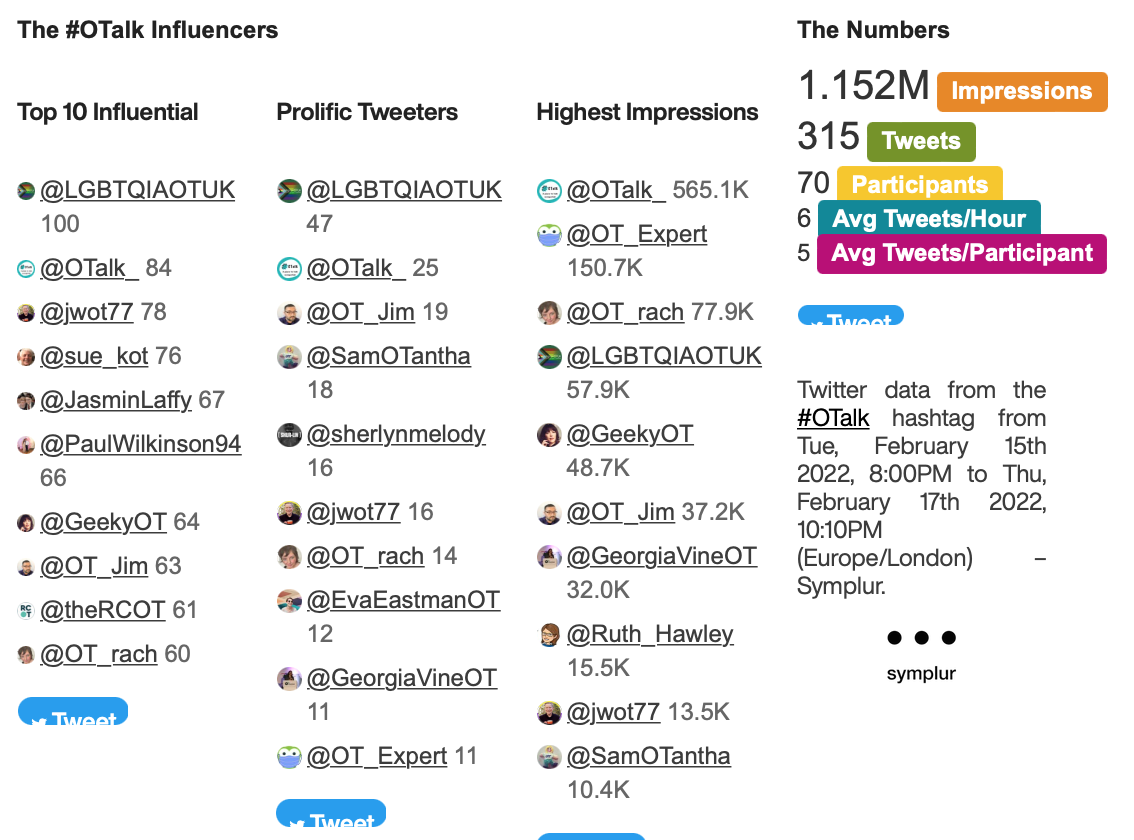
#OTalk – Tuesday 15th February 2022 -‘Pride’: what LGBTQIA+ progress within occupational therapy can we celebrate? ï¿¼ï¿¼

This week @LGBTQIAOTUK will be hosting the chat. Here’s what they had to say –

It’s LGBT History Month in the UK and so we wish to look at our recent LGBTQIA+ occupational therapy history. We thank #OTalk for providing a platform for us to be visible and be heard.

On 27th October 2020 Kirsty, Hannah and Hunter hosted the third #OTalk in the series on improving diversity in the occupational therapy profession: ‘Improving LGBTQIA+ and Gender Representation in OT’. Here is a link to the original blog: 

What has changed in the past 15 months? We invite people to repeat the challenge:

We have a challenge for you before the chat. Pop the word ‘transgender’ and the acronym ‘LGBT’ into any of the occupational therapy professional bodies’ web pages (also think beyond the usual suspects) and the physiotherapy ones e.g. CSP. 

Questions for the #OTalk

  1. What did you find from the pre-chat challenge? What is your reaction to this (and did you carry out the task last time)?
  2. How do you feel you provide colleagues and clients with safe spaces to live authentically? Are there any commitments to LGBTQIA+ needs within your workplace setting?
  3. What actions have you taken to improve the lives and experiences of LGBTQIA+ populations? 
  4. What actions will you take forwards to make your workplace more inclusive with respect to gender and sexuality? 

POST CHAT

Host:  @LGBTQIAOTUK

Support on OTalk Account: @PaulWilkinson94

Evidence your CPD. If you joined in this chat you can download the below transcript as evidence for your CPD, but remember the HCPC are interested in what you have learnt.  So why not complete one of our reflection logs to evidence your learning?

HCPC Standards for CPD.

  • Maintain a continuous, up-to-date and accurate record of their CPD activities.
  • Demonstrate that their CPD activities are a mixture of learning activities relevant to current or future practice.
  • Seek to ensure that their CPD has contributed to the quality of their practice and service delivery.
  • Seek to ensure that their CPD benefits the service user.
  • Upon request, present a written profile (which must be their own work and supported by evidence) explaining how they have met the Standards for CPD.