#BlogSquad2018, OTalk

RCOT 2018 Blog 7 4 valuable lessons from a nervous 1st time presenter

Here are 4 lessons that Orla Hughes, an occupational therapy student, learnt from presenting for the first time at a RCOT conference:

  1. Encourage everyone to ‘give it a go’

The different ways we can present at conference gives us a chance to get creative and ‘give it a go.’

If you have a passion for an activity, why not apply to host an occupation station? If you have interesting research but don’t enjoy public speaking, could you submit a poster instead? Personally, I haven’t conducted any traditional research yet so I shared a personal reflection of my experience volunteering while being an occupational therapy student for the first time. I’d encourage you to think, ‘what could I do?’

  1. Wear suncream

Be prepared to take it easy and look after yourself before you are presenting. Self-care and occupational balance need to be considered even more so when you are putting yourself out there at a conference. For me that meant I should have worn suncream the weekend before as I could have avoided presenting while looking like a lobster.

  1. Remember Murphy’s Law

We are in Northern Ireland and therefore, Murphy’s law applies: ‘If technical difficulties can happen, they probably will’ which is what arose in my presentation. Having interesting videos and slideshows are a welcome bonus to your presentation but have a back-up plan if it isn’t possible to show them on the day.

  1. Get interactive

Finally, my favourite presentations are the ones that have some banter with the audience whether it’s asking the crowd discussion questions, conducting a ‘hands-up’ poll, or singing a song together.

The opportunity to interact can turn the session into something people can engage more with and hopefully make the learning outcomes more tangible.  In my presentation, I did this through running a twitter competition. I announced I would be picking my favourite tweet from the session and award the winner with their favourite chocolate bar.

Stay tuned for the award ceremony coming soon on twitter (@orlatheot).


#BlogSquad2018, OTalk

RCOT 2018 Blog 5 Sess 33.1 – Exploring the theraputic potential of the team sport of boccia occupation station

This session was led by Lyndset from Sport for Confidence @sportforconf

Session aims were to:
  • Explore the use of boccia as a theraputic activity
  • Discuss potential uses of boccia as an assessment tool in terms of activity analysis
  • Have a go and experience the sport of boccia
It all started with being introduced to boccia, pronounced bot-cha. A game of one jack, two teams, red and blue, six balls per side and a fiercly competitive bunch of occupational therapists.
Lyndsey Barrett, an occupational therapist from Essex is the founder of Sport for Confidence, an organisation aiming to involve people with and without learning disabilities in sport. They recently worked alongside the Royal College of Occupational Therapists to produce an evidence guidelines based on using boccia as an assesment and intervention tool.
The occupation station itself was aimed at getting occupational therapists thinking about the activity of boccia and it’s relevance in assesment. What better way to do it than to give it a go?
Que the group being split into two and the first lot of attendees sat on the edge of their chairs throwing like they’ve never thrown before. The jack was launched into the middle and the first few balls added into the mix, red team had an early lead and the blue team (myself included) were struggling to catch up. Much debate and conversation went on, a few woops and cheers and the reds were united in their victory before we all had to get up and shake hands. The red team had won 3-0.
Then came the team swap, the next 8 were up. But here’s when the competition took on another level, red went first and a tactical move by blue knocked it out. The teams matched each other play by play but in the last moment the jack was moved and blue took it 2-0. Again the victors celebrated before the teams stood up and shook hands.
But, what relevance does this have to occupational therapy you say?
Core to occupational therapy is activity analysis. At some point along our educational journey we were taught about breaking activities down into the skills used to perform the activity.
Boccia provides a perfect platform to asses a person’s strength, endurance, turn taking,  communication skills and many more. Within moments of watching the game it was easy to spot people repositioning themselves to throw, working out the required strength to throw the ball, considering their options and socially becoming part of a team.
The session brought with it a powerful reminder of the skill of activity analysis and unique role occupational therapy can provide in the area. The sport itself is simple, easily graded or forward and backward chained and an asset to the occupational therapy toolkit.
This blog was written by @Amie_OT Current RCOT Education Liaison Officer
#BlogSquad2018, OTalk

RCOT 2018 Blog 4. Network Meeting: The Elizabeth Casson Trust: Professional Leadership Programme – what’s next?

This inspiring fringe event hosted by Sally Townsend and Cat Evans, Trustees at the Elizabeth Casson Trust, focused on the Trust’s commitment to support the development of leadership capacity within occupational therapy through awards available as part of its Leadership Project.

The Elizabeth Casson Trust aims to ‘advance the occupational therapy profession by supporting the development of occupational therapists’ primarily through its funding opportunities. One of the Trust’s three strategic intentions is to ‘help develop leaders in occupational therapy with the capability of taking the profession forwards within the context it needs to operate’.

The Leadership Project, launched in February 2018, enables occupational therapists to apply for up to £10,000 to develop their leadership skills. When applying for the award applicants are required to describe how they will lead and deliver on a project that addresses leadership challenges, and how they plan to develop leadership skills to achieve the required changes.

Sally talked compellingly about research undertaken by Caroline Waters (HR consultant) which informed the development of the Leadership Project. She identified that the overwhelming theme from the research was that occupational therapists lack confidence in their leadership abilities. She went on to highlight that the Trust’s Leadership Programme launched in February 2018 aims to redress skill deficits by providing opportunities to enable all occupational therapy staff, from support assistants to senior management, to develop the requisite behaviours and skills to perform as leaders.

Sally explained that the Elizabeth Casson Trust is collaborating closely with the Royal College of Occupational Therapists to develop occupational therapy leaders so that each organisation can complement the other with the support that it offers to therapists.

Karin Ormin RCOT Lead Professional Advisor attended the session. She highlighted the RCOT vision for ‘all members to recognise themselves as leaders and act as leaders, sharing a vision of occupational therapy and its value within their service’. She highlighted that traditionally occupational therapists have excelled in enabling others and consequently ‘follow behind’ the enabled person rather than perform as leaders.

She went on to urge occupational therapists to raise their heads above the parapet and be proud and vocal about their leadership attributes. Together Sally and Karin concurred that a cultural shift is gathering momentum within the profession as occupational therapists are being challenged to individually and collectively recognise themselves as leaders in order to move the profession forward.

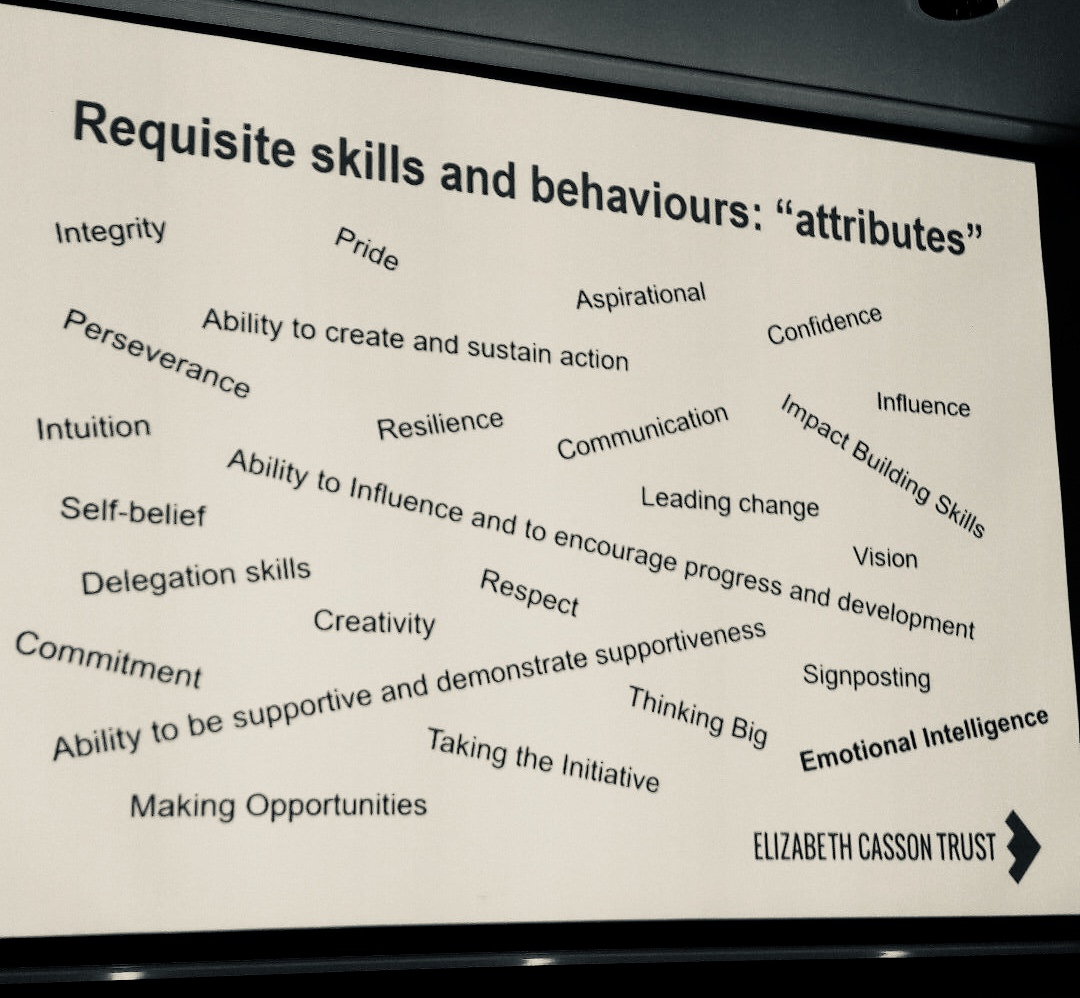
I was motivated to attend this session as I am passionate about developing research leadership and research capacity within occupational therapy and I’m seeking out opportunities to achieve this aim. I recently completed an HEE/NIHR Internship award and am co-presenting at Belfast this year about the clinical academic pathway as an approach to increasing research leadership in occupational therapy. This slide has particular resonance to me as it reflects many of the qualities I must foster within my plans to become established as a clinical academic.  If we are to succeed as leaders we must develop essential skills such as confidence, resilience and tenacity.
IMG_0053

If you are interested in the opportunities offered by the Leadership Project and wish to apply you will need to attend the next Leadership Project Event held by the Trust on 3rdOctober 2018 in preparation for developing your proposal for submission by 2ndJanuary 2019.  Feedback regarding the success of your bid is given by the end of February 2019 and you will be ready to commence your project in March 2019.

For those seeking to apply Sally stressed the importance of giving consideration to the impact of your project and to consider how your proposal aligns with and could influence your organisational strategic aims. Sally went to advocate that occupational therapists seize opportunities to network with key decision makers and be proactive in creating opportunities to promote the occupational therapy profession. For occupational therapists intent on building their skills as leaders this is an invaluable opportunity to secure funding to evolve as a leader. What’s to stop you from applying?

More information about the Leadership Project and opportunities offered by the Elizabeth Casson Trust can be found at https://elizabethcasson.org.uk/

Written by Faye Dunford @FayeDunford
 

#BlogSquad2018, OTalk

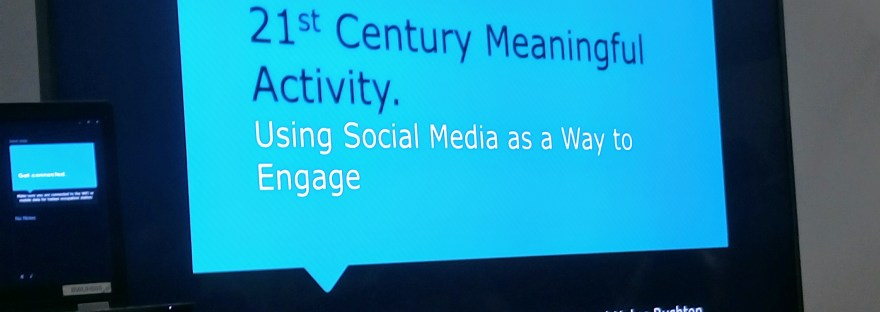
RCOT 2018 Blog 3 Sess. 21: 21st Century meaningful activity – Using social media as a way to engage.

Led by members of the #OTalk team – Rachel Booth, Kirstie Hughes, Kelly Murray and Helen Rushton.

Session aims:

  • To explore how to use Twitter, Pinterest, Instagram and Facebook social media platforms for professional means.
  • To discuss how to use social media as a therapeutic intervention with service users

We all know that social media is huge – not just with the younger generation but with all generations. Never have we been more connected to each other all over the world or able to gain information in an instance. But do we use it in our professional lives? And if we do, are we using it properly, and in an engaging way that benefits both us for CPD activity and our service users as a therapeutic intervention?

One way in which Occupational Therapists are using social media is for CPD. At 8pm every Tuesday on Twitter #OTalk happens. There is a weekly topic and questions for people to respond and contribute towards. They are all volunteers who run the group chat and their aim is to support the profession and all OTs with their personal development in a free and informal way.

In this Occupation Station session we were given 7 minutes to move around 4 social media tables:

DSC_1564


Table 1: Twitter:
How to use it professionally and personally – a quick guide for non-Twitter users.
For those who use Twitter they shared the hashtags they follow for work and play. It’s also the first place to see when new research, publications and initiative get released.

Table 2: Pinterest and Instagram
On this table there was a discussion of how Pinterest can be used for collating ideas for interventions and session as well as using it with service users as a therapeutic intervention. For Instagram it is a photo based social media, a great way of promoting activities in Occupational Therapy or for service users to explore their occupations through photography in a 21st century way.

Table 3: Facebook
Many of use have Facebook for personal use. The key message for this table was to utilise the 4OT Groups (e.g. OT4OT, CPD4OT, MH4OT) for networking and learning and if you wish to use Facebook for promoting professional practice then create a Page. A take home message for Facebook was to check your security settings regularly as the change.

DSC_1570Table 4: Blogs

Blogs are online journals and they can be found on all manner of topics. Many healthcare professionals and Occupational Therapists use them to reflect on clinical practice, discuss and share interventions and log CPD activity- like this conference! But you can also find a variety of blogs from service users, these are valuable for professionals and services users to learn from and have a greater awareness of other people’s experiences. There are a few different platforms in which to write a blog e.g. Blogger and WordPress, and it is a case of have a go and see which you like and suit your style.

As a final note it is important to check your Trusts / workplace policies on use of social media and have a look at the HCPC, RCOT guidance on social media and the dos and don’ts!

Blog written by Catherine Gray, @CupOTservice @CGray_OT