OTalk

#OTalk 9thJuly – Age Appropriate Occupations

This weeks #OTalk is on the topic of “Age Appropriate Occupations” and will be hosted by Kirstie Hughes (@Kirstie_OT).

Over the years when I have told people I enjoy building Lego I am met with responses such as “but its for Kids” or “Really, why?” and my answer is always why not?!

At this years Royal College of Occupational Therapist Annual Conference I presented an occupation station to share my love of Lego. I was hugely overwhelmed by demand for my session and the positive feedback with one attendee commenting on how he felt calm and relaxed engaging in occupational flow amongst the busy few days of conference

The queries have often left me thinking about age appropriate occupations in Occupational Therapy and the wider Health and Social Care context. Activities such as Easter bonnet making in residential homes, nursery rhymes in Learning Disabilities and Coloring in mental health services were often looked upon as “not appropriate”. As research in these areas have progressed we have an evidence base for their benefits to health and well being and they are now seen as mainstream activities, but why were they ever seen as inappropriate in the first place?

This chat aims to encourage discussion around age appropriate occupations, what impacts on them and why we stop engaging within adulthood.

Some questions to consider;

1: Do you engage with or participate in any occupations that may not be deemed as “age appropriate”? In addition to Lego building I also play PokemonGo.

2: What was your favourite occupation as a child? What did you gain from it? Do you still participate in it now? If not why not?

3: As OTs we know the importance of meaning in occupation, so does age really matter to us?

4: Is the need to provide a group activity impacting on the options available to us? Does catering for the many reduce meaningful options?

5: Are there any types of occupation based activities you would like to try within your service but have concerns around justifying them? Maybe you have tried some and was successful in your clinical reasoning?

6: Are the any new occupations you would like to try as an adult? Why barriers are there to your participation?

Post Chat

Host and On OTalk Account; @kirstieot

Online Transcript

#OTalk Healthcare Social Media Transcript July 9th 2019

The Numbers

2.351M Impressions
336 Tweets
36 Participants
269 Avg Tweets/Hour
Avg Tweets/Participant

#OTalk Participants


OTalk

#OTalk – 25th June 2019 – The Sentinel Stroke National Audit Programme (SSNAP)

This week’s chat will be hosted by Louise Clark on behalf of the Royal College of Occupational Therapists Specialist Section for Neurological Practice @RCOT_NP here is what they had to say.

The Sentinel Stroke National Audit Programme (SSNAP) is the national dataset for stroke, widely used in England, Wales and Northern Ireland. The aim of the audit is to improve stroke care by measuring the structure and processes of stroke care against evidence based standards, such as the RCP guidelines for stroke (2016). For example this includes length of stay on a stroke unit, time to initial assessment by an occupational therapist, number of days OT delivered as a % of patient stay, number of minutes of therapy delivered on average per day, % of mood and cognition screens completed.

Data collection and entry is a significant feature in stroke unit care and Early Supported Discharge and for some is not always a welcome addition to our workload. However, there are positives to having such a huge database of information and comparisons against other services and national averages…..

The aim of this #OTalk is to explore those positives and think how can best use the information we collect and share ideas regarding meeting the 45 minute therapy target. We are joined for our talk by a member of the SSNAP team (………) and will share tools and signpost to resources/help regarding SSNAP.

This #OTalk has been hosted by Louise Clark from the stroke forum of the Royal College of Occupational Therapists specialist section for Neurological practice, in response to member feedback for topics. We hope you enjoy it and carry on the conversations in your workplace.

1. What do you think are the positives about SSNAP?

2. How do you use the data day to day to plan or improve patient care?

3. People have mixed feelings about the 45 minute therapy target. Why is it important (for patients, therapy services)?

4. What can you do to help meet your 45 minute target?

We would ask participants to look out for 3 short feedback questions posted with the transcript in the week following this #OTalk. We’d really appreciate your feedback in helping us evaluate and plan our sessions.

Future sessions from the stroke forum include;
24th September 2019 – Neglect (with Dr Ailie Turton)
26th November 2019 – Driving (with Paul Graham)
25th February 2020 – Vision (with the British and Irish Orthoptic Society- BIOS

Post Chat

Host: Louise Clark @RCOT_NP

Support on Otalk account: @otrach Rachel Booth

Online Transcript

#OTalk Healthcare Social Media Transcript June 25th 2019

The Numbers

1.105M Impressions
371 Tweets
31 Participants
297 Avg Tweets/Hour
12 Avg Tweets/Participant

#OTalk Participants


OTalk

Tuesday 18th June 2019 – Reflections from #RCOT2019

This years Royal College of OT Conference is being held at the ICC in Birmingham on Monday 18th and Tuesday 19th June, 2019.  As always delegates are encourage to share their learning and impressions of conference on twitter using #RCOT2019, so if you not at the conference you can still join in the learning.   As most of the #OTalk crew will at this years conference our student intern Carolina will be leading the chat reflecting on what happened, for those travels home or those who joined in the conference via Twitter.

Question will include

Q1 Did you attend this years RCOT conference or follow it on Twitter?

Q2. What was your highlight?

Q3. Will you be changing your practice at all after something you saw or read on Twitter at the conference?

Q4. Did you meet anyone in real life that you only knew on Twitter? How was that?

Q5.  Is there anyone you think we should approach to host a #OTalk chat that you saw at conference?

Q6. What is your take home message?

POST CHAT

Host and OTalk support- Carolina

Online Transcript

#OTalk Transcript June 18th 2019

The Numbers

1.188M Impressions
259 Tweets
69 Participants
10 Avg Tweets/Hour
Avg Tweets/Participant

#OTalk Participants

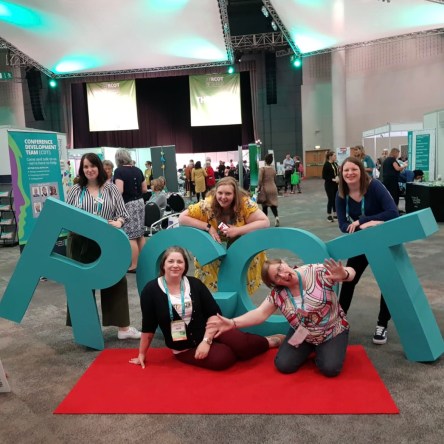
Here are the OTalk Crew at this years Conference.

IMG_0028

OTalk

#OTalk – 11th June 2019 – Occupational Therapy for MND

This weeks topic will explore the role of Occupational Therapy for persons with MND. The chat will be hosted by Lisa Cousins @lisa_mnd_ and MND Education @mndeducation

This is what they had to say:

Motor neurone disease (MND) is a fatal, rapidly progressing neurological condition affecting up to 5,000 adults in the UK at any one time. The disease causes messages from nerves (motor neurones) in the brain and spinal cord that control movement to gradually stop reaching the muscles, leading them to weaken, stiffen and waste.

The result is that people become locked in a failing body, unable to move, talk and eventually breathe. Some may experience changes in thinking and behaviour, with a proportion experiencing a rare form of dementia. MND does not usually affect senses such as sight, hearing and touch.

MND kills a third of people within a year and more than half within two years of diagnosis. It affects people from all backgrounds and a person’s lifetime risk of developing MND around 1 in 300. Today six people will be diagnosed and six will die from MND. There is no cure.

Occupational therapists play a vital role in supporting people with the disease to maximise their quality of life by supporting them to adapt to their changing symptoms and continue to participate in occupations that are important to them. However, supporting people with complex and changing needs, alongside a terminal diagnosis can prove challenging for all involved.  

This #OTalk is being hosted by the MND Association Education and Information Team, and will focus on the role of occupational therapy in MND and the challenges the disease can raise for health and social care professionals. We are really looking forward to hearing about your experiences of working with the disease and creative solutions to the challenges of MND. 

Some questions to get you thinking in preparation for the chat:

  1. What can Occupational Therapists do to help pain management with people living with MND?
  2. What can Occupational Therapists do to help prepare people living with MND for the types of equipment they may need in the future ?
  3. What is the Occupational Therapists role in postural management in MND?
  4. How can Occupational Therapists support social inclusion for people living with MND and their families and carers?
  5. Do Occupational Therapists manage fatigue in MND? (I think people miss this in MND and usually associate it with MS)
  6. Do Occupational Therapists suffer compassion fatigue when working with this client group?

POST CHAT

Online Transcript

#OTalk Transcript June 11th 2019

The Numbers

511.760K Impressions
149 Tweets
24 Participants
119 Avg Tweets/Hour
Avg Tweets/Participant

#OTalk Participants


OTalk

#OTalk Research 4th June 2019 ‘The NIHR Integrated Clinical Academic Programme: a potential opportunity for occupational therapists’.

This months #OTalk Research topic is “ The NIHR Integrated Clinical Academic Programme: a potential opportunity for occupational therapists”. The chat will be host by Chris Lovegrove @CLovegrove_OT Clinical Lead Occupational Therapist (Royal Devon & Exeter Hospital) and Clinical Research Fellow (CRN South West Peninsula) Chris will be tweeting from the ROTTERs Exeter @ROTTERsExeter account for the chat and Dr Jenny Preston MBE @preston_jenny will be on the @OTalk_ account supporting.
The National Institute for Health Research (NIHR) recognises that Allied Health Professionals (AHPs) play a vital role in the delivery of high quality, patient-centered clinical research [1]. As a professional group, AHPs represent the third largest workforce in health & social care and includes Occupational Therapy [2]. Research -active AHPs are at the core of the NIHR mission to support outstanding individuals to conduct leading research focused on the needs of patients and the public [1, 3]. With core principles of participation, meaningful occupation, and holism, occupational therapists are ideally positioned to lead in clinically-relevant frontline research.
In collaboration with Health Education England, the NIHR offer the Integrated Clinical Academic (ICA) programme [4]. This multi-level award programme provides personal research training awards for AHPs who wish to develop careers that combine clinical research and research leadership with continued clinical practice and development. The awards range from introductory research internships through to senior clinical lectureships [4]. While the numbers of occupational therapists applying to these schemes are increasing, they remain relatively low compared to other professions [5].
Whether you are an experienced researcher or clinical academic, clinician, or student, please join us for this #OTalk twitter chat and share your ideas and experiences. Suggested talking points and discussion questions to focus the chat:

  1. What are your experiences of the NIHR ICA scheme?
  2. Are you contemplating applying to the scheme?
  3. How long do you think an application takes?
  4. What preparation do you think goes into an application?

References:
[1] https://www.nihr.ac.uk/our-research-community/clinical-research-staff/Allied%20Health%20Professionals/Allied%20Health%20Professionals%20Strategy%202018_20.pdf
[2] https://www.nihr.ac.uk/our-research-community/clinical-research-staff/allied-health-professionals.htm
[3] https://www.nihr.ac.uk/news/makespace4research-campaign-launched-to-encourage-staff-to-increase-research-capacity/11563?diaryentryid=43708
[4] https://www.nihr.ac.uk/our-research-community/NIHR-academy/nihr-training-programmes/nihr-hee-ica-programme/
[5] https://www.nihr.ac.uk/funding-and-support/documents/ICA/PCAF/TCC-ICA-PCAF-Round%201-Chairs-Report.pdf

POST CHAT

Host: Chris Lovegrove @CLovegrove_OT

Support on the #OTalk account: @preston_jenny

Online Transcript

#OTalk June 4th 2019

The Numbers

815.269K Impressions
230 Tweets
32 Participants
184Avg Tweets/Hour
7Avg Tweets/Participant

#OTalk Participants