OTalk

#OTalk – 9th June 2020 – The Occupational Therapy role in Epilepsy assessment and intervention

This week @GarroneJuliana is hosting.

I thought the topic of the role of Occupational Therapy in epilepsy would be a valuable one to discuss. Throughout my MSc it was not discussed in great detail and I would love for people to share ideas with one another on this topic. As part of my education I completed a research project (thematic analysis) looking at quality of life in youth with epilepsy. It was a valuable project that opened my eyes to the various areas where OT can be involved with those who have epilepsy. It highlighted how a range of occupations can be impacted by a diagnosis of epilepsy. Additionally, I am currently completing a Community Development placement at an Epilepsy non-profit in Canada. Our project is to create a “Personalized Seizure Plan” focusing on how an individual’s occupations are impacted by epilepsy so they can education their caregivers, teachers, health care professionals, etc.


Epilepsy and its varied seizure types effect the physical, social, emotional, spiritual, recreational and vocational functioning of individuals and their families (Clerico, 1989). Occupational therapists can help find out why people have problems with activities of daily living and teach them ways of adapting or compensating for the problems (Epilepsy Foundation). In addition to the physical and social implications of epilepsy, epilepsy affects cognition, mood, affect, memory and attention (Motamedi & Meador, 2003).


I believe Occupational Therapists should be a necessary health care professional involved in the care of those with epilepsy. Our role as client-centered practitioners can be utilized extensively in this area. Advocating for ourselves as clinicians in epilepsy care, as well as our clients is vital.


Questions:

  1. What does quality of life mean to you?
  2. What is your understanding of the OT role in epilepsy care?
  3. How can we promote a need for OTs to work with this population?
  4. What occupations are most affected by epilepsy?
  5. Does the OT role differ when comparing the broad range of epilepsy types?
  6. How can we advocate for the role of OT in epilepsy?


Thank you for your time!

-Juliana

OTalk

#OTalk 26th May 2020 – How important is Posture Management?

This week Lauren Osborne @LaurenOsborneOT is hosting here is what she had to say,

I’ve just completed my MSc in Rehabilitation and Posture Management and my dissertation was a scoping review looking at “What is the evidence for 24 hour posture management?”. I concluded from the literature that posture management is a pre-requisite to occupational performance and therefore, I feel that it should be central to our work as OTs when working with people with complex physical disabilities. I would like to see it as part of the pre-registration OT training and to develop national guidance and NICE guidelines. I believe that posture management is a safeguarding and human rights issue because the people who need it are unable to change position independently and therefore rely on others to protect their body shape from distortion caused by gravity, which can have devastating effects through the development of skeletal deformities and contractures, leading to compromised respiration, digestion etc.
My questions for the discussion are:
1. What is your understanding of the term 24 hour posture management?
2. Did your pre-reg course include any training on posture management and/or positioning for people with complex physical disabilities?
3. How confident would you feel to assess a person for postural seating or night-time positioning equipment?
4. When assessing people’s ADLs, do you consider their posture e.g. can they sit unsupported to use their hands freely? Can they hold their head up to see?
5. If someone is unable to sit upright with their arms free and hold their head up, how can we as OTs best support them to engage in activity?
6. What could you do in your setting to increase awareness and knowledge of the importance of posture management?
CPD, OTalk, Professionalism

#OTalk 19th May 2020 – Yr1: Thriving not Surviving

This week’s #OTalk is explores well-being in the first year of practice. It is being led by Andrew Bates (@AndrewbatesOT) and Deb May (DMay_OT) of the year 1: Thriving not Surviving project team.

The project is funded by the Elizabeth Casson Trust and aims to develop a resource to support well-being in the first year of practice. The team comprises newly qualified OTs working with OT Dr Lynne Goodacre and writer Rob Young.   More information about the project can be found here (https://www.lgpersonaldevelopment.co.uk/year-1/) and details about the team is found here.

We know that the first year of practice can be hard. You suddenly feel as though you don’t know enough about anything. You’re not sure how you will fit into the existing team. The previous band 5 in the rotation was so amazing you may never fill their shoes. You arrive with models of practice and theoretical approaches and find that the team you’ve joined doesn’t fit anything you’ve learned. Suddenly you have your own caseload and you sign your own notes – with nobody checking on you or countersigning them. You have responsibility. Your work life balance may be totally altered. You may have a long commute. You have money burning a hole in your pocket. There are so many things to juggle. It can be frightening. It’s challenging and rewarding and fun and it’s exactly what you’ve worked so hard for but some days it can be utterly overwhelming. On those days, where do you turn?

We would as many newly qualified occupational therapists as possible to join us for tonight’s talk to explore how you are managing your own well-being in your first year of practice and to help us develop the resources which would help future cohorts of newly qualified OT .

The questions we will be exploring include:

  1. What support was available for you as a newly qualified OT?
  2. What made the biggest difference to your well-being during your first year of practice?
  3. What actions did you take to maintain a state of well-being during your first year?
  4. What would have better improved your well-being during your first year?
  5. What piece of advice would you give to new graduates to support their well-being?


OTalk

OTalk – 12th May 2020: CPD Opportunities for Students

As the Derby Occupational Therapy Society, we encourage to increase continued professional development for students by either providing the opportunity to organise events, attend our events or support students to attend external events.
We facilitate an educational, charity, revision and social event each month, aiming to capture all needs of the student. This has proved successful in integrating cohorts and giving students the confidence to attend CPD opportunities.
We would love to facilitate discussion around how CPD is viewed and accessed amongst Occupational Therapy Students nationally and internationally! We look forward so speaking with you all (past and present students)!

  • What CPD events have you been able to access whilst being a student, has this been internal or external to your curriculum?
  • How easy do you think it is to access CPD as a student alongside your studies?
  • What barriers have you come across in terms of accessing CPD as a student (personally and structurally?
  • What changes have you seen in the ability to access CPD as a student during your studies / since your studies?

Post Chat Updates:

Online transcripts from HealthCare#

PDF of transcript

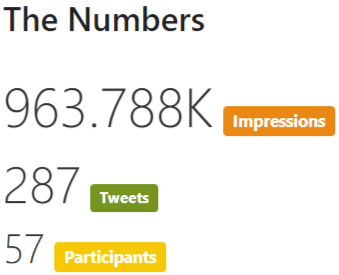
The Numbers

231.138K Impressions
80 Tweets
38 Participants

OTalk

#OTalk Research: Managing your research during a pandemic. Hosted by Dr Eddie Duncan

The COVID-19 pandemic is a global life-changing event effecting all parts of society.  Research, as with all aspects of life, has been directly affected.  

My own research activities have been impacted. I am now working from home in a busy family household (with all the challenges that brings), studies that I lead and collaborate in have been paused indefinitely, new major grants awarded since lockdown are unable to start. 

However there are also opportunities. I have become actively involved in a number of funded COVID related studies, new opportunities of digital collaboration and remote working are becoming apparent, new collaborations are forming and the requirement for taking an interdisciplinary approach to research has never been more apparent!

This week’s #OTALK provides an opportunity for us to look at the challenges and opportunities that the global COVID-19 pandemic has had for occupational therapists involved in research.  I am looking forward to joining you all for a great discussion!

Questions to discuss:1. What has changed in your research activities as a result of COVID-19?

2. What challenges have you faced as a result of COVID-19 and how (if you possible) have you overcome them?

3. What areas should occupational therapists be leading or collaborating in as a consequence of COVID-19?

4. What can we learn from this time so that our future research, and research activities, becomes smarter, more focused, and more impactful?

Post Chat Updates:

Online transcript from HealthCare#

PDF of transcript: