OTalk

#OTalk – Tuesday 11th July 2023 – Spotting and Challenging Ableism #BeAnAbleOTUKAlly

July is Disability Pride Month and it is nearly two years since the AbleOTUK affinity group popped into existence. Today’s #OTalk is being hosted by the group on how to spot and challenge ableism and continue to #BeAnAbleOTUKAlly 

Do check out our previous chats here:

18th August 2020 https://otalk.co.uk/2020/08/11/otalk-18th-august-2020-occupational-therapy-and-ableism/ 

26th July 2022

These introduce the concept of ableism and discuss concepts re allyship to the disabled community. Tonight’s chat is going to explore the different types of ableism you make come across in order that we can begin to spot and challenge these in our practice and day to day lives. 

Levels of Ableism

Institutional

This form of ableism affects institutions. An example is medical ableism, which is rooted in the idea that disability of any kind is a problem that needs fixing. When this is part of medical teaching and health policy, it affects the entire healthcare system and the well-being of patients.

Interpersonal

This is ableism that takes place in social interactions and relationships. For example, a parent of a child with a disability might try to “cure” the disability rather than accept it.

Internal

Internalized ableism is when a person consciously or unconsciously believes in the harmful messages they hear about disability and applies them to themselves. For example, a person may feel that disability accommodations are a privilege and not a right.

Different Forms of Ableism 

ExperienceDescriptionSpecific ExperiencesLink to example

Benevolent Ableism
An assumption wherein disabled people are vulnerable, weak and dependent. This tends to romanticise acts of ‘overcoming their limitations’ resulting in the objectification of disabled people as they are perceived as ‘specimens of wonder and amazement’Being an inspiration when in:
Public
School/Work
A Medical Context

Being depicted as ‘heroic supercrips’ in stories. 
I’m not your inspiration, thank you very much https://www.ted.com/talks/stella_young_i_m_not_your_inspiration_thank_you_very_much 

Hostile Ableism
Negative forms of ableism in which other members of the society exploit or attack disabled peopleVerbal Abuse
Physical Assault
Sexual Assault 
Bullying
General Harassment
Trigger warning for SA in this video
https://www.tiktok.com/@blindtobes/video/7251642245143645467?lang=en 

Ambivalent Ableism
A combination of both hostile and benevolent ableism, shifting from one to the other depending on the situation and circumstances.
3a. Paternalistic Patronising speech and behaviours.Unwanted help
Infantalisation
General Pity
Invalidation
Overprotection
Consequences of Confronting Patronizing Help for People with Disabilities: Do Target Gender and Disability Type Matter?
https://www.ncbi.nlm.nih.gov/pmc/articles/PMC7316393/ 
3b. Jealousy/EnvyAn attitude of desiring things that a disabled person receives/gets.Jealousy over a disabled person’s:
Accomodations
Perceived Privileges 
Accusation over benefit exploitation
People on benefits with mental health problems given cars worth £40k
https://www.telegraph.co.uk/news/2023/07/07/benefits-mobility-scheme-mental-health-cars-worth-40k/ 
3c. Dehumanising/objectifyingBehaviours that fail to respect the inherent right of being human.Depersonalisation
Invasion of Privacy 
Abandonment/Neglect
Deligitimisation.
Medical or Physical Neglect
https://disabilityjustice.org/medical-or-physical-neglect/ 
3d. Fear-basedBehaviours ruled by fear.Existential concerns over life
Fears of Catching or passing a disability
General Avoidance.
‘I’d Rather Be Dead Than Disabled’—The Ableist Conflation and the Meanings of Disability
https://www.researchgate.net/publication/317621712_%27I%27d_Rather_Be_Dead_Than_Disabled%27-The_Ableist_Conflation_and_the_Meanings_of_Disability 

Source: Yao et al.

Questions

  1. Tell us about your experiences of the three different levels of Ableism: Institutional, Interpersonal and Internal – which you do see more of and why?
  2. How can Occupational Therapists act to challenge these three different levels of Ableism: Institutional, Interpersonal and Internal
  3. Benevolent Ableism is rife in Occupational Therapy practice – why do you think this is? 
  4. Share some examples of paternalistic speech or behaviours you have seen within healthcare and offer some more empowering alternatives.
  5. How can you challenge your own Internal Ableism and how might this benefit society as a whole?

Reference

Yao et al., (2022) . Is occupational therapy an ableist health profession? A critical reflection on ableism and occupational therapy. Cadernos Brasileiros de Terapia Ocupacional, 30(e3303). doi:10.1590/2526-8910.ctoRE252733032
OTalk

#OTalk Research – Tuesday July 4th 2023 – Into the unknown, how a scoping review can be a useful tool within occupational therapy.  


Hosted by @SamOTantha and supported by @Bevaturtle on the #OTalk account 

One of my favourite descriptions of a scoping review in the literature is as a “reconnaissance” activity (Peters et al., 2015) this was particularly beneficial when faced with needing to present the literature in a relatively unexplored area of occupational therapy for my PhD.   

For context, my PhD aims to explore the lived experience and impact of endometriosis on occupation.  When I started, I could only find a few sources to support my work, I knew there would not be enough data to support a systematic review but wanted a way to synthesize the available evidence and map it to concepts within occupation and occupational science.  A scoping review offered a way for me to be able to achieve this. 

Scoping reviews can be used for a variety of reasons: 

  • As a precursor to a systematic review.
  • To identify the types of available evidence in a given field.
  • To identify and analyse knowledge gaps.
  • To clarify key concepts/ definitions in literature.
  • To examine how research is conducted on a certain topic or field.
  • To identify key characteristics or factors related to a concept. 

(Munn et al., 2022)

Practically, there are a few ways in which a scoping review can be conducted from a methodological framework and the most commonly cited within the literature is Arksey and O’Malley (2005). Which was selected for my review tilted: Why we need to research the lived experience of endometriosis: A scoping review exploring occupational justice and health equality for women and those assigned female at birth with endometriosis (Tavender, 2023).  

The steps outlined by Arksey and O’ Malley (2005, p. 14) are: 

“Stage 1: identifying the research question

Stage 2: identifying relevant studies

Stage 3: study selection

Stage 4: charting the data

Stage 5: collating, summarizing and reporting the results”

These steps are not too dissimilar from other methodological approaches that people may also be familiar with and anecdotally from my experience can either be completed by one or multiple researchers. However, for many reasons scoping reviews are often overlooked or not highly valued as an evidence source. 

Often in practice we find ourselves presented with questions and gaps in knowledge; with little literature to support evidence-based practice. This is even more prevalent in role emerging areas.  A scoping review offers an opportunity to start to find some potential answers to these questions, bridge the knowledge gap and can be used as evidence to support policy development and support funding applications.  The questions for tonight’s #OTalk will explore the use, feasibility and potential for scoping reviews and reflect on its potential to support your area of practice. 

Questions: 

What do you understand a scoping review to be?

Have you ever conducted a scoping review before?  If not, would you feel confident to conduct one?  

What skills and/or support do you feel is needed to complete a scoping review?

Could you see the benefit of scoping review for your practice area?  

What are the unexplored areas within your practice that you could potentially conduct a scoping review of? 

References:  

Arksey, H., & O’Malley, L. (2005). Scoping studies: Towards a methodological framework. International Journal of Social Research Methodology, 8(1), 19-32. https://doi.org/10.1080/1364557032000119616

Munn, Z., Pollock, D., Khalil, H., Alexander, L., Mclnerney, P., Godfrey, C. M., Peters, M., & Tricco, A. C. (2022). What are scoping reviews? Providing a formal definition of scoping reviews as a type of evidence synthesis. JBI Evidence Synthesis, 20(4), 950–952. https://doi.org/10.11124/JBIES-21-00483 

Peters, M. D., Godfrey, C. M., Khalil, H., McInerney, P., Parker, D., & Soares, C. B. (2015). Guidance for conducting systematic scoping reviews. International Journal of Evidence-Based Healthcare, 13(3), 141–146. https://doi.org/10.1097/XEB.0000000000000050 

Tavender, S. (2023). Why we need to research the lived experience of endometriosis: A scooping review exploring occupational justice and health equity for women and those assigned female at birth with endometriosis. [Poster presentation]. Occupational Science Europe, Odense, Denmark.

OTalk

#OTalk Tuesday 27th June 2023: Using physical activity in OT practice to tackle health inequalities hosted by @MovingOTs

As occupational therapists, our profession is based around the basic tenet that occupation influences people’s health and wellbeing, with occupational therapy having the potential to be a health promoting profession (Wilcock 1998). But do we see ourselves as health promoters in our work roles, and if so, what does this mean?

At least 60% of occupational therapists in the UK work in the NHS or adult social care (Health & Care Professions Council 2021), and current pressures on these services have been highlighted through the Royal College of Occupational Therapists’ recent survey (RCOT 2023). Taking all of this into account, it can feel that promoting the health of service users and the wider population through physical activity is a ‘nice to have’, another thing we need to add into our already incredibly busy everyday work as occupational therapists.

But what if it could be different? 

What if when you thought about where an occupational therapist works, you thought of a leisure centre, or a golf club, instead of a hospital or clinic? What if knowledge of the benefits of physical activity was embedded in our practice, so it became second nature for this to be part of a standard occupational therapy assessment or intervention? 

Seems like a distant dream? 

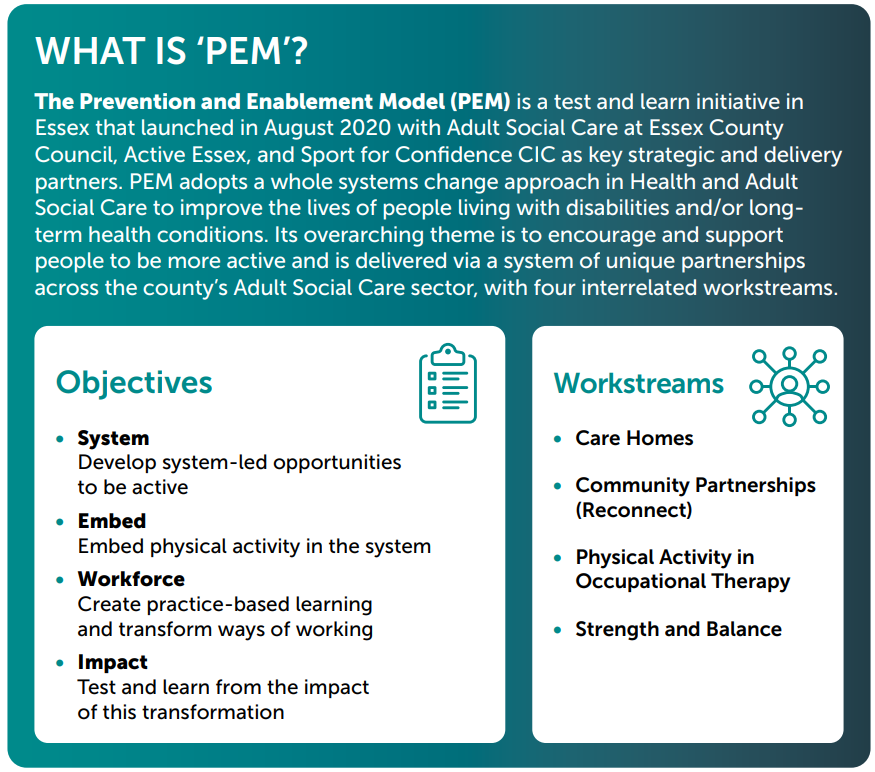
It’s already happening here in the UK! Community Interest Companies (CICs) such as Sport for Confidence, and Golf in Society, are already tackling health inequalities by supporting access to opportunities for physical activity, and building wellbeing, belonging and connection into their communities. An example of this work includes the Prevention & Enablement Model (PEM), a joint initiative between adult social care, Active Essex and Sport for Confidence, which evidences the value of occupational therapy in promoting the health of population including those in care homes and people with learning disabilities. More information on this project can be found in the ‘More Resources’ section below. 

For those of us working in statutory services, we can support our service users to consider physical activity by increasing our knowledge of the benefits of movement …

Firstly, let’s define what we mean by physical activity, and talk about what the current guidance for how much physical activity we need. The World Health Organisation (WHO) defines physical activity as:

‘any bodily movement produced by skeletal muscles that requires energy expenditure. Physical activity refers to all movement including during leisure time, for transport to get to and from places, or as part of a person’s work. Popular ways to be active include walking, cycling, wheeling, sports, active recreation and play, and can be done at any level of skill and for enjoyment by everybody.’ WHO 2022

What are the benefits of regular physical activity? WHO (2022) states that ‘physical activity is proven to help prevent and manage noncommunicable diseases such as heart disease, stroke, diabetes and several cancers. It also helps prevent hypertension, maintain healthy body weight and can improve mental health, quality of life and well-being.’

And how much physical activity is recommended on a weekly basis? Here are the WHO (2022) recommendations for children and adults:

Children and adolescents aged 5-17 years

  • should do at least an average of 60 minutes per day of moderate-to-vigorous intensity, mostly aerobic, physical activity, across the week.
  • should incorporate vigorous-intensity aerobic activities, as well as those that strengthen muscle and bone, at least 3 days a week.

Adults aged 18–64 years

  • should do at least 150–300 minutes of moderate-intensity aerobic physical activity; 
  • or at least 75–150 minutes of vigorous-intensity aerobic physical activity; or an equivalent combination of moderate- and vigorous-intensity activity throughout the week
  • should also do muscle-strengthening activities at moderate or greater intensity that involve all major muscle groups on 2 or more days a week, as these provide additional health benefits
  • as part of their weekly physical activity, older adults (65+) should do varied multicomponent physical activity that emphasizes functional balance and strength training at moderate or greater intensity, on 3 or more days a week, to enhance functional capacity and to prevent falls.

In addition, for all age groups, the World Health Organisation recommends limiting the amount of time spent being sedentary.

Back to our focus on occupational therapists as promoters of physical activity … There’s a lot of support from our governing bodies on increasing access to physical activity for clients and communities. The World Federation of Occupational Therapists (WFOT), in its statement in response to the Physical Activity Strategy for the WHO European Region (2016), states:

‘Occupational therapists are experts in adapting and grading activities and environments to help remove barriers and facilitate full participation and satisfaction in physical activities.’ (WFOT 2015).

This document also states that OT member organisations, as well as OTs themselves, should be involved in advocacy, supporting access to physical activity:

‘WFOT and its European member organisations are deeply committed to working with governments at all levels, non-governmental organisations and clients to promote societal change and increase physical activity across the life course.’ (WFOT 2015)

This advocacy is very much needed due to the health inequalities that are present in our communities. Focusing on England, Sport England have produced their 10 year vision for reducing health inequalities through sport and physical activity, called ‘Uniting the Movement’. This aims to create more connected, equal and inclusive communities. Check out the ‘more resources’ list below for further information.

In this #OTalk, members of the @MovingOTs account will invite participants to discuss their own experiences of physical activity as part of occupational therapy practice. The @MovingOTs Twitter account is run by members of Sport for Confidence’s National Team, who sharing the learning from Sport for Confidence’s delivery model with organisations from health, sport and leisure; connect OTs to harness good practice; and co-produce training and resources with healthcare organisations and higher education institutions for embedding physical activity into practice. We look forward to seeing you for the #OTalk we’re hosting on Tuesday 27th June 2023!

Here are the questions we’ll be considering during the #OTalk:

  • Are you promoting health through physical activity in your OT practice? If so, how?
  • Have you come across any barriers or downsides to including physical activity in your practice?
  • What evidence are you aware of, that supports using physical activity as part of occupational therapy practice?
  • At Sport for Confidence, we have a huge focus on co-production. What do you understand by the term ‘co-production’, and how do you use it in your practice?
  • What questions do you have for the Sport for Confidence and MovingOTs team around tackling health inequalities through physical activity?

More Resources:

Sport England (2021) Uniting the Movement. Sport England, London. doi: https://sportengland-production-files.s3.eu-west-2.amazonaws.com/s3fs-public/2021-02/Sport%20England%20-%20Uniting%20the%20Movement%27.pdf?VersionId=7JxbS7dw40CN0g21_dL4VM3F4P1YJ5RW

PEM Evaluation Consortium (2022) Prevention & Enablement Model Evaluation Report. PEM Evaluation Consortium, Essex. doi: https://www.sportforconfidence.com/_webedit/uploaded-files/All%20Files/Prevention%20and%20Enablement%20Model%20-%20Evaluation%20Report%20-%20Sport%20for%20Confidence%20Active%20Essex%20%20Adult%20Social%20Care%20at%20Essex%20County%20Council.pdf

References

Health & Care Professions Council (2021) HCPC Diversity Data Report 2021: occupational therapists. HCPC, London. doi: https://www.hcpc-uk.org/globalassets/resources/factsheets/hcpc-diversity-data-2021-factsheet–occupational-therapists.pdf

Royal College of Occupational Therapists (2023) Occupational therapy under pressure: Workforce survey findings 2022–2023. RCOT, London. doi: https://www.rcot.co.uk/sites/default/files/Workforce%20survey%202023%20-%20Demands%20and%20impacts.pdf

Wilcock, A. A. (2006) An occupational perspective of health (2nd Ed.). Slack, Thorofare NJ.

World Federation of Occupational Therapists (2015) Statement in response to EUR/RC65/9 Physical activity strategy for the WHO European Region 2016 – 2025. WFOT, London. doi: https://www.wfot.org/assets/resources/WHO-EUR-RC65-9-Statement-020915.pdf

World Health Organisation (2016) Physical activity strategy for the WHO European Region 2016–2025. World Health Organisation, Copenhagen. Doi: https://apps.who.int/iris/bitstream/handle/10665/329407/9789289051477-eng.pdf?sequence=1&isAllowed=y
World Health Organisation (2022) Physical Activity. World Health Organisation, Geneva. Website accessed on 22.5.23, available at: https://www.who.int/news-room/fact-sheets/detail/physical-activity

OTalk

#OTalk Tuesday 20th June 8pm – The LGBTQIA+ Community and Occupational Therapy – Where Are We Now? Hosted by @LGBTQIAOTUK

2023 sees the Health and Care Professions Council (HCPC) ‘strengthen’ their equality, diversity and inclusion (EDI) commitments (HCPC, 2022). The expectations of registrants are now clear, but how to achieve said expectations, less so. 

The number of LGBTQIA+ individuals requiring health and social care support is increasing (Lecompte et al., 2020). As part of HCPC’s (2022) updated standards in relation to EDI, the following is now expected of all registrants: “respond appropriately to the needs of all different groups and individuals in practice, recognising this can be affected by difference of any kind including, but not limited to, protected characteristics, intersectional experiences and cultural differences”. Furthermore, it calls on all registrants to ensure legal literacy surrounding protected characteristics (Equality Act, 2010) and how this applies to practice. 

Whilst we can take learning from across the globe, within the UK we lack a rigorous knowledge base surrounding both the experiences and needs of the LGBTQIA+ community accessing occupational therapy services. Further research is required in this area. 

You may now be asking yourself how one can practice in a non-discriminatory and inclusive (HCPC, 2022) way when working with members of the LGBTQIA+ community. But first, arguably, you would need to be able to identify when you are working with a member of the LGBTQIA+ community. 

#OTalk questions: 

Question one: Have you/are you currently working with the LGBTQIA+ community?

Question two: Thinking about question one, what leads you to believe/know this? 

Question three: Do you routinely consider sexual orientation and/or gender identity when completing your assessments and considering interventions? 

Question four: What do you feel would aid/improve your confidence/competence when working with members of the LGBTQIA+ community? 

Blog written by: Rachael Daniels (on behalf of LGBQTIA+OTUK) 

References 

Equality Act 2010, c.15. Available at: https://legislation.gov.uk/ukpga/2010/15/part/2/chapter/1… (Accessed: 06 June 2023) 

Health & Care Professions Council (2022) Equality, Diversity and Inclusion. Available at: https://hcpc-uk.org/standards/standards-of-proficiency/reviewing-the-standards-of-proficiency/equality-diversity-and-inclusion/… (Accessed: 06 June 2023) 

Lecompte, M., Ducharme, J., Beauchamp, J., & Couture, Mélanie. (2020) ‘Inclusive Practices toward LGBT Older Adults in Healthcare and Social Services: A Scoping Review of Quantitative and Qualitative Evidence’, Clinical Gerontologist, 44, pp.1-12. doi: 10.1080/07317115.2020.186294

OTalk

#OTalk – Diabetes Awareness Week 13th June 2023- hosted by @mel_chieza

As part of the Diabetes Week, I’m facilitating today’s Twitter discussion to talk about whether occupational therapists can help people manage their diabetes. Diabetes Week is around the third week of June from the 12th to the 18th. During this crucial week it raises awareness of the condition, and it gives an opportunity for everyone to gather and support those who are affiliated with Diabetes. 

 According to Tack et al. (2018) people living diabetes on average, can make up to 180 decisions related to diabetes per day. Good glycaemic control is achieved by the hourly decisions made by those living with diabetes. Whilst having an insulin pump makes monitoring slightly easier, the burdens of managing diabetes are a daily chore for the person living with this condition. “Technological advances like insulin pumps and continuous glucose monitors or flash glucose monitors are relatively good, However, they still require concerted effort. Other things that come with diabetes like counting carbohydrates, decision-making around exercise and its impact on insulin relies on patient input, considering all activities in the day that they anticipate to engage in.

Diabetes management is a demanding task that calls for consistency, order, and stability. To effectively follow the diabetes regimen, self-care is necessary. According to the Diabetes self- management (DSM), self-care is letting diabetics understand and pay attention to their bodies and minds while they are experiencing the effects of diabetes.

 This twitter chat aims to determine whether occupational therapists can help people with diabetes manage their condition. There is currently very little evidence to support the role of an occupational therapist, which is why it is important to support patients who live with diabetes. 

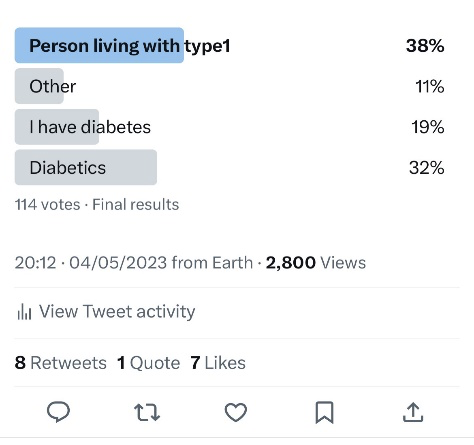
According to a twitter poll on the 4th May, 2023 people with diabetes may address themselves differently to their friends vs when reviewed by health professionals. ( See Poll results) .

What is Diabetes? 

Diabetes is a condition caused when a person’s glucose level becomes elevated and becomes high. There are four types of diabetes: Pre-diabetes, Type 1 diabetes, Type 2 diabetes, and gestational diabetes.  (WHO, 2016). Five million individuals in the United Kingdom have diabetes, according to Diabetes UK, (2023). In the UK, 4.3 million individuals currently have diabetes diagnosis. We are aware that type 2 diabetes makes up around 90% of diagnoses, followed by type 1 diabetes which equates to about 8%, and the other 2% of diagnoses are for different forms of the disease. 

Type One Diabetes occurs when the body fights the cells in the pancreas that produce insulin, and so preventing production of insulin. Everyone needs to have insulin in order to stay alive. Glucose moves around an individual’s blood and enters their cells and gives their bodies energy. This is facilitated by the presence of insulin. When an individual has Type 1 diabetes, their body still breaks down carbohydrates from food and drinks into glucose (sugar). However, when the glucose enters the bloodstream, the lack of insulin means it is unable to enter the body’s cells. Glucose then builds up in your bloodstream (Diabetes UK, 2012). 

Type Two Diabetes is a condition when the pancreas cannot work efficiently to make insulin. The role of the pancreas is to distribute insulin, when this does not occur this causes high glucose levels. In Type Two diabetes, the pancreas can become more tired causing the body to produce less insulin. Type 2 can be managed by lifestyle changes like healthy eating, regular exercise and losing weight (Diabetes UK, 2012). Otherwise, alternative treatment such as medications or insulin may be appropriate.

Other types of diabetes include gestational diabetes, a temporary condition in pregnancy where the mother becomes insulin resistant (WHO, 2016), and ‘pre-diabetes’ which places the individual at higher risk of Type 2 Diabetes (American Diabetes Association, 2011).

Diabetes and Occupational Therapy 

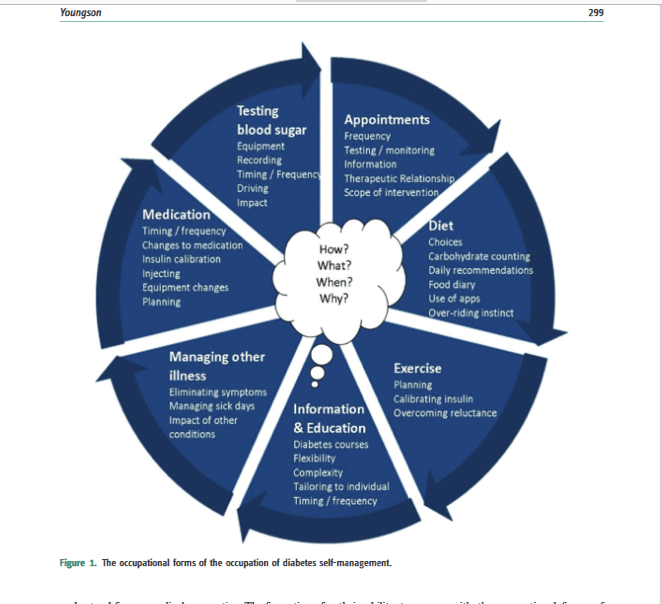
Early studies on OTs and diabetes focuses mostly on the OTs involvement in managing diabetes complications (Hand et al., 2011). The function of OTs in Diabetes Self-Management (DSM), with or without such complications, will be the main topic of this session. By seeing DSM as a profession, it’s becoming clear that the OT can play a major role in enabling and supporting DSM and promoting a fulfilled happy life with diabetes. Exhibited results are presented in Youngson (2019) as a pie chart (p298-300- Please see diagram above). In two additional tables, the results are organised into the MOHO categories of  environment, habit, and performance in a format that is simple to understand. For instance, Youngson (2015, 2019) and Pyatak (2011) both point out a gap in earlier research that has neglected to explore the impact of the OT in assisting control of Diabetes in daily life.  

This is an under-researched area and the role of the OT in diabetes is sparse. However, the main findings are around complications of diabetes. 

Questions 

  1. What are the current roles for occupational therapist in supporting diabetes self – management?
  2. What occupational therapy intervention could be used to support diabetes self-management?
  3. What are the views of health professionals and the potential for occupational therapists to support self-management in people with diabetes?
  4. What does the future of Occupational therapy practice need to support diabetes and OT in practice?
  5. What could be the role of the occupational therapist in support adults in self-management in relation to mental health and diabetes burn out.? 
  6. What is your takeaway from tonight’s chat? What will you share with others about tonight’s chat?

Reference List:

Diabetes UK (2023) Diabetes Week 2023.Available from :https://www.diabetes.org.uk/diabetes-week [ Accessed 16th April 2023]. 

Diabetes UK (2023) Number of People living with diabetes in the UK tops 5 million for the first time. Available from: https://www.diabetes.org.uk/about_us/news/number-people-living-diabetes-uk-tops-5-million-first-time [Accessed 16th April 2023]. 

Hand, C. L., Letts, L. J. and von Zweck, C. M. (2011) ‘An agenda for occupational therapy’s contribution to collaborative chronic disease research’, Canadian Journal of Occupational Therapy, 78(3), pp. 147–155. doi: 10.2182/ciot.2011.78.3.2.

Pyatak, E. (2011) ‘Participation in Occupation and Diabetes Self-Management in Emerging Adulthood’, American Journal of Occupational Therapy, 65(4), pp. 462–469. doi: 10.5014/ajot.2011.001453.

Pyatak, E. et al. (2019) ‘Addressing Diabetes in Primary Care: Hybrid Effectiveness–Implementation Study of Lifestyle Redesign® Occupational Therapy’, American Journal of Occupational Therapy, 73(5), pp. 1–12. doi: 10.5014/ajot.2019.037317.

Tack, C. J. et al. (2018) ‘Glucose Control, Disease Burden, and Educational Gaps in People with Type 1 Diabetes: Exploratory Study of an Integrated Mobile Diabetes App’. doi: 10.2196/diabetes.9531.

Youngson, B. (2019) ‘Understanding diabetes self-management using the Model of Human Occupation’, British Journal of Occupational Therapy, 82(5), pp. 296–305. doi: 10.1177/0308022618820010.