This week Suzy England @RCOT_Suzy from The Royal College of Occupational Therapy is hosting a chat on Digital Literacy and here is what she had to say……
Occupational Therapists practise in an age of ‘information abundance’, and over recent years a growing number of different tools and communication channels have been adopted in practice to record, use, and share information or data. It is not uncommon for occupational therapists to report that “information sits in different places and in different formats” all of which contributes to problems with working efficiently as well as difficulties in sharing information and capturing impact.
In December 2021, RCOT published The RCOT Data and Innovation Strategy (2021-2023) with a vision that:
Every occupational therapist is confident in engaging in a range of activities that use, collect and share data for the purposes of improving health outcomes at the individual, service and population level.
Data intelligence or data literacy is about making sense of different forms of data, so that we can gain meaningful insights and make better decisions in the future.
Little is known about how confident occupational therapists feel working with data at different points in their career and in different roles and contexts. For this reason, this #OTalk chat is one of 6 engagement activities that seeks to better understand the quick wins and larger projects that members identify as being relevant to advances in the professions data literacy skills.
Questions to consider:
What CPD or workplace activities have you engaged in which has improved your data literacy?
What area of data literacy do you most feel you could benefit from learning more about?
Do you think there are benefits to using a smaller subset of uniformed terminology and outcome measures to better evidence our impact?
What activities or projects do you think RCOT should lead on or facilitate to increase the data literacy skills across the profession?
POST CHAT
Host:Suzy England @RCOT_Suzy from The Royal College of Occupational Therapy
Support on OTalk Account: @kirstie_OT (her last)
Evidence your CPD. If you joined in this chat you can download the below transcript as evidence for your CPD, but remember the HCPC are interested in what you have learnt. So why not complete one of our reflection logs to evidence your learning?
The first weeks of January are traditionally a time for turning over a new leaf, ditching bad habits and setting ambitious goals for the coming year. As occupational therapists we are all very aware of the value of goal-setting and reflection, and the New Year presents a unique opportunity for us to pause and consider our hopes and expectations for 2022.
Join #OTalk for one of our first chats of the year (hosted by team member Carolina @colourful_ot), and tell us about your own OT New Year’s Resolutions – whether that’s a commitment to learning something new, changing your practice for the better, or improving your occupational balance!
Questions for tonight’s chat:
Q1. Do you have any professional resolutions for this year? Is there anything you’re hoping to achieve or want to start doing differently?
Q2. Outside of work, have you set yourself any occupation-related resolutions? For example, taking up a new hobby?
Q3. What resources do you think will support you in sticking to your resolutions?
Q4. If you could set a 2022 New Year’s Resolution for the whole OT community – something we should all be aiming for – what would it be?”
When was the last time you actually sat down and wrote a good activity analysis? Feeling out of practise? A student who is currently working on this skill? Very experiences an have some expertise to offer?
This week @OTalk_ team Member @OT_rach will lead the chat in a slightly different manner than normal, we are going to Analysis the activity of engaging in an #OTalk whist engaging in an #OTalk.
What is activity Analysis?
Activity Analysis is the process of breaking down an activity into steps and detailed subparts and examining its components. With each activity being evaluated carefully to determine its therapeutic potential (Creek 2003 cited in Creek and Bullock 2008).
Any activity can be broken down into performance components to analyse the performance skills required as a means of understanding the client’s ability to complete the task or identify areas where the activity can be adapted (Mosey 1986 cited in Creek and Bullock 2008).
To understand activities and occupations to determine their demands, therapeutic potential, skills required to do them and their particular meaning. The thought process contributes to clinical reasoning during interventions and evaluation. With the therapist skill and expertise in analysing activities is critical in setting realistic treatment goals (Hagedorn 2001 cited in Creek and Bullock 2008).
The Questions tweeted on the night will be looking to fill the below in.
Name of activity –
Timing/length of time/number of sessions:
Special features of the environment: (Space and Setting)
Creek, J. and Bullock, A., 2008. Planning and Implentation. In: Creek, J. and Lougher, L., 4th Edition. Occupational Therapy and Mental Health. Edinburgh: Churchill Livingstone, 109 – 131.
Evidence your CPD. If you joined in this chat you can download the below transcript as evidence for your CPD, but remember the HCPC are interested in what you have learnt. So why not complete one of our reflection logs to evidence your learning?https://otalk.co.uk/reflection-logs/
HCPC Standards for CPD.
Maintain a continuous, up-to-date and accurate record of their CPD activities.
Demonstrate that their CPD activities are a mixture of learning activities relevant to current or future practice.
Seek to ensure that their CPD has contributed to the quality of their practice and service delivery.
Seek to ensure that their CPD benefits the service user.
Upon request, present a written profile (which must be their own work and supported by evidence) explaining how they have met the Standards for CPD.
Activity analysis is breaking down of activities to the simplest, a patient will start from the easiest to the more difficult task activity.
A hobby, a social network.
A community of practice,
CPD
An OT brain tickle.
A meaningful activity, My Tuesday night occupation in-front of the tv.
Definitely my new favourite Tuesday night occupation!
Meaningful engagement within the online community
Timing/length of time/number of sessions:
50minutes
1 hour for the session, time before and after to set up twitter, time for reflections after
Time before hand to read blog, download reflection template, participate and time to write up reflection. Time may be longer or shorter depending on familiarity with platform and navigating links
50mins. 10 mins hardcore Tweet (usually ten mins late),
I like to split my time in the hour so I have time for my answers and interacting, engaging with others to broaden my knowledge.
Time to read the blog beforehand and familiarise with topic.
That prep time for occupations is so important, but often ‘hidden’ when I think initially about the ‘doing’!
1 hour… or if you come late 50mins sorry.
Special features of the environment: (Space and Setting)
Physical environment – Internet access, reliable device to tweet from, place to sit comfortably, right level of sensory input e.g lights, noise to allow for concentration to engage in the chat
I like to be alone in my room. But sometimes like to listen to music whilst doing so.
Locality, space for equipment & seating for person (& move around), time to organise and or have space & equipment for the whole #OTalk session/event
Comfy sofa, cup of tea, electronic device, humour
Peace (so alternative room needed for child) , usually in bed… lights dimmed… limited distractions!!
Sofa – my half (Sheldons seat, doesn’t feel right if I sit somewhere else in the house to tweet!). View of tv. View of mobile. View of partner. Warm (fire on, wood chip), near food and hot tea.
Phone battery! Laptop privacy to use. Comfy seat, food and water available and within easy reach.
Relaxing environment away from the distractions of the rest of my household #OTalk
The social media environment. privacy, who can read the posts
Emotional environment that considers awareness of acceptance like participating in a music session with welcoming environment
Emphasising on engaging and shared learning experience. Respect, respect and respect
Remind of house rules
Consciousness of language used, abbreviations and so forth which may restrict understanding of the conversation.
Depends also how individuals use Twitter (or social medial generally), and like to interact (a twitter chat is mostly text based, so might not suit all learning styles eg if visual impairment and using screen reader?)
Ensure content is suitable for young people as they may be in the vicinity. Respect towards all participants whatever their age, gender, culture, beliefs etc
Variety of topics, welcoming, respecting views but not tolerating discrimination or harassment in anyway. Inclusive, open to feedback and change…..
Oooh I like that! Challenging any discrimination we see as well.
Hear far too often we live in a free world and freedom of speech but we need to challenge that of it is hurtful to others
Having respect but also recognising that people are probably at different stages of their learning & experiences so being inclusive eg to students.
Found #otalk to be useful for my learning whilst being a student. Also using inclusive language so no one group is marginalised.
I set an alarm on my phone, I genuinely use my phone and nothing else. However when hosting I’ve used multiple devices, timers, a cool glass of water to help me refocus. There’s all sorts going off!
Phone (with a charged battery) or Laptop (same). Seat, uncluttered
Surroundings, privacy (if possible) for concentration, Other people and the team keeping us on track and reminding us about the # and asking great questions.
Must confess I usually forget or don’t have time to read the blog… but keep an eye out for the talks on Twitter. Usually a case of going with flow!
Its a great examples of an occupation you can engage with at different levels (depending on how you are feeling, everything else going on and the topic etc…)
q5 mobile phone charged or on charger, wifi, read script off website, reflected, brain fed and watered, mindset switched to I’ll give it a go to grow
Equipment, professional conduct, cup of tea. Listening eyes.
I mean, if we’re talking ideal scenario maybe quiet space, appropriate quiet space, pen, notepad, phone or laptop, read the blog. In reality sometimes just a phone
Prepared myself, Charger for my phone as well as my phone, my password for my Twitter account as it often randomly signs me out, The OTtalk team, pre downloaded reflection template, other people engaging in order to support my learning and understanding
Precautions:
Confidentiality, self-care, non judgemental
Like the self care bit… sometimes I feel like I want to engage but don’t know enough or feel good enough. #otalk are generally inclusive and supportive but just mindful that we aren’t all experts in everything
Recognition of it being a public platform and so monitoring communication.
Removal of distractions.
For me, it’s ensuring my little ones are in bed on time to allow me the peace I need to participate!
Sometimes if it’s fast pace I struggle therefore I remind myself to just go at my own pace.
Definitely I used to get really stressed with the speed and not keeping up. Then discovered the art of click “latest” button and chilled/ read in my own time
For me, I need to eat or I’ll not last the hour. Ensure water is available and set alarms to remind me it’s on. Also, have a rest in the afternoon to allow for evening activity.
Incorporating rest time is so important!
Understand social media codes, be in right state (may need to bale if overtired/self care or family member comes first
Ability to take breaks if needed or ‘lurk’ if preferable or as an initial engagement strategy
Performance requirements
Physical demands (sensation, sensory, integration, perception, spatial awareness, co-ordination, balance, fine motor movement, mobility, speed, strength)
#OTalk speed to type and keep up with the conversation, fine motor skills required to type, or if using voice dictation the right environment to allow for dictation software to work. Demands of screen brightness, sensation of typing and if using keyboard the noise from the keys.
Able to hold phone and tweet at same time…. Coordination, movement in thumb…strength to hold phone in hand whilst moving thumb. Vision to see phone. Nb: No balance needed as currently laid with head on a pillow. These of course could be different depending on my needs.
I need to be sat otherwise you’ll have to do a lot of decoding of my typos.
Coordination of keeping up with live chat and remembering your hash tags!
Absolutely agree I often need to pause to remind myself to add the before I press reply
All of the ones you’ve listed! Add in stamina as well and we’re set. I often find quite speedy and my fingers can’t keep up! And alertness in order to meaningfully engage.
Used to think speed type was the only way, have replied days later
Physically to be able to tweet … type in my mobile phone, suppose voice recognition to tweet might be possible?
I think the hand eye coordination and dexterity is the bit I become acutely aware of physically. Can be painful if a particularly busy.
Understanding the format and keeping up with the chats can be quite demanding particularly if you are not familiar with Twitter or how #otalk works.
#otalk definitely need concentration to keep up with chat! Having someone with knowledge is a bonus. Being careful of use of any triggering language
All of the above!! I’m also a person who finds it really difficult to think of questions on the spot so sometimes I want to get involved in a conversation from the thread but don’t know how (probably due to fatigue as well). So I put ‘I agree’ a lot then come back later #OTalk
Multi tasking with a friend on WhatsApp tonight… changing from one to another without loosing track is very hard. I’m very tired tonight too which is having an impact….. #otalk
Amused to think of your friends bemused expression when she receives something meant for this chat
We are talking about my LFT results… (which are still disappointingly positive meaning another 2 days in the house at least)…. Im sure I’m texting and tweeting about how fatigued I feel so I might get away with it
Sorry to hear that. Hope this is a useful distraction #otalk
Semi concentration can multi-task (watch tv), planning (what to say, in what order), knowledge of the topic (by reading #otalk website), reading (everyone’s tweets) , numeracy (checking order of replies, memory (short term what am I doing and why)
Plan the diary time and set an alarm as a reminder. Ability to concentrate reading blog and consider answers or other reading to do before the evening. Ability to focus attention for 1hr on the evening. Ability to ignore drummer upstairs and other distracting noises #OTalk
#otalk receptive communication skills, willing to share experiences, good leadership from #otalk team to keep to time
Following rules such as adding the #OTalk hashtag! Understanding and use of twitter interpersonal communication and how this is different to other communication forms, e.g pressing the
Family demands…. Meeting my sons needs, ensuring hubby puts him to bed….#otalk
The limited characters makes it hard but then also that’s a good thing because we’d be here forever if not! I always have respect for everyone, I’ve learnt to much by lurking. But yes you can feel a bit out of it when you lurk but we can’t all know everything. #OTalk
I enjoy lurking and revisiting when more alert at a later time. Sometimes it’s good to lurk I find. Other times I feel quite engaged and active. #OTalk
All the other bits of communication we miss so have to manage without while still trying to full understand the other person/tweeters (no tone of voice, body language or any of those others clues we often use in our interactions!) #OTalk
Text communications, turn taking, pause before tweet, follow #otalk rules (use the hashtag !)
Ability to communicate thoughts clearly, being open to other’s views and sharing learning. leaving competition at the door. Respecting the #OTalk acd3d3team, Use of the hashtag
and encouraging participation but respecting lurkers as well.
Adding the hashtag, that’s worth a topic to analyse in itself!! How and why DO we still not put it?! Even those taking part for yearsacd3d3
impulse to send response quickly? Inattention? On purpose?! #OTalk
Knowing the ground rules, sharing knowledge and experiences, also interacting with others to gain a deeper level understanding. Good leadership to keep us all on track #otalk
#OTalk confidence in self to engage in chat and trust that it’s a safe, non-judgemental space to do so. Risk taking for voicing thoughts, especially on topics you’re less knowledgeable about.
Frustration when battery runs out but deal! Trusting people online (most I’ve never met), taking risks and putting self out there, accepting I may be wrong at times. Sharing knowledge, trying not to buckle under the speed of it all
#otalk definitely trust, sharing, creativity to think of out of box ideas
And learning to type slowly enough to be what actually in head! Out of the box #otalk
Not being afraid to say you don’t understand something, accepting we are all learning in different ways, it’s not a competition, respectful to each other……. #Otalk
All of the above, (I can feel myself flagging now). A bit one for me taking a step back and reflecting #OTalk
I need to use the reflection sheet for sure after this one. Tomorrow though. #OTalk
Me too! What a absolutely fabulous #OTalk Rach deffo in my top 5!
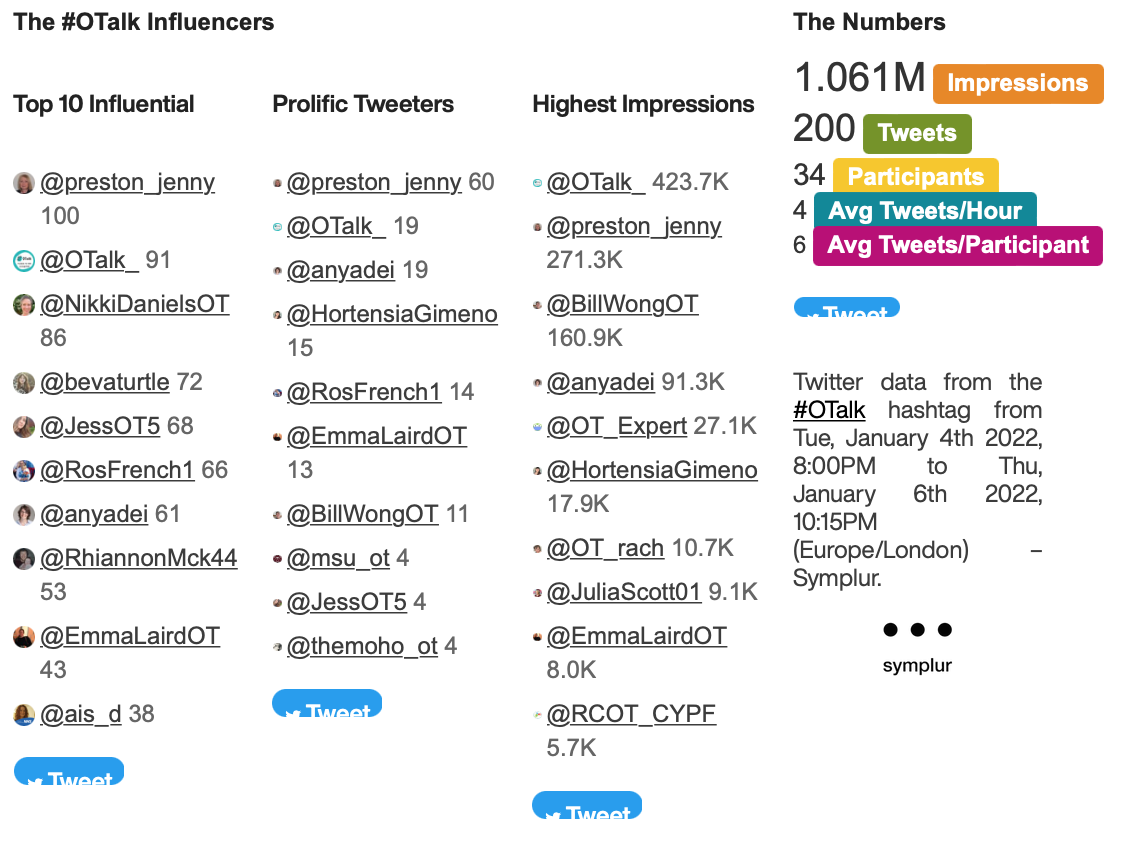
Happy New Year everyone and welcome back to our first #OTalk Research in 2022, this week Hosted by @preston_jenny with @NikkiDanielsOT on the @OTalk_ account Inevitably it’s that time again when we reflect on the previous year and start to plan and set goals for the forthcoming year. Inspired by a keynote address that I delivered last year entitled “Research and Development: that’s not my business” I wanted to bring this discussion to the #OTalk forum for a wider debate and what better time than when we are setting out our resolutions for the year.
During the keynote I challenged whose responsibility is it to create a research culture within an organisation. Of course, it’s obvious, it’s everyone’s business. Yet the evidence tells us that we don’t all share the same level of enthusiasm and excitement for research and development and inevitably we all demonstrate different levels of confidence in our abilities as researchers. We also know that not everyone within health and social care sees research and development as their business. We frequently hear from #OTalk participants who tell us that research and development within their organisations is often reserved for those individuals who have a clearly defined academic role or those who sit within specialist research teams.
In March 2021 the UK Government and the devolved administrations “set out a bold and ambitious vision for the future of clinical research delivery and seeks to make research everyone’s business across health and social care through contributing to the delivery of clinical trials, supporting patients to access the latest research opportunities, or adapting current practices in line with new findings.” Making research everyone’s business relies on the involvement of participants, volunteers and staff who provide day-to-day patient care – whatever clinical speciality they work in and whatever their job is. This can be as simple as talking about a research opportunity, right through to participating in the trial of a new medicine.”
Matus et al in their 2018 systematic review concluded that developing a research culture within an organisation requires “commitment and multi-faceted support from all levels of leadership and management.” The findings of their review further emphasise that in order to build and sustain research engagement, leaders and managers should recognise the benefits of having research-active practitioners in the workforce and consider research to be part of their core business alongside clinical practice.
Commitment to and personal responsibilityfor the subsequent development of research and evaluation skills is clearly defined within the standards of proficiency for each Allied Health Profession as defined by the Health and Care Professions Council (HCPC, 2021). Research and evaluation in occupational therapy practice is also dependent on the active involvement and commitment of managersin promotingandsupporting their staffas research consumers, research participants and career researchers.
Boaz et al (2015) and Harding et al (2017) advocate that health and social care organisations that engage in high quality, person-centred research activity have demonstrated higher rates of patient satisfaction, reduced mortality, improved quality performance, and improved organisational efficiency. At a departmental level, they argue that a strong research culture is associated with reduced staff turnover and faster translation of evidence into practice with potential to improve patient outcomes, patient satisfaction and resource efficiency.
Research skills according to Pighills et al (2013) are generally considered as components within a “research continuum” with evidence-based practice (EBP) skills at one end of the spectrum, progressing to the skills required to conduct research at the other. Matus et al (2018) suggests that building research capacity may be targeted across the three different levels incorporating foundational skills in using research including understanding how to search for, appraise and consciously apply research evidence to inform practice; participating in research through activities such as participant recruitment and data collection; and leading research by developing research protocols and applying for funding.
Successful strategies at an organisational level, according to Borkowski et al (2016) include embedding research activities into strategic plans, visions, missions and values and developing targets or key performance indicators (KPIs) for research. Organisation level strategies also include incorporating research into clinical roles, increasing funding for appropriate backfill of clinical positions, supporting staff with joint clinical and academic appointments and creating opportunities to engage in research through secondment (Matus et al, 2018).
Similarly, Matus et al (2018) found that academic-practice partnerships were reported as an important strategy for increasing research capacity, engagement and output. This was further supported by Slade et al (2018) who found that collaborations between healthcare practice settings and academic institutes such as universities were perceived to have impact at an organisational level. Collaboration with universities and employing research facilitators within the healthcare service to provide guidance and support were identified by Hilder et al (2020) as emergent strategies for addressing some of the barriers to research engagement.
For anyone seeking to develop their research skills the RCOT Career Development Framework outlines the skills set required for nine levels within the Evidence, Research and Development pillar of practice. This is a really helpful framework enabling us to establish our current level of skill while identifying some very practical tasks and skills to further our learning.
During this discussion we intend to focus on your personal plans for developing your research skills in 2022 while considering how this impacts on your wider organisation. In order to support and challenge your thinking the chat will focus on the following questions:
Do you discuss and set research goals within your annual performance review?
Do you intend to set personal research goals for 2022?
What might these goals look like?
How likely are you to access a goal setting framework e.g. SMART goals (other frameworks are available)?
What tools do you use to monitor and manage your performance against your goals?
References
Boaz A, Hanney S, Jones T, Soper B (2015). Does the engagement of clinicians and organisations in research improve healthcare performance: a three-stage review. BMJ Open. 5(12):e009415
Borkowski D, McKinstry C, Cotchett M, Williams C, Haines T. Researchculture in allied health: a systematic review. Aust J Prim Health. 2016;22(4):294–303.
Harding KE, Porter J, Horne-Thompson A, Donley E, Taylor NF (2014). Not enough time or a low priority? Barriers to evidence-based practice for allied health clinicians. J Contin Educ Heal Prof. 34(4):224–31. https://doi.org/10.1002/chp.21255
Matus, J; Walker, A; Mickan, S (2018) Research capacity building frameworks for allied health professionals – a systematic review. BMC Health Services 18:716-727. https://doi.org/10.1186/s12913-018-3518-7
Pighills AC, Plummer D, Harvey D, Pain T (2013) Positioning occupational therapy as a discipline on the research continuum: results of a cross sectional survey of research experience. Aust Occup Ther J. 60(4): 241–51.
RCOT Career Development Framework: Second Edition (2021)
Evidence your CPD. If you joined in this chat you can download the below transcript as evidence for your CPD, but remember the HCPC are interested in what you have learnt. So why not complete one of our reflection logs to evidence your learning?
The holidays are a joyous time – take some time out to indulge yourself in occupations that make you feel happy and stress-free. We wishs you all happiness, and blessings!
We just want to say thank you for all your ongoing support and engagement, over the past ten years, We are taking a break and will be back in the New Year on Tuesday 3rd January with an #OTalk Research.
The last two years have been some of the most challenging, but also some amazing innovations and ideas have come out of the darkness. We are so blessed to have been a part of that, and love seeing the profession grow and grow.




 OTalk
OTalk 