OTalk

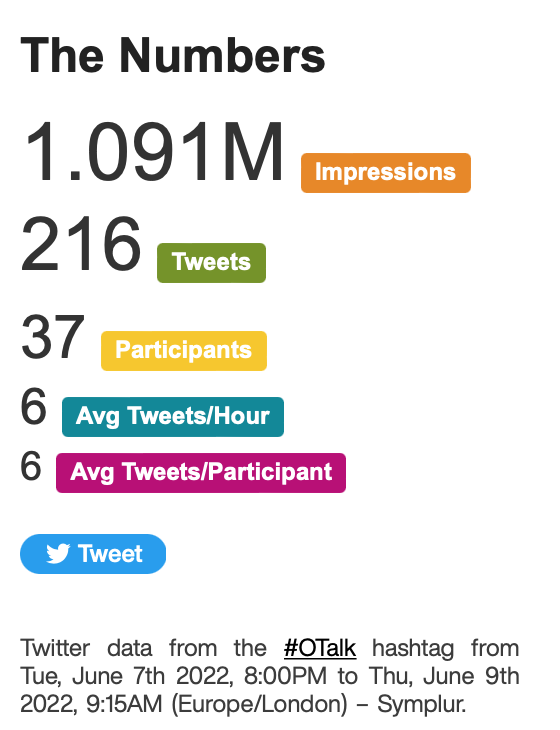
#OTalk Research Chat- Tuesday 7th June 2022 – Evidencing research engagement as a clinical practitioner

This #OTalk Research Chat will be hosted by @preston_jenny with @NikkiDanielsOT on the account 

Many of our #OTalk Research chats have focussed on the challenges of engaging with research and  development (R&D) as a clinical practitioner when there is no explicit research component within our roles or titles, and no dedicated time, resources or support made available. The barriers to  research engagement for occupational therapy clinicians are well documented. Yet the HCPC  requires that all registered practitioners are able to demonstrate the safe delivery of evidence based  practice. With the increasing requirement for occupational therapists to deliver safe and effective  care along with unprecedented demands on our resources this arguably presents an even greater  need for occupational therapists to be able to demonstrate confidence and competence in their  research skills as part of their core business alongside clinical practice. Occupational therapists have  shown no end of innovation during the last two years but how are we acknowledging, sharing and  disseminating this new knowledge? 

So how do we demonstrate that we use a wide range of research skills within clinical practice? I  was recently invited to address a group of clinical occupational therapists about their role in  research, development and innovation within practice. This initially felt like quite a daunting task as  I fully appreciate the demands of clinical practice and the apparent lack of time to fit anything else  into your working week. So I began to think about research, development and innovation within the  context of the four pillars of practice, nothing unusual there you might say, and rightly so!  

However as I began to explore the specific HCPC criteria within the context of the four pillars of  practice it quickly became apparent to me that as clinical practitioners we are accessing evidence  and developing knowledge routinely throughout our work. I was very positively encouraged by this  concept as I started to build on it. I subsequently chose to apply the HCPC requirements within the  following framework: 

Clinical Practice 

• 12.1 be able to engage in evidence-based practice, evaluate practice systematically and  participate in audit procedures 

• 12.6 be able to evaluate intervention plans using recognised outcome measures and revise  the plans as necessary in conjunction with the service user 

• 14.22 recognise the value of research to the critical evaluation of practice • E2.1 know the importance of evidence and research to deliver safe and effective services

Facilitating Learning 

• 14.13 be able to use research, reasoning and problem solving skills to determine  appropriate actions 

• 14.24 be able to evaluate research and other evidence to inform their own practice 

• E2.2 constructively question own and others’ practice to create opportunities to generate  new knowledge 

Leadership 

• 12.2 be able to gather information, including qualitative and quantitative data, that helps to  evaluate the responses of service users to their care 

• 12.3 be aware of the role of audit and review in quality management, including quality  control, quality assurance and the use of appropriate outcome measures 

• 12.4 be able to maintain an effective audit trail and work towards continual improvement 

• 12.5 be aware of, and be able to participate in, quality assurance programmes, where  appropriate 

Evidence, Research and Development 

• 14.11 be able to analyse and critically evaluate the information collected 

• 13.7 be aware of the principles and applications of scientific enquiry, including the  evaluation of treatment efficacy and the research process 

• 14.23 be aware of a range of research methodologies 

Feedback from the presentation about the use of this approach was very encouraging and I’m keen  to explore this further within the chat. I would be interested in understanding if this is something  that would be helpful for you in your own situation. Have you considered research, development  and innovation within this context in relation to your own role? Are you like me and didn’t even  realise that we do most of these things without even noticing that this level of thinking and critical  reflection is taking place? And how many of you are contributing to the development of new  knowledge without any sharing or dissemination?  

Lots of questions as always for our discussion. However in order to keep it focussed on the night  here are some questions that you may wish to consider in advance of the chat: 

1. Do you consider research, development and innovation to be part of your core business within your current role?

2. When considering this framework, does it impact on how you think about research,  development and innovation in relation to your role? 

3. Is this there anything that you might find helpful about this framework within the context of  your own practice? 

4. If you were required to submit your evidence to the HCPC, how would you evidence your  contribution to the evidence, research and development pillar? 

5. What would enable you to feel that research, development and innovation is core business? 

6. Are there any topics that we could discuss in future #OTalk Research chats that might help  with these challenges?

POST CHAT

Host:   @preston_jenny

Support on OTalk Account:  @NikkiDanielsOT

Evidence your CPD. If you joined in this chat you can download the below transcript as evidence for your CPD, but remember the HCPC are interested in what you have learnt.  So why not complete one of our reflection logs to evidence your learning?

HCPC Standards for CPD.

  • Maintain a continuous, up-to-date and accurate record of their CPD activities.
  • Demonstrate that their CPD activities are a mixture of learning activities relevant to current or future practice.
  • Seek to ensure that their CPD has contributed to the quality of their practice and service delivery.
  • Seek to ensure that their CPD benefits the service user.
  • Upon request, present a written profile (which must be their own work and supported by evidence) explaining how they have met the Standards for CPD.
OTalk

#OTalk Tuesday 31st May 2022 – Getting the best out of a virtual conference.

Conference season is upon us once again, however not all conferences have returned to physical events, some adopting a hybrid model whilst others have retained the virtual model.

With such a range of offerings it can be difficult to decide which to attend? What offers the most value for money? Is travel and being away from home not possible? Is the conference only available virtually? Whatever the reason many people will be attending virtual conferences this coming year… and beyond.

To prepare us for this developing style of conference this chat will look to explore the communities’ experiences, garner resources and share ways we can “get the best out of virtual conferences”. As a UK based chat, many of the community may also be attending #RCOT2022 which is a fully virtual conference.

We thought an old school #OTalkTeaParty would be a good idea, so grab a slice of cake and a cuppa….. (other treats and drinks are permissible)

Some tips found on Twitter to get the thoughts flowing:

Do check out the replies to these tweets too.

Before we get to it, feel free to share you #OTalkTeaParty treats of choice.

Questions: (Subject to change if requested)

  1. Are you planning on attending any virtual conferences in 2022?
  2. How many virtual conferences have you attended before?
  3. What did you find most beneficial from attending a virtual conference?
  4. What did you find least beneficial form attending a virtual conference?
  5. What is your top tip for attending a virtual conference?
  6. Do you have any tools that you have found useful when attending a virtual conference?
  7. and finally…. do you have any further questions you would like posing to the chat?

We look forward to chatting all things virtual conference with the community…

If you have any questions you would like including do tweet us @OTalk_

POST CHAT

Host:  Helen @helenotuk

Support on OTalk Account: Rachel @OT_rach

Evidence your CPD. If you joined in this chat you can download the below transcript as evidence for your CPD, but remember the HCPC are interested in what you have learnt.  So why not complete one of our reflection logs to evidence your learning?

HCPC Standards for CPD.

  • Maintain a continuous, up-to-date and accurate record of their CPD activities.
  • Demonstrate that their CPD activities are a mixture of learning activities relevant to current or future practice.
  • Seek to ensure that their CPD has contributed to the quality of their practice and service delivery.
  • Seek to ensure that their CPD benefits the service user.
  • Upon request, present a written profile (which must be their own work and supported by evidence) explaining how they have met the Standards for CPD.
OTalk

#OTalk – Tuesday 24th May 2022 – World Schizophrenia Day: How You Can Spread Awareness

This #OTalk is hosted by Ruth Hawley

24th May is World Schizophrenia Day.

Psychosis and schizophrenia are mental health problems that affect how a person thinks, feels and behaves. They can make it hard for the person to think clearly and tell the difference between what’s real and what’s not. The person may act differently or lose interest in things and other people.

The main symptoms are called ‘psychotic’ symptoms. These are:

  • hearing voices and sometimes seeing things that are not really there (called a hallucination)
  • believing that something is real or true when it is not (called a delusion); such as, believing they are being watched or having their thoughts monitored.

NICE (2014) defines psychosis and schizophrenia as a major psychiatric disorder (or cluster of disorders) that alters a person’s perception, thoughts, mood and behaviour recognising that each person will have a unique combination of symptoms and experiences.

Schizophrenia Awareness Day is practiced on a global scale to break down the stigma and prejudice that affect individuals with these experiences.

Questions that will be discussed during the #OTalk are:

1. What’s your awareness of schizophrenia/ psychosis? And where has this come from?

2. Can you share any good educational resources that you aware of in relation to schizophrenia or psychosis?

3. Do you think people with schizophrenia/ psychosis experience any stigma?  Does choice of language used influence this?

4. How could you/ have you challenged stigma about schizophrenia/ psychosis?

5. What role do you think social media plays or could play in awareness around schizophrenia/psychosis?

NICE (2014) Psychosis and schizophrenia in adults: prevention and management.  Available at: https://www.nice.org.uk/guidance/cg178/resources/psychosis-and-schizophrenia-in-adults-prevention-and-management-pdf-35109758952133 (Accessed 20th April 2022)

Post Chat

Host:  Ruth Hawley

Support on OTalk Account: @HelenOTUK

Evidence your CPD. If you joined in this chat you can download the below transcript as evidence for your CPD, but remember the HCPC are interested in what you have learnt.  So why not complete one of our reflection logs to evidence your learning?

HCPC Standards for CPD.

  • Maintain a continuous, up-to-date and accurate record of their CPD activities.
  • Demonstrate that their CPD activities are a mixture of learning activities relevant to current or future practice.
  • Seek to ensure that their CPD has contributed to the quality of their practice and service delivery.
  • Seek to ensure that their CPD benefits the service user.
  • Upon request, present a written profile (which must be their own work and supported by evidence) explaining how they have met the Standards for CPD.

OTalk

#OTalk – Tuesday 17th May 2022 – Stabilising the flaky bridge of transition for newly qualified professionals

Tonight’s #OTalk will be hosted by:

Dr Lisa Taylor (@drlisataylor) – Associate Professor in Occupational Therapy School of Health Sciences and Associate Dean in Employability Faculty of Medicine and Health, University of East Anglia Norwich. Lisa has a passion for employability with student transitions being a key part of UEA’s employability strategy.

Ruth Laws (@ruth_laws)– recent MSc preregistration graduate from UEA – now working as a band 5 occupational therapist within Suffolk. Whilst at UEA Ruth completed her MSc dissertation on student transitions, supervised by Lisa. Ruth has presented her work at an international conference, and then completed her elective placement with the Health Education England (HEE) Reducing Pre-registration Attrition and Improving Retention (RePAIR) team, having developed a keen interest in the transition from student to newly qualified practitioner.

Lisa and Ruth have a shared interest and passion in graduate transitions and how to make the flaky bridge of transition more stable!

The transition from student to newly qualified professional can be challenging, and is a period reported and explored withing the HEE RePAIR project, being described as the flaky bridge. In recognition of the difficulties newly qualified occupational therapists (NQOTs) face, the Elizabeth Casson Trust funded the project Year 1: Thriving not Surviving to develop a series of resources to support NQOTs. Preceptorship programmes have also been developed by many organisations with the aim to support graduates in their transitions. However, as Ruth found out in her dissertation, these programmes can have a dual impact. The programmes can provide both positive and negative contributions to the transition from student to NQOT, including aiding professional development and fostering a supported, structured environment, but also being confusing, complicated, frustrating, and stressful.

We would like to use our #OTalk to explore the experiences of the flaky bridge from all perspectives tonight for a rich discussion. We would love contributions from all health and social care professions, including students, HEI academics, careers and employability staff, recent graduates, clinicians, employers and statutory bodies and policy makers. We have put together a series of questions to capture the main considerations, offering insights as to how we can help stabilise the transition from student to graduate health care professional. We hope that you will join in this important conversation.

  1. What do students, higher education institutes and employers need to know and be prepared for, to aid graduate transition into the workplace?
  2. Based on your experiences, what resources, support, and advice has helped graduates transition into the workplace?
  3. How could placement-based learning experiences better prepare students for the transition into the workplace?
  4. What experiences do you have of preceptorship? How can this experience be maximised for all involved?
  5. How could an online peer assisted cross-professional support network/community for new graduates work in conjunction with the more formal individual preceptor packages?

Relevant resources

POST CHAT

Host:  Dr Lisa Taylor (@drlisataylor) Ruth Laws (@ruth_laws)

Support on OTalk Account: Sam Pywell (@smileyfacehalo)

Evidence your CPD. If you joined in this chat you can download the below transcript as evidence for your CPD, but remember the HCPC are interested in what you have learnt.  So why not complete one of our reflection logs to evidence your learning?

HCPC Standards for CPD.

  • Maintain a continuous, up-to-date and accurate record of their CPD activities.
  • Demonstrate that their CPD activities are a mixture of learning activities relevant to current or future practice.
  • Seek to ensure that their CPD has contributed to the quality of their practice and service delivery.
  • Seek to ensure that their CPD benefits the service user.
  • Upon request, present a written profile (which must be their own work and supported by evidence) explaining how they have met the Standards for CPD.
OTalk

OTalk 10th May 2022 – The impact of Covid 19 on Occupational Balance. Hosted by @SharonOTUClan

This chat will be hosted by Sharon Hardman (@SharonOTUClan) 

The global Coronavirus pandemic, starting March 2020, had significant impacts on pre-registration Occupational Therapy (OT) students.  OT literature highlighted that occupational balance is an important concept in OT professional training.  Despite this, there is a paucity of research exploring occupational balance in pre-registration OT students.  As part of my research module I conducted primary research on the impact of the Covid-19 pandemic on the occupational balance of MSc and BSc pre registration students in England.  The purpose of this research was to address the gap in the literature by exploring the impact of the Coronavirus pandemic on the occupational balance of undergraduate and post graduate pre-registration OT students in England. 

Key findings of this research were: 

●Occupational Therapy students had mixed experience of occupational balance during the Covid-19 pandemic, with online learning improving occupational balance. 

● Occupational deprivation experiences in Covid-19 Pandemic consolidated learning on occupational balance concepts and provided valuable insights in the ability to relate to clients for Occupational Therapy students.

● Occupational Therapy students recognised their identity was conjoined with occupations.  Identity was classified as the same during the Covid- 19 Pandemic, even when Occupational Therapy students were not actively participating in meaningful occupations.

Fundamental connections between lived experience of the Covid-19 pandemic and skills as an OT were shown as the crucial missing piece of the puzzle in occupational balance concepts, not evident in the literature.

I wanted to create an #OTalk that disseminated my findings and promoted further discussion in this area.

The questions that I would like you to consider are:

  1. Despite the long history of occupational balance, Wagman et al. (2012) found it remains an abstract and evolving concept that can be misunderstood compared to more concrete and observable OT theories.  What is your understanding of occupational balance?
  1. What matters to you in meaningful occupation?
  1. What was your experience of occupational balance during the Covid-19 pandemic?
  1. What strategies do you use to address occupational balance?
  1. How did being on placement/working during the Covid-19 pandemic influence your professional development?

Post Chat

Host:  Sharon Hardman (@SharonOTUClan)

Support on OTalk Account: @PaulWilkinson94

Evidence your CPD. If you joined in this chat you can download the below transcript as evidence for your CPD, but remember the HCPC are interested in what you have learnt.  So why not complete one of our reflection logs to evidence your learning?

HCPC Standards for CPD.

  • Maintain a continuous, up-to-date and accurate record of their CPD activities.
  • Demonstrate that their CPD activities are a mixture of learning activities relevant to current or future practice.
  • Seek to ensure that their CPD has contributed to the quality of their practice and service delivery.
  • Seek to ensure that their CPD benefits the service user.
  • Upon request, present a written profile (which must be their own work and supported by evidence) explaining how they have met the Standards for CPD.