Blog Posts

#BlogSquad2018, OTalk

RCOT 2018 Blog 4. Network Meeting: The Elizabeth Casson Trust: Professional Leadership Programme – what’s next?

This inspiring fringe event hosted by Sally Townsend and Cat Evans, Trustees at the Elizabeth Casson Trust, focused on the Trust’s commitment to support the development of leadership capacity within occupational therapy through awards available as part of its Leadership Project.

The Elizabeth Casson Trust aims to ‘advance the occupational therapy profession by supporting the development of occupational therapists’ primarily through its funding opportunities. One of the Trust’s three strategic intentions is to ‘help develop leaders in occupational therapy with the capability of taking the profession forwards within the context it needs to operate’.

The Leadership Project, launched in February 2018, enables occupational therapists to apply for up to £10,000 to develop their leadership skills. When applying for the award applicants are required to describe how they will lead and deliver on a project that addresses leadership challenges, and how they plan to develop leadership skills to achieve the required changes.

Sally talked compellingly about research undertaken by Caroline Waters (HR consultant) which informed the development of the Leadership Project. She identified that the overwhelming theme from the research was that occupational therapists lack confidence in their leadership abilities. She went on to highlight that the Trust’s Leadership Programme launched in February 2018 aims to redress skill deficits by providing opportunities to enable all occupational therapy staff, from support assistants to senior management, to develop the requisite behaviours and skills to perform as leaders.

Sally explained that the Elizabeth Casson Trust is collaborating closely with the Royal College of Occupational Therapists to develop occupational therapy leaders so that each organisation can complement the other with the support that it offers to therapists.

Karin Ormin RCOT Lead Professional Advisor attended the session. She highlighted the RCOT vision for ‘all members to recognise themselves as leaders and act as leaders, sharing a vision of occupational therapy and its value within their service’. She highlighted that traditionally occupational therapists have excelled in enabling others and consequently ‘follow behind’ the enabled person rather than perform as leaders.

She went on to urge occupational therapists to raise their heads above the parapet and be proud and vocal about their leadership attributes. Together Sally and Karin concurred that a cultural shift is gathering momentum within the profession as occupational therapists are being challenged to individually and collectively recognise themselves as leaders in order to move the profession forward.

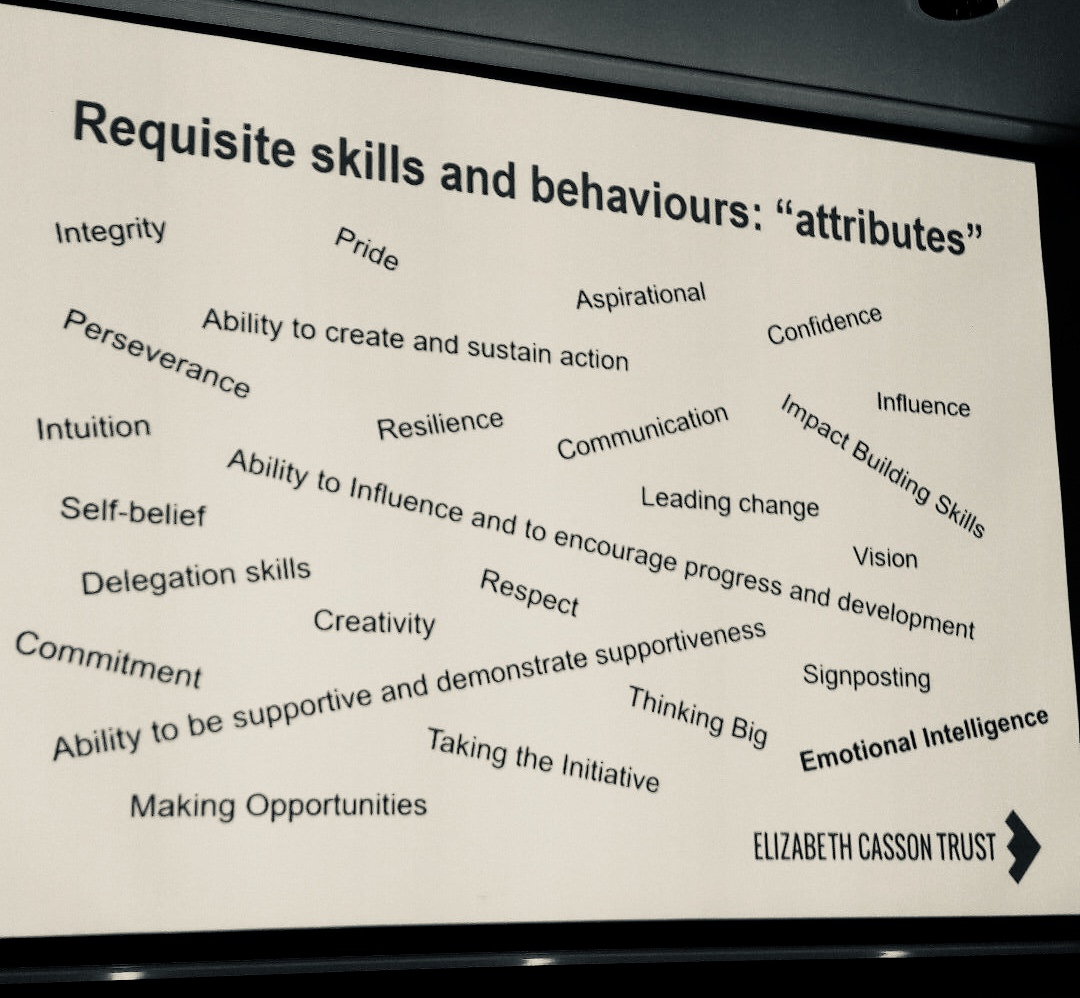
I was motivated to attend this session as I am passionate about developing research leadership and research capacity within occupational therapy and I’m seeking out opportunities to achieve this aim. I recently completed an HEE/NIHR Internship award and am co-presenting at Belfast this year about the clinical academic pathway as an approach to increasing research leadership in occupational therapy. This slide has particular resonance to me as it reflects many of the qualities I must foster within my plans to become established as a clinical academic.  If we are to succeed as leaders we must develop essential skills such as confidence, resilience and tenacity.
IMG_0053

If you are interested in the opportunities offered by the Leadership Project and wish to apply you will need to attend the next Leadership Project Event held by the Trust on 3rdOctober 2018 in preparation for developing your proposal for submission by 2ndJanuary 2019.  Feedback regarding the success of your bid is given by the end of February 2019 and you will be ready to commence your project in March 2019.

For those seeking to apply Sally stressed the importance of giving consideration to the impact of your project and to consider how your proposal aligns with and could influence your organisational strategic aims. Sally went to advocate that occupational therapists seize opportunities to network with key decision makers and be proactive in creating opportunities to promote the occupational therapy profession. For occupational therapists intent on building their skills as leaders this is an invaluable opportunity to secure funding to evolve as a leader. What’s to stop you from applying?

More information about the Leadership Project and opportunities offered by the Elizabeth Casson Trust can be found at https://elizabethcasson.org.uk/

Written by Faye Dunford @FayeDunford
 

#BlogSquad2018, OTalk

RCOT 2018 Blog 3 Sess. 21: 21st Century meaningful activity – Using social media as a way to engage.

Led by members of the #OTalk team – Rachel Booth, Kirstie Hughes, Kelly Murray and Helen Rushton.

Session aims:

  • To explore how to use Twitter, Pinterest, Instagram and Facebook social media platforms for professional means.
  • To discuss how to use social media as a therapeutic intervention with service users

We all know that social media is huge – not just with the younger generation but with all generations. Never have we been more connected to each other all over the world or able to gain information in an instance. But do we use it in our professional lives? And if we do, are we using it properly, and in an engaging way that benefits both us for CPD activity and our service users as a therapeutic intervention?

One way in which Occupational Therapists are using social media is for CPD. At 8pm every Tuesday on Twitter #OTalk happens. There is a weekly topic and questions for people to respond and contribute towards. They are all volunteers who run the group chat and their aim is to support the profession and all OTs with their personal development in a free and informal way.

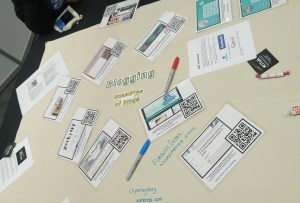
In this Occupation Station session we were given 7 minutes to move around 4 social media tables:

DSC_1564


Table 1: Twitter:
How to use it professionally and personally – a quick guide for non-Twitter users.
For those who use Twitter they shared the hashtags they follow for work and play. It’s also the first place to see when new research, publications and initiative get released.

Table 2: Pinterest and Instagram
On this table there was a discussion of how Pinterest can be used for collating ideas for interventions and session as well as using it with service users as a therapeutic intervention. For Instagram it is a photo based social media, a great way of promoting activities in Occupational Therapy or for service users to explore their occupations through photography in a 21st century way.

Table 3: Facebook
Many of use have Facebook for personal use. The key message for this table was to utilise the 4OT Groups (e.g. OT4OT, CPD4OT, MH4OT) for networking and learning and if you wish to use Facebook for promoting professional practice then create a Page. A take home message for Facebook was to check your security settings regularly as the change.

DSC_1570Table 4: Blogs

Blogs are online journals and they can be found on all manner of topics. Many healthcare professionals and Occupational Therapists use them to reflect on clinical practice, discuss and share interventions and log CPD activity- like this conference! But you can also find a variety of blogs from service users, these are valuable for professionals and services users to learn from and have a greater awareness of other people’s experiences. There are a few different platforms in which to write a blog e.g. Blogger and WordPress, and it is a case of have a go and see which you like and suit your style.

As a final note it is important to check your Trusts / workplace policies on use of social media and have a look at the HCPC, RCOT guidance on social media and the dos and don’ts!

Blog written by Catherine Gray, @CupOTservice @CGray_OT

OTalk

RCOT 2018 Blog 2. S11.1 Feminism & occupational therapy- question, debate and reflect

It was a surprise yesterday, on arriving in Belfast for #RCOT2018 to see women dressed as Suffragettes on the streets of the city. It turns out the date of this year’s conference co-insides with the 100-year anniversary of women getting the vote, and marches were held in capital cities across the UK. This was reported in the national press but busy with my preparations for the conference I was totally unaware. As well as a pleasure to observe it was also a timely reminder of the rights we perhaps nowadays take for granted that were secured for us by feminist movements of the past.

FullSizeRender

The question of what links can be made between feminism and the occupational therapy profession was the focus of Heather Davidson’s presentation. The session started with the questions ‘What can feminism offer occupational therapy?’ and ‘Why is feminism important to you?’ The audience were asked to contribute their answers live through their mobile devices using software which enabled digital audience participation. The answers were then displayed in a word cloud on the screen; the picture below displays the audience’s answers from today.

IMG_3358

In preparation for this presentation I had already reflected on how feminism is important for me, and the service users I support. I work as an occupational therapist on a community team for adults with intellectual disabilities and I am (sadly) familiar with the disparity between health outcomes for this client group and the general population. What I wasn’t really prepared for was the shocking gender bias in health outcomes illustrated by statistics released by the NHS last year (see https://digital.nhs.uk/data-and-information/publications/statistical/health-and-care-of-people-with-learning-disabilities/health-and-care-of-people-with-learning-disabilities-experimental-statistics-2016-to-2017)

These suggest that while men with intellectual disabilities die 14 years earlier than the general population, on average women with intellectual disabilities die approximately 18 years earlier than women in the general population. As women without an intellectual disability generally outlive men this suggests that there may be some pre-disposing factors behind these figures that relate to gender discrimination, and one which perhaps an overtly feminist approach to the delivery of health care for women with intellectual disabilities could mitigate. So I was motivated to understand more about feminism and occupational therapy practice from this seminar, and I wasn’t disappointed.

As the seminar progressed the audience were guided through a tour of the ‘waves’ of feminism from the last century, how these relate to the development of occupational therapy, and also how there are many varied (and sometimes contradictory) perspectives on feminism and female power, (for a very contemporaneous example of this type ‘Germaine Greer and Beyoncé’ into Google). Differing schools of feminist ideology were discussed, and the point was highlighted from the audience that men can be and often are, feminist too.  In fact some would argue that anyone who believes in equality between men and women is essentially a feminist.

Herein lies the crux of the discussion in while there are inherent links between occupational therapy philosophy and feminist ideology, such as a fundamental belief in equality and a focus on power dynamics in client centred practice, it was suggested there might be a wider reluctance to connect the label of ‘feminist’ with occupational therapy.

However, statistics in the presentation suggested that the profession is currently 90% women, and occupational therapy students are currently 90% women so matters that affect women’s rights (such as equal pay) are by their nature inherently feminist.

I found it brilliantly refreshing to hear perspectives that position the NHS as essentially a patriarchal system being discussed, even if ones personal views may differ from this it is still exciting to have these ideas raised at the national conference. There was enthusiasm from the audience to continue the discussion further, and the presenter asked for people interested to get in touch, her contact details shared at the end of the presentation are H.Davidson@salford.ac.ukor on twitter at @TheLoft_connect. ‘Loft’ stands for leadership. feminism and occupational therapy  – what’s not to like?

Written by Elspeth Clark @Els_OT

OTalk

RCOT2018 Blog 1. Opening Plenary: Chris Pointon – “#Hellomynameis…”

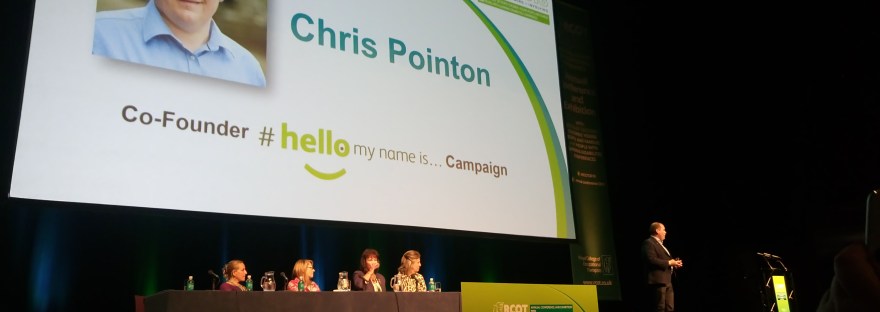
Chris Pointon is co-founder of the #hellomynameis… campaign.  He started the plenary session with a motto: “Through adversity comes legacy”. Speaking about his late wife, Kate, he continued to challenge the audience to ask themselves three questions:

  1. What is important to you in terms of your life plans? This may be where you see yourself in the next 5, 10 years.
  2. What date is important in your life? (marriage, birth of a child, the day you became an Occupational Therapist)
  3. What legacy do you want to leave in the world?

Chris described how he met Kate when she was studying medicine and how they knew they were going to spend the rest of their lives together, they were soul mates.

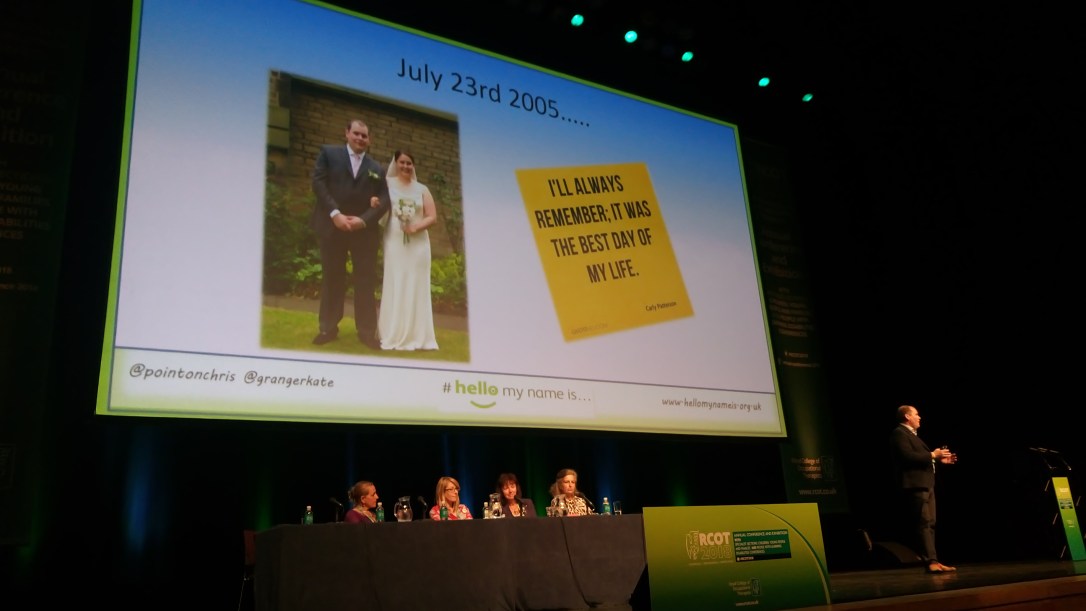
DSC_3306“July 23rd 2005 is the most important day of my life. This was the date that we got married. Our life plans were:
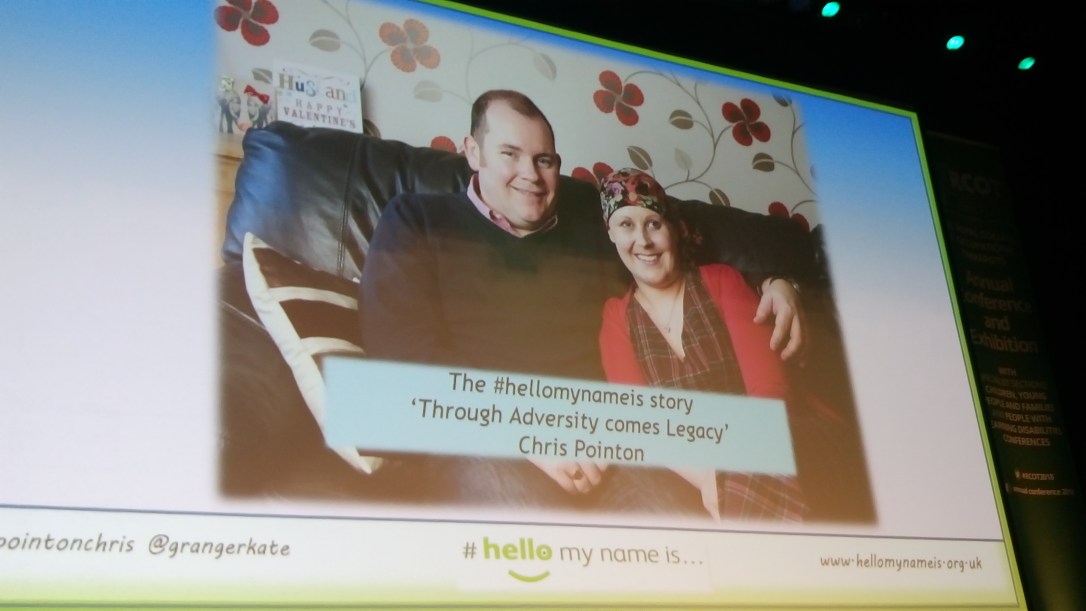
  1. Travelling
  2. To have a family
  3. Our careers”

However at just 29 years of age Kate was diagnosed with terminal cancer. Their saying was “Play the cards in life that we’ve been dealt”.  Chris was not from a healthcare background, but from being with Kate, her job as an older person’s Physician and her illness thrust him into the healthcare world. They felt that they just had to deal with and play their cards the best and most positively as they could.

Christ spoke at length about the stages of Kate’s illness and the healthcare professionals and treatment they received along the way, as well as Kate’s extensive bucket list and achievements. Kate wanted to be seen as a person who had made a difference, not the person who died young of cancer.  Chris played a video of Kate speaking about her core values:

  1. Communication – bad communication can do so much harm. Kate spoke about two very different experiences she had of healthcare workers giving her diagnoses, the first was a junior doctor who she had not met before. “He said “Hello my name is…” then looked away and didn’t ask if I wanted anyone with me. And then said “your cancer has spread” then just left. I never saw him again. I’m psychologically scarred by this”. We break news to people every day and we really need to think about how we do this. Her Oncologist on the other hand, when he have her the final diagnosis, held her hand, sat on edge of bed, sat with her in silence as it sank in. Although this was more devastating news, it wasn’t as traumatic.
  2. The little things – makes the difference between a good experience and a bad experience. “Holding my hand, sitting next to me, introduce themself. Listening to my fears and anxieties. He recognised how scared and anxious I was.   The Registrar, refused to sit down the next day, instead stood looming over and making me feel small and less in control.”
  3. Person centred care – this is banded around NHS care and management but what does it really mean?

As Kate’s journey continued she met many healthcare professionals who often failed to introduce themselves, even when taking her blood and carrying out observations.  Kate and Chris then met Brian who was a porter, he introduced himself and chatted about cricket to try and calm Kate before going down to theatre. After some reflecting that evening on the 30th Aug 2013 #hellomynameis… was born.

It is a common courtesy to introduce yourself by name, for it to be delivered with a smile and to be warm, welcoming and genuine.

DSC_3305The #hellomynameis campaign took off all over the world.  This is where Kate started to talk about her own legacy.  “If I was to die today then I know I have made a difference and left a legacy”.  Introducing yourself by name takes little time to do, it costs little money and it makes a huge difference to patient care.

On the 23rd July 2016 it was Kate and Chris’ 11th wedding anniversary – Kate passed away on this afternoon. Chris spoke about how she was in control to the end, of her destiny and passed away almost to the minute that they said their vows.  Pain free and at peace.

Chris is currently on a global tour with the campaign and carrying on Kate’s legacy.

To find out more about the #Hellomynameis… campaign visit:

www.hellomynameis.org.uk

Twitter: @pointonchris, @grangerkate

Blog post written by Catherine Gray @CupOTServices

OTalk

OTalk’s Occupation Station #RCOT2018

21st Century Meaningful Activity – Using Social Media to Engage.

This year the OTalk team hosted a occupation station, on Tuesday 12th June, at the Royal College of Occupational Therapist annual conference in Belfast.

The Aim of the session was to explore the use of the Twitter, Pinterest, Instagram, Facebook and Blogging platforms for professional and therapeutic means.

We did this by inviting partisapants to engage in a social media speed dating exercise with 7 minutes per platform. Ending with a reflecting on why we use social media and reminding use to ensure our use is in line with our codes of conduct.

Below are resources we used during the occupation station.

Blogging as an Occupation

Using Image Based Apps as Occupation

Using Twitter as an Occupation – CPD from Sofa Poster

Attitudes to using social media for CPD Poster

IMG_2650

If you have any questions or queries, get in touch and we’ll do our best to answer them.