Blog Posts

#BlogSquad2018, OTalk

RCOT 2018 Blog 9 Sess. 29 Evidence Based Practice and National Guideline Development. Do the National Institute of Care and Excellence (NICE) guidelines provide Therapists with meaningful evidence for practice?

This thought provoking seminar was hosted by Dee Christie who is a retired occupational therapist and a current NICE Fellow. It explored the presenter’s experiences of chairing the NICE guideline committee on Intermediate Care and the challenges of incorporating guidelines into practice. I was motivated to attend in order to develop my understanding of how NICE guidelines are produced, and have the opportunity to discuss strategies for incorporating evidence – based paradigms into practice.

As an introduction the steps involved in producing NICE Guidelines were discussed, this process usually takes about two years and includes involvement from working groups who are made up of health and social care professionals, patients, carers, members of the public and experts in the field.

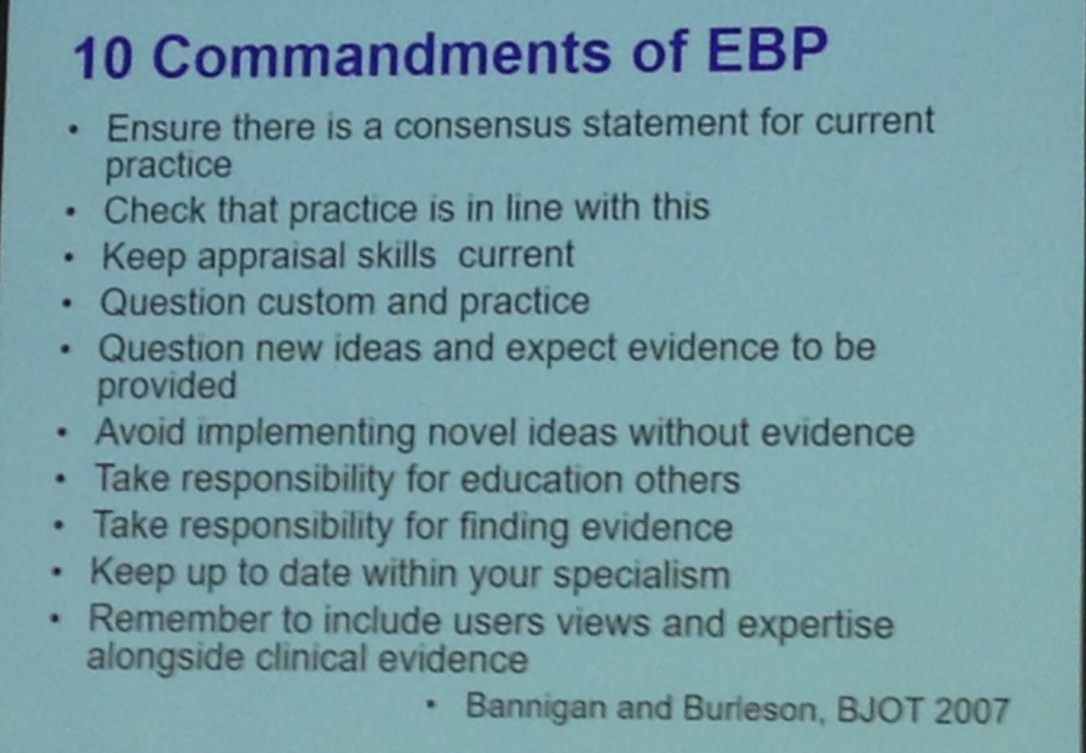
As well as discussions about the development of the guidelines this seminar identified the ten commandments of EBP (as defined by Bannigan and Burleson, 2007) and also covered the challenges of embedding guidelines into practice.
IMG_3428

Examples of NHS Trusts that have well established governance structures that ensure guidelines are incorporated into frontline clinical care were discussed and practical strategies of how to embed evidence into practice personally were included.

These included:

  • Find yourself guidelines that support your practice and discuss it with your team
  • Take responsibility for your personal learning, be active in seeking out actively appropriate evidence to support your practice
  • Make a commitment to yourself to do something simple for CPD every month, one example from the presenter was to commit to reading one article from the BJOT a month, small actions like this can then become habitual over time.

There was a lively discussion relating to the benefits and disadvantages of implementing the guidelines into clinical practice, the sheer number of guidelines available was discussed and the lack of time available to implement recommendations. Some therapists have suggested that guidelines can lack a client centred focus. However in contrast the increasing opportunities for AHP’s to get involved in the development of the guidelines was emphasised, and the robustness of some of the recommendations was identified as supportive for occupational therapists working in MDT’s.

In response to a comment from the floor that suggested there are some topics that currently aren’t properly covered by NICE guidelines the discussion moved onto how occupational therapists need to focus on creating more evidence from our practice to build the evidence base, with the presenter concluding that if our profession isn’t defined by evidence then we wont move forward.

Since attending the seminar I have had time to reflect on the funding opportunities that are currently available for occupational therapy clinicians who are interested in developing a research career (through organisations such as the NIHR and the Elizabeth Casson Trust ) and I would encourage anyone interested in doing this to visit their websites for more info as to how to get started.

I left the seminar with a better understanding of how NICE Guidelines are created, and developed, and with strategies to take back to my clinical team to enable us to embed them deeper into our practice.

Written by Elspeth Clark    @Els_OT
#BlogSquad2018, OTalk

RCOT2018 Blog 8 Sess. 45 Mindfulness & Zentangle: Science, Health & Happiness…even when you do not think there is time

As this was my first time at conference I was keen to try the occupation stations on offer, and I jumped at the chance to attend this Tuesday afternoon session. This hands on mindfulness session was facilitated by Christine Urish, Occupational Therapist and Professor at St Ambrose University in the United States (find her on Twitter @curish).

Mindfulness as a therapeutic approach is becoming increasingly popular in the occupational therapy paradigm. This was clearly reflected in the the large numbers of delegates keen to attend this session! Although I arrived early I had to sit on the floor as the session was jam-packed! I have used mindfulness both personally and professionally in my own practice with service users on a mental health placement, and was keen to hear from Christine how this approach might be applied to different client populations.

Christine explained how she has worked within psychiatric services and with university students, identifying the need for effective interventions to combat stress and anxiety. She undertook specialist training and has now used mindfulness approaches with clients for the last two years, explaining how mindfulness involves being present in the moment, free from judgement.

Christine briefly introduced us to the Koru Mindfulness Program. This is an evidence-based course designed to teach mindfulness, meditation and stress management to college students and young adults. Christine guided us through one of the strategies within this training – diaphragmatic breathing. This technique is useful in calming the mind and body by activating the parasympathetic nervous system. She uses strategies such as this to encourage clients to become more mindful and centred, in preparation for engaging in Zentangle.

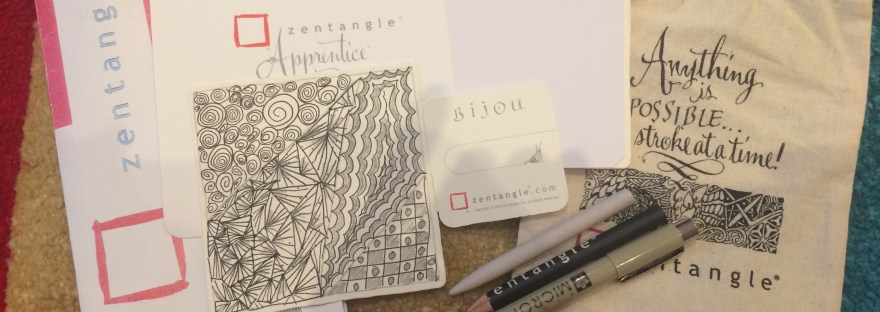
Zentangle is a creative and artistic occupation in which the participant draws a beautiful image from repetitive patterns. Christine explained how clients with stress and anxiety respond particularly well to this occupation, as it enhances self-esteem and self-efficacy. Patterns are called ‘tangles’ made up of dots, lines and curves. These patterns are drawn onto small pieces of card or paper called ’tiles’ which can then be assembled into mosaics.

This occupation can be used with almost every population group, including children and older adults. We were provided with our own Zentangle materials, including a selection of tiles and pens. We had a go at creating our own tiles and Christine encouraged us not to compare ourselves and reminded us within Zentangle, there are no mistakes! Although I am not particularly artistic I found myself becoming absorbed in the activity and lost track of time, suggesting this occupation has the power to facilitate flow for service users. The client is encouraged to take the activity at their own pace and the philosophy of Zentangle is anything is possible…one stroke at a time! This was reflected in the relaxed and informal ethos of the session.

So how does it relate to occupational therapy? Zentangle has important implications for many areas of practice. Within paediatrics it can be used to improve fine motor skills, concentration, attention, sequencing skills and sensory and emotional regulation. For older adults it can be used to facilitate reminiscence, provide opportunities for social interaction if ran as a group session, and provides participants with the chance to engage in a creative and meaningful occupation. With palliative care it can foster a sense of positivity, by encouraging the client to be creative and share their creation with loved ones.

Christine explained how after being introduced to Zentangle many clients pass on the activity to friends and family, which encourages them to undertake meaningful roles. Zentangle also provides occupational therapists with a useful tool for their own self-care by enabling reflection and relaxation, and reducing the risk of professional burnout.

Written by Cathy Roberts  @CathyARoberts

#BlogSquad2018, OTalk

RCOT 2018 Blog 7 4 valuable lessons from a nervous 1st time presenter

Here are 4 lessons that Orla Hughes, an occupational therapy student, learnt from presenting for the first time at a RCOT conference:

  1. Encourage everyone to ‘give it a go’

The different ways we can present at conference gives us a chance to get creative and ‘give it a go.’

If you have a passion for an activity, why not apply to host an occupation station? If you have interesting research but don’t enjoy public speaking, could you submit a poster instead? Personally, I haven’t conducted any traditional research yet so I shared a personal reflection of my experience volunteering while being an occupational therapy student for the first time. I’d encourage you to think, ‘what could I do?’

  1. Wear suncream

Be prepared to take it easy and look after yourself before you are presenting. Self-care and occupational balance need to be considered even more so when you are putting yourself out there at a conference. For me that meant I should have worn suncream the weekend before as I could have avoided presenting while looking like a lobster.

  1. Remember Murphy’s Law

We are in Northern Ireland and therefore, Murphy’s law applies: ‘If technical difficulties can happen, they probably will’ which is what arose in my presentation. Having interesting videos and slideshows are a welcome bonus to your presentation but have a back-up plan if it isn’t possible to show them on the day.

  1. Get interactive

Finally, my favourite presentations are the ones that have some banter with the audience whether it’s asking the crowd discussion questions, conducting a ‘hands-up’ poll, or singing a song together.

The opportunity to interact can turn the session into something people can engage more with and hopefully make the learning outcomes more tangible.  In my presentation, I did this through running a twitter competition. I announced I would be picking my favourite tweet from the session and award the winner with their favourite chocolate bar.

Stay tuned for the award ceremony coming soon on twitter (@orlatheot).


#BlogSquad2018, OTalk

RCOT 2018 Blog 5 Sess 33.1 – Exploring the theraputic potential of the team sport of boccia occupation station

This session was led by Lyndset from Sport for Confidence @sportforconf

Session aims were to:
  • Explore the use of boccia as a theraputic activity
  • Discuss potential uses of boccia as an assessment tool in terms of activity analysis
  • Have a go and experience the sport of boccia
It all started with being introduced to boccia, pronounced bot-cha. A game of one jack, two teams, red and blue, six balls per side and a fiercly competitive bunch of occupational therapists.
Lyndsey Barrett, an occupational therapist from Essex is the founder of Sport for Confidence, an organisation aiming to involve people with and without learning disabilities in sport. They recently worked alongside the Royal College of Occupational Therapists to produce an evidence guidelines based on using boccia as an assesment and intervention tool.
The occupation station itself was aimed at getting occupational therapists thinking about the activity of boccia and it’s relevance in assesment. What better way to do it than to give it a go?
Que the group being split into two and the first lot of attendees sat on the edge of their chairs throwing like they’ve never thrown before. The jack was launched into the middle and the first few balls added into the mix, red team had an early lead and the blue team (myself included) were struggling to catch up. Much debate and conversation went on, a few woops and cheers and the reds were united in their victory before we all had to get up and shake hands. The red team had won 3-0.
Then came the team swap, the next 8 were up. But here’s when the competition took on another level, red went first and a tactical move by blue knocked it out. The teams matched each other play by play but in the last moment the jack was moved and blue took it 2-0. Again the victors celebrated before the teams stood up and shook hands.
But, what relevance does this have to occupational therapy you say?
Core to occupational therapy is activity analysis. At some point along our educational journey we were taught about breaking activities down into the skills used to perform the activity.
Boccia provides a perfect platform to asses a person’s strength, endurance, turn taking,  communication skills and many more. Within moments of watching the game it was easy to spot people repositioning themselves to throw, working out the required strength to throw the ball, considering their options and socially becoming part of a team.
The session brought with it a powerful reminder of the skill of activity analysis and unique role occupational therapy can provide in the area. The sport itself is simple, easily graded or forward and backward chained and an asset to the occupational therapy toolkit.
This blog was written by @Amie_OT Current RCOT Education Liaison Officer