Blog Posts

OTalk

#OTalk 16th July – The Role of occupational therapy in safeguarding

This week Sophie Grantham @OTSophie will be hosting the chat, here is what she has to say. 

In light of recent experience in my own work setting of increased occupational therapy input in safeguarding enquiries, I felt an OTalk about the topic may help develop my own knowledge, as well as find out more about what is going on in other Occupational Therapy settings.

Safeguarding is a term used in the UK to denote measures to protect the health, wellbeing and human rights of individuals, which allow people to live free from abuse, harm and neglect (Care Act, 2014).

Safeguarding offers a framework used to put appropriate measures in to place to protect people, but if this is the case, why do we as therapists not view it quite in the same way?

Whilst our Social Work colleagues have always been involved in safeguarding, it is something Occupational Therapists appears to be increasingly involved in, and with this in mind, how can we do this, whilst keeping our Occupational values at the core?

This OTalk therefore plans to explore this topic, with the aim of learning from each other.

 Questions:

-What is your current involvement with safeguarding? (any? Explain).

-How do safeguardings affect current practice?

-Do you feel safeguarding should be part of the Occupational Therapy role, why?

-What systems (if any) are in place currently for you to prevent safeguardings?

-How can we as Occupational Therapist’s positively prevent safeguardings?

Post Chat

Host: Sophie Grantham @OTSophie

OTalk Support: Carolina @colourful_ot

Online Transcript

#OTalk Healthcare Social Media Transcript July 16th 2019

The Numbers

1.281M Impressions
253 Tweets
22 Participants
202 Avg Tweets/Hour
12 Avg Tweets/Participant

#OTalk Participants

Data for #OTalk can be up to 15 minutes delayed

OTalk

#OTalk 9thJuly – Age Appropriate Occupations

This weeks #OTalk is on the topic of “Age Appropriate Occupations” and will be hosted by Kirstie Hughes (@Kirstie_OT).

Over the years when I have told people I enjoy building Lego I am met with responses such as “but its for Kids” or “Really, why?” and my answer is always why not?!

At this years Royal College of Occupational Therapist Annual Conference I presented an occupation station to share my love of Lego. I was hugely overwhelmed by demand for my session and the positive feedback with one attendee commenting on how he felt calm and relaxed engaging in occupational flow amongst the busy few days of conference

The queries have often left me thinking about age appropriate occupations in Occupational Therapy and the wider Health and Social Care context. Activities such as Easter bonnet making in residential homes, nursery rhymes in Learning Disabilities and Coloring in mental health services were often looked upon as “not appropriate”. As research in these areas have progressed we have an evidence base for their benefits to health and well being and they are now seen as mainstream activities, but why were they ever seen as inappropriate in the first place?

This chat aims to encourage discussion around age appropriate occupations, what impacts on them and why we stop engaging within adulthood.

Some questions to consider;

1: Do you engage with or participate in any occupations that may not be deemed as “age appropriate”? In addition to Lego building I also play PokemonGo.

2: What was your favourite occupation as a child? What did you gain from it? Do you still participate in it now? If not why not?

3: As OTs we know the importance of meaning in occupation, so does age really matter to us?

4: Is the need to provide a group activity impacting on the options available to us? Does catering for the many reduce meaningful options?

5: Are there any types of occupation based activities you would like to try within your service but have concerns around justifying them? Maybe you have tried some and was successful in your clinical reasoning?

6: Are the any new occupations you would like to try as an adult? Why barriers are there to your participation?

Post Chat

Host and On OTalk Account; @kirstieot

Online Transcript

#OTalk Healthcare Social Media Transcript July 9th 2019

The Numbers

2.351M Impressions
336 Tweets
36 Participants
269 Avg Tweets/Hour
Avg Tweets/Participant

#OTalk Participants


#OTalk Research Chats

#OTalk (Research), 2nd July 2019 Testing out the new draft RCOT Research and Development Strategy

#OTalk (Research), 2nd July 2019
Testing out the new draft RCOT Research and Development Strategy

This week’s #OTalk is the latest hosted by the Royal College of Occupational Therapists (RCOT) as part of its Research and Development Review, which is now drawing to a conclusion. The Review has provided the opportunity to engage with a range of constituent groups within RCOT’s membership, and to consider how the organisation supports the building of research capacity within the profession and the expansion of the evidence base informing practice. The primary output of the Review is a new RCOT Research and Development Strategy, the draft of which is the focus of this week’s #OTalk.

The chat will be co-hosted by @TheRCOT and @JoWatson22

The RCOT Research and Development (R&D) Review was launched in June 2017. Since then, we have held a series of listening events and consultations around the four nations of the UK and with a wide variety of occupational therapists including: practice-based staff, academics, researchers, service managers, consultant occupational therapists, post-graduate research students, specialist section R&D leads, members of the Council of Occupational Therapy Education Directors (COTED), occupational therapy professors and RCOT staff. We have consulted the literature and related policies across the four nations, reviewed the strategies of similar organisations and undertaken a number of focused projects including: a review of the RCOT Annual Awards, a review of the UK Occupational Therapy Research Foundation, and desk-based research scoping the research knowledge and skills related content of pre-registration education programmes accredited by RCOT.

Approximately 18 months’ work is now culminating in the drafting of the new RCOT Research and Development Strategy 2019-2024, which we anticipate will be published in early autumn 2019. As part of the process of consulting on and testing out the draft strategy, we are sharing key elements with you that we’d like to chat with you about during the #OTalk scheduled for July 2nd 2019.

You can access a summary of the core elements of the draft Research and Development Strategy here: https://www.rcot.co.uk/summary-draft-rcot-research-and-development-strategy-2019-2024

The questions forming the basis of the #OTalk discussion are:

1. Does the direction of travel set out in the draft R&D Strategy seem appropriate? If not, please try to explain why you think that is.

2. Bearing in mind the principle that we can all contribute something small to a larger collective effort, how does the draft R&D Strategy feel for you, in your circumstances?

3. How do you see yourself responding to the strategy? What actions do you think you could take?

4. Is there anything missing that you might have expected to see in draft R&D Strategy?

We are really looking forward to hearing your thoughts which will be very welcome contributions to the development of the new RCOT R&D Strategy.

Thank you.

POST CHAT

Host: Royal College of Occupational Therapists @TheRCOT and @JoWatson22

OTalk support: @LynneGoodacre

Online Transcript#OTalk Healthcare Social Media Transcript July 2nd 2019

#OTalk Healthcare Social Media Transcript July 2nd 2019

The Numbers

1.395M Impressions
315 Tweets
27 Participants
164 Avg Tweets/Hour
12 Avg Tweets/Participant

#OTalk Participants


OTalk

#OTalk – 25th June 2019 – The Sentinel Stroke National Audit Programme (SSNAP)

This week’s chat will be hosted by Louise Clark on behalf of the Royal College of Occupational Therapists Specialist Section for Neurological Practice @RCOT_NP here is what they had to say.

The Sentinel Stroke National Audit Programme (SSNAP) is the national dataset for stroke, widely used in England, Wales and Northern Ireland. The aim of the audit is to improve stroke care by measuring the structure and processes of stroke care against evidence based standards, such as the RCP guidelines for stroke (2016). For example this includes length of stay on a stroke unit, time to initial assessment by an occupational therapist, number of days OT delivered as a % of patient stay, number of minutes of therapy delivered on average per day, % of mood and cognition screens completed.

Data collection and entry is a significant feature in stroke unit care and Early Supported Discharge and for some is not always a welcome addition to our workload. However, there are positives to having such a huge database of information and comparisons against other services and national averages…..

The aim of this #OTalk is to explore those positives and think how can best use the information we collect and share ideas regarding meeting the 45 minute therapy target. We are joined for our talk by a member of the SSNAP team (………) and will share tools and signpost to resources/help regarding SSNAP.

This #OTalk has been hosted by Louise Clark from the stroke forum of the Royal College of Occupational Therapists specialist section for Neurological practice, in response to member feedback for topics. We hope you enjoy it and carry on the conversations in your workplace.

1. What do you think are the positives about SSNAP?

2. How do you use the data day to day to plan or improve patient care?

3. People have mixed feelings about the 45 minute therapy target. Why is it important (for patients, therapy services)?

4. What can you do to help meet your 45 minute target?

We would ask participants to look out for 3 short feedback questions posted with the transcript in the week following this #OTalk. We’d really appreciate your feedback in helping us evaluate and plan our sessions.

Future sessions from the stroke forum include;
24th September 2019 – Neglect (with Dr Ailie Turton)
26th November 2019 – Driving (with Paul Graham)
25th February 2020 – Vision (with the British and Irish Orthoptic Society- BIOS

Post Chat

Host: Louise Clark @RCOT_NP

Support on Otalk account: @otrach Rachel Booth

Online Transcript

#OTalk Healthcare Social Media Transcript June 25th 2019

The Numbers

1.105M Impressions
371 Tweets
31 Participants
297 Avg Tweets/Hour
12 Avg Tweets/Participant

#OTalk Participants


OTalk

Tuesday 18th June 2019 – Reflections from #RCOT2019

This years Royal College of OT Conference is being held at the ICC in Birmingham on Monday 18th and Tuesday 19th June, 2019.  As always delegates are encourage to share their learning and impressions of conference on twitter using #RCOT2019, so if you not at the conference you can still join in the learning.   As most of the #OTalk crew will at this years conference our student intern Carolina will be leading the chat reflecting on what happened, for those travels home or those who joined in the conference via Twitter.

Question will include

Q1 Did you attend this years RCOT conference or follow it on Twitter?

Q2. What was your highlight?

Q3. Will you be changing your practice at all after something you saw or read on Twitter at the conference?

Q4. Did you meet anyone in real life that you only knew on Twitter? How was that?

Q5.  Is there anyone you think we should approach to host a #OTalk chat that you saw at conference?

Q6. What is your take home message?

POST CHAT

Host and OTalk support- Carolina

Online Transcript

#OTalk Transcript June 18th 2019

The Numbers

1.188M Impressions
259 Tweets
69 Participants
10 Avg Tweets/Hour
Avg Tweets/Participant

#OTalk Participants

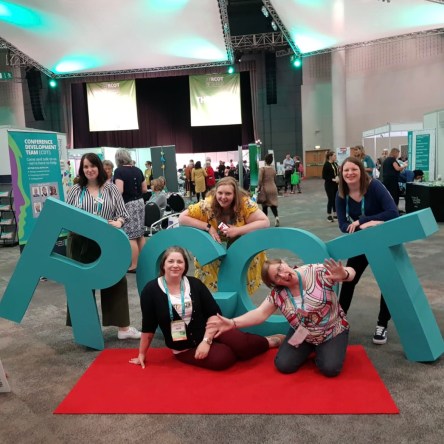
Here are the OTalk Crew at this years Conference.

IMG_0028