OTalk

#OTalk – Diabetes Awareness Week 13th June 2023- hosted by @mel_chieza

As part of the Diabetes Week, I’m facilitating today’s Twitter discussion to talk about whether occupational therapists can help people manage their diabetes. Diabetes Week is around the third week of June from the 12th to the 18th. During this crucial week it raises awareness of the condition, and it gives an opportunity for everyone to gather and support those who are affiliated with Diabetes. 

 According to Tack et al. (2018) people living diabetes on average, can make up to 180 decisions related to diabetes per day. Good glycaemic control is achieved by the hourly decisions made by those living with diabetes. Whilst having an insulin pump makes monitoring slightly easier, the burdens of managing diabetes are a daily chore for the person living with this condition. “Technological advances like insulin pumps and continuous glucose monitors or flash glucose monitors are relatively good, However, they still require concerted effort. Other things that come with diabetes like counting carbohydrates, decision-making around exercise and its impact on insulin relies on patient input, considering all activities in the day that they anticipate to engage in.
Diabetes management is a demanding task that calls for consistency, order, and stability. To effectively follow the diabetes regimen, self-care is necessary. According to the Diabetes self- management (DSM), self-care is letting diabetics understand and pay attention to their bodies and minds while they are experiencing the effects of diabetes.

 This twitter chat aims to determine whether occupational therapists can help people with diabetes manage their condition. There is currently very little evidence to support the role of an occupational therapist, which is why it is important to support patients who live with diabetes. 
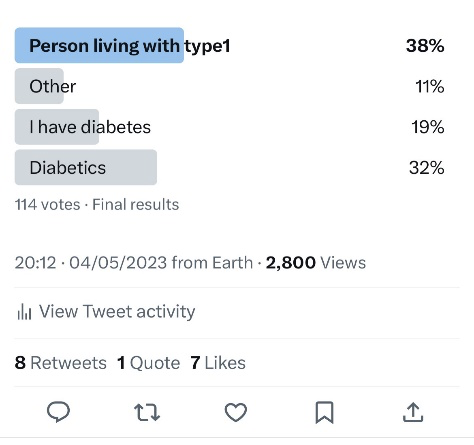
According to a twitter poll on the 4th May, 2023 people with diabetes may address themselves differently to their friends vs when reviewed by health professionals. ( See Poll results) .

What is Diabetes? 

Diabetes is a condition caused when a person’s glucose level becomes elevated and becomes high. There are four types of diabetes: Pre-diabetes, Type 1 diabetes, Type 2 diabetes, and gestational diabetes.  (WHO, 2016). Five million individuals in the United Kingdom have diabetes, according to Diabetes UK, (2023). In the UK, 4.3 million individuals currently have diabetes diagnosis. We are aware that type 2 diabetes makes up around 90% of diagnoses, followed by type 1 diabetes which equates to about 8%, and the other 2% of diagnoses are for different forms of the disease. 

Type One Diabetes occurs when the body fights the cells in the pancreas that produce insulin, and so preventing production of insulin. Everyone needs to have insulin in order to stay alive. Glucose moves around an individual’s blood and enters their cells and gives their bodies energy. This is facilitated by the presence of insulin. When an individual has Type 1 diabetes, their body still breaks down carbohydrates from food and drinks into glucose (sugar). However, when the glucose enters the bloodstream, the lack of insulin means it is unable to enter the body’s cells. Glucose then builds up in your bloodstream (Diabetes UK, 2012). 

Type Two Diabetes is a condition when the pancreas cannot work efficiently to make insulin. The role of the pancreas is to distribute insulin, when this does not occur this causes high glucose levels. In Type Two diabetes, the pancreas can become more tired causing the body to produce less insulin. Type 2 can be managed by lifestyle changes like healthy eating, regular exercise and losing weight (Diabetes UK, 2012). Otherwise, alternative treatment such as medications or insulin may be appropriate.

Other types of diabetes include gestational diabetes, a temporary condition in pregnancy where the mother becomes insulin resistant (WHO, 2016), and ‘pre-diabetes’ which places the individual at higher risk of Type 2 Diabetes (American Diabetes Association, 2011).

Diabetes and Occupational Therapy 

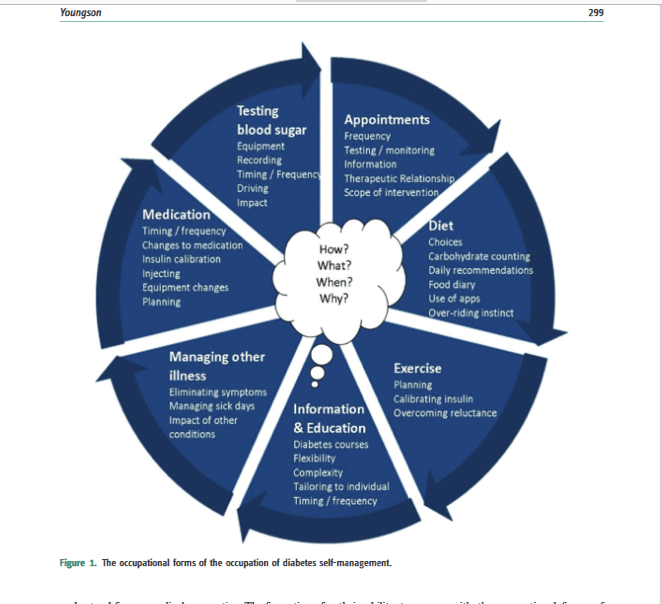
Early studies on OTs and diabetes focuses mostly on the OTs involvement in managing diabetes complications (Hand et al., 2011). The function of OTs in Diabetes Self-Management (DSM), with or without such complications, will be the main topic of this session. By seeing DSM as a profession, it’s becoming clear that the OT can play a major role in enabling and supporting DSM and promoting a fulfilled happy life with diabetes. Exhibited results are presented in Youngson (2019) as a pie chart (p298-300- Please see diagram above). In two additional tables, the results are organised into the MOHO categories of  environment, habit, and performance in a format that is simple to understand. For instance, Youngson (2015, 2019) and Pyatak (2011) both point out a gap in earlier research that has neglected to explore the impact of the OT in assisting control of Diabetes in daily life.  

This is an under-researched area and the role of the OT in diabetes is sparse. However, the main findings are around complications of diabetes. 

Questions 

  1. What are the current roles for occupational therapist in supporting diabetes self – management?
  2. What occupational therapy intervention could be used to support diabetes self-management?
  3. What are the views of health professionals and the potential for occupational therapists to support self-management in people with diabetes?
  4. What does the future of Occupational therapy practice need to support diabetes and OT in practice?
  5. What could be the role of the occupational therapist in support adults in self-management in relation to mental health and diabetes burn out.? 
  6. What is your takeaway from tonight’s chat? What will you share with others about tonight’s chat?

Reference List:

Diabetes UK (2023) Diabetes Week 2023.Available from :https://www.diabetes.org.uk/diabetes-week [ Accessed 16th April 2023]. 

Diabetes UK (2023) Number of People living with diabetes in the UK tops 5 million for the first time. Available from: https://www.diabetes.org.uk/about_us/news/number-people-living-diabetes-uk-tops-5-million-first-time [Accessed 16th April 2023]. 

Hand, C. L., Letts, L. J. and von Zweck, C. M. (2011) ‘An agenda for occupational therapy’s contribution to collaborative chronic disease research’, Canadian Journal of Occupational Therapy, 78(3), pp. 147–155. doi: 10.2182/ciot.2011.78.3.2.

Pyatak, E. (2011) ‘Participation in Occupation and Diabetes Self-Management in Emerging Adulthood’, American Journal of Occupational Therapy, 65(4), pp. 462–469. doi: 10.5014/ajot.2011.001453.

Pyatak, E. et al. (2019) ‘Addressing Diabetes in Primary Care: Hybrid Effectiveness–Implementation Study of Lifestyle Redesign® Occupational Therapy’, American Journal of Occupational Therapy, 73(5), pp. 1–12. doi: 10.5014/ajot.2019.037317.

Tack, C. J. et al. (2018) ‘Glucose Control, Disease Burden, and Educational Gaps in People with Type 1 Diabetes: Exploratory Study of an Integrated Mobile Diabetes App’. doi: 10.2196/diabetes.9531.

Youngson, B. (2019) ‘Understanding diabetes self-management using the Model of Human Occupation’, British Journal of Occupational Therapy, 82(5), pp. 296–305. doi: 10.1177/0308022618820010.

OTalk

#OTalk Tuesday 30th May 2023 8pm -Exploring coaching as an intervention approach to working with children, young people and families. Hosted by @EmmaLairdOT

Coaching is commonly used in sports settings to instruct and motivate the athlete but has emerged as an intervention approach to support children and young people to participate in occupations. There is no consensus on a definition for coaching, but key characteristics emerging from the literature have been identified which include; joint planning, observation, action, reflection and feedback (Rush and Shelden, 2011).

Occupational therapy has increasingly used coaching within child health to:

  • Facilitate parental involvement in interventions (Foster et al., 2013)
  • Enhance performance and participation (Weinstock-Zlotnick & Hinojosa, 2004)
  • Evidence-based approach (Novak and Honan, 2019) Occupational Performance Coaching (OPC) is described as an “Intervention for people with goals related to improving occupational performance and social participation in personally valued aspects of life” (Graham Kennedy-Behr and Ziviani, 2021 pg.9).

The basic concepts of this approach are founded on parents being the experts and a process of enablement which looks at the person, environment and occupation. OPC has three domains which are integrated and used by occupational therapists to facilitate parents to find a strategy for a specific goal (Kahjoogh et al.,2020)

I am keen to hear about individual experiences of coaching in paediatric occupational therapy services and identify what can be done to help develop coaching in this area.

The Questions

1. What is your understanding of coaching as an intervention approach in children’s services?

2. What coaching approaches are you aware of and use within children’s occupational therapy services?

3. How confident do individuals feel in delivering coaching as an intervention approach in children’s services?

4. What are your needs as an occupational therapist to embrace coaching as a therapeutic tool?

5. What would be helpful in building capacity for delivering coaching as an intervention tool?

OTalk

#OTalk 16th May 2023 -What’s next for OTalk? Hosted by @colourful_ot

Since its launch in October 2011, OTalk has provided a space for discussing Occupational Therapy practice and research, sharing learning, and professional networking through social media, on a weekly bases, hosting over 500 chats.

A lot can change in a decade, particularly on the Internet, and there is now a wide range of social media platforms for sharing information and building communities in different ways.

As many people choose to leave Twitter for other sites or to step away from social media more generally, we wanted to get the comminiuties thoughts on the next steps for OTalk and what our options might be for moving the chats to a new home?

We hope the questions below will help to get the conversation started and give us some inspiration for our future planning!

The questions

1. What do you enjoy or appreciate about OTalk chats? Is there anything that is unique to Twitter?

2. On the other hand, is there anything that you think OTalk chats are missing? Are there any features of other social media sites that you think would improve our chats?

3. Aside from Twitter, what other social media platforms do you use for connecting with other people in the OT world? What do you like about them?

4. Do you think you would continue to participate in OTalk chats if they were happening outside of Twitter?

OTalk

#OTalk 9th May 2023 -Enhanced Level Practice ‘Mid-career’ development: what are the needs of the occupational therapy workforce? 

Hosts: Dr Kim Stuart (Associate Professor Coventry University) and Dr Nikki Daniels Head of Communities and Connections RCOT

The Coventry University and University of Salford are working together to co-lead a commissioned programme by HEE to develop a curricula framework for Enhanced Clinical Practice. As a team across the two universities, we are working to develop 7 AHP curricula for Occupational Therapy, Dietetics, Physiotherapy, Podiatry, Prosthetists and Orthotists, Diagnostic Radiography and Operating Department Practitioners. 

I this week’s #Otalk, we want to explore your understanding of Enhanced Clinical Practice, and how it can benefit us as a profession.

Background 

The overall aim of the Enhanced Clinical Practitioner curricula framework is to produce proficient and effective occupational therapists who are confident in their profession specific knowledge, skills, and behaviours but at ease in working in complex multi professional teams across health and social care sectors. At an enhanced level of practice, we are developing confident, creative, critical thinkers, agile in their mindset, solution focused leaders who are secure in their professional identity. We are not describing a new level of practice or specific role here but capturing and focusing on the mid-career development of occupational therapists. To provide a structured programme of development that enables occupational therapists to thrive and grow in their roles, responding to the ever-changing challenges and opportunities in practice across all four pillars of our professional life. 

Whilst the curricula framework is centred around the Enhanced Clinical Practitioner Apprenticeship, it is much more than this and aims to capture the level of practice and programme of development we can create for occupational therapists. Thinking about how this level of practice can be described across the variety of roles and sectors that occupational therapists work including both statutory, independent and voluntary sectors is essential to ensure that we all have access to high quality professional development. 

In developing the curricula framework, the ambition is to create an open framework approach that is sustainable and scalable for delivery, inclusive of all allied health professions. Continuous Professional Development (CPD) may be an individual-led or an employer-led activity that meets the requirements of the workplace, supports employers’ aspirations for skilled and productive employees and facilitates personal growth and career progression of the individual. Adopting an open framework curriculum for Enhanced Practice enables the provision to be responsive to the needs of the workforce at a national level whilst being flexible in delivery at a local system level in collaboration with other universities and their sector partners. 

By using an innovative open framework approach we can widen access to high quality professional development that can be tailored to the individual profession as well as supporting collaborative learning across diverse professions and disciplines to meet the needs of the individual and employer. The aim is to provide occupational therapists with a diverse curriculum that is relevant to their profession, speciality, and interests, seeking to celebrate the depth of practice within health and social care, retaining our highly valued and skilled workforce. 

There have been several key reports published by HEE that set out the career framework, you can access them here 

Enhanced practice | Health Education England (hee.nhs.uk)

To do this we need your input, so the focus of the #OTalk is for us as a professional community to come together and explore Enhanced Level Practice, what does it mean to you. What do you recognise as the unique features of occupational therapy practice at this level and how do we support occupational therapist career development across all four pillars of practice at this level. 

The questions that we would like to explore are 

  1. Have you heard about enhanced practice? If so tell us what you know about it.
  2. The aim of ECP curricula framework is to produce proficient and effective OTs, confident in their profession specific knowledge, skills, and behaviours.  How do you think this could benefit us as a profession?
  3. What do you think should be delivered for occupational therapy professional development within this level of practice across all four pillars that is UNIQUE to occupational therapy?
  4. What areas of practice do you think should be prioritised initially in supporting professional development at an enhanced level within occupational therapy?
  5. Would this be attractive to you as part of your professional development? Why/Why not?
OTalk

#OTalk Research – Tuesday 2nd May 2023 Writing a research question hosted by @preston_jenny

Chat will be hosted by @preston_jenny 

Despite the abundance of evidence in existence finding answers to our clinical questions can remain challenging.  Whether you are seeking to explore the evidence base or develop an idea for further research, the one thing that is key to everything is the ability to formulate a clear and specific question.  In this #OTalk I want to take you on a journey from that early curiosity through to publication of new and emerging evidence.  

My journey started 9 years ago when I was given responsibility for setting up a service for young people living with a neurological condition as they transitioned from child health to adult services. As a clinician it felt like a fairly natural thing to do.  After all I had many years of clinical experience so why should this be any different?  And there the questions began … I had spent a career working with adults living with neurological conditions so what did I know about young people and their needs?  What did I know about transition?  How might I be able to help them?  What would a service need to look like?  How will I know if it is helpful?  What interventions will I need to offer?  What about the legislation? What is everyone else doing?

As a busy clinician I didn’t necessarily have the time to commit to additional study or even time to review the evidence so like many I just started doing what “felt right.”  Yet I remained curious, fuelled by my observations that I was being asked different questions; that I was delivering different interventions; and that the more engaged I became the less I seemed to understand the concept of transitioning.  There seemed to be so many questions at this stage and even when I did engage with the evidence I didn’t really know what I was looking for as on reflection I had not yet formulated my questions.  I really did not know where to start.  

However after some reading I started to formulate my thoughts into three main categories as follows (McCombes, 2022, http://scribbr.co.uk):

  1. Describing and exploring:
    1. What are the characteristics of this population?
    2. How do their needs change over time?
    3. What causes this change?
    4. How is this dealt with?
  1. Explaining and testing
    1. What are the trends/relationships within/between this population and any other group?
    2. What is the role of occupational therapy within transitions?
    3. What is the impact of occupational therapy?
  1. Evaluating and acting
    1. What are the advantages and disadvantages of interventions?
    2. How effective are interventions?
    3. How can interventions be improved?

Suddenly it became much clearer to me as I realised that there were many questions that required to be answered and each with very different purposes.  This structure enabled a more focussed approach to a single topic.  It helped to clarify that there was not one single question but this would in fact become a series of questions, all designed around a single topic that should aim to improve understanding rather than demand a ready-made solution (McCombes, 2022, http://scribbr.co.uk).  

We have subsequently developed three studies based on this programme of enquiry:

  1. An overview of interventions used across the life span to support transitions of those with a neurological condition: a systematic review of reviews 
  2. A qualitative evaluation of transition experiences from individuals living with a neurological condition 
  3. Exploring the clinical interventions within a Transitions Programme through the use of the ICF

These studies are all at various stages of development and are being prepared for publication with one already accepted.  The main learning throughout this journey has undoubtedly been around the following key principles (adapted from http://scribbr.co.uk):

  • Focussing on a single problem or issue
  • Researching using primary and secondary sources with a clear question in mind
  • Feasible to answer within time constraints and practical constraints 
  • Specific enough to answer thoroughly
  • Complex enough to develop the answer into a meaningful presentation, paper or publication
  • Relevant to your area of interest (clinical or research)

Tonight’s chat will focus on the following key questions:

  1. Have you ever had to develop a research question?
  2. What resources did you access to help?
  3. How did this meet your needs?
  4. Were there any limitations?
  5. What advice would you give to anyone writing a research question?