OTalk

#OTalk – 27th April 2021 – Perinatal Mental Health – an Occupational Approach in Journeys to Recovery

This chat will be hosted by Rachael Coates (@rachaelOTUK) and Sarah Maris-Shaw (@sarahmarisshaw)

Following the recognition of significant inequality in access to perinatal mental health care across the UK, the Government committed to 3 waves of funding to increase access to services. Since 2015, a vast investment has been made, and there are now 21 mother and baby inpatient units and 80% of England has access to some form of perinatal mental health service. This service expansion has produced a rapid increase in occupational therapy posts and has required occupational therapists to upskill quickly, considering both the mother, baby and their relationship in their day to day practice. An occupational approach to supporting those in the perinatal period is very relevant and reflected in the rate at which the specialism is growing. Significant changes in daily routines, responsibilities, associated roles, and relationship are commonplace in the journey to motherhood, with associated occupational imbalance and deprivation being common.

Working with Health Education England, RCOT have addressed some of the training needs of those who are new into post and those wanting support and direction in their role through the development of an E-Learning training programme. In addition, the RCOT Specialist Section for Mental Health launched the Perinatal clinical forum in 2019. The long term plan 2019 also pledged to align provision with the 1001 day campaign to provide support to those with mental health issues from pre-conception until baby’s second birthday and recognising the support needs of partners within the family unit.

A few years on it is interesting to reflect on the diversity of our work, how the pandemic has influenced practice and what have we learnt from working with families in their journey. We are also keen to support the UK maternal mental health awareness week 3-9 May are interested in exploring the theme ‘Journeys to Recovery’. UK Maternal Mental Health Awareness Week 2021 – Perinatal Mental Health Partnership (perinatalmhpartnership.com)

  1. What is your priority as an occupational therapist when working with women during the perinatal period?
  2. What skills do you bring that others in team are not trained or aware of?
  3. What barriers do you face and how have you overcome them?
  4. What have you learnt that might help another OT working in perinatal mental health?
  5. Please share an example of a Journey to Recovery – what did occupational therapy add to this journey to recovery?

POST CHAT

The Numbers

1.040M Impressions
256 Tweets
44 Participants
5Avg Tweets/Hour
6Avg Tweets/Participant

OTalk

#OTalk 20th April 2021 – Advocacy in Occupational Therapy

This weeks chat will be host by Toks Odutayo @tokunbotweetz

As one who was once described as a ‘mouthy martyr’ (a label I proudly bear), I can confess that I typically do not shy away from offering my tuppence worth on matters that I consider to be unjust, unfair or discriminatory. As an occupational therapist working in the youth justice sector, I have observed issues with occupational deprivation, alienation, imbalance and dysfunction in children and young people within the justice system. Identifying such health, social and educational needs within this marginalised group has highlighted the inextricable link between justice and advocacy in occupational therapy practice (Stover 2016).

The more exposure I have to such issues, the more the subject of advocacy in occupational therapy has been stirring within, quite like a musical earworm. It is worth stating at this point that I by no means approach this subject as an expert. Rather, I come to it as an absolute novice, looking to facilitate conversations and shared learning that would further shape, strengthen and develop our approach to advocacy in practice. 

As occupational therapists, we acknowledge that occupation is a fundamental human right (World Federation of Occupational Therapists 2019), and therefore naturally find ourselves advocating for the clients we serve when their rights are compromised. One reason for this could be related to the fact that we primarily view health from the lens of the social model of disability, as opposed to the medical model (Dhillon et al. 2010). Although advocacy may not be an essential component to our training curriculum, it is inherent to what we do as occupational therapists (Kirsh 2015) and is also identified as one of the six core intervention types of occupational therapy (American Occupational Therapy Association 2020). 

My newly curated curiosity into this subject has also led to the consideration of advocacy in occupational therapy in relation to recent social issues. The past 12 months has seen instrumental campaigns such as Black Lives Matter and women’s public safety, which many of us have been affected by, had a particular interest in, and involvement with. But what have these issues got to do with our occupational therapy practice? Do we simply use our professional platform to lobby for matters that hold meaning and value to us? Or could it be that we acknowledge how these matters impact our practice by not only setting up barriers to us as clinicians, but also account for the lived experiences of our clients (as well as ourselves), and therefore impede on their ability to perform their desired occupations; and/or act as secondary barriers to their engagement with therapeutic interventions and subsequent functioning?

I firmly believe in the latter as experience has shown the significant detriment to our client’s health, wellbeing and quality of life, when their needs are not acknowledged, understood or catered to in our practice. However, I hope this OTalk would open up more conversation that affirms, challenges, and proposes additional considerations to my thinking.

With inclusion and participation being integral to occupational therapy practice, as well as the assumed promise of equality and diversity being core to our practice (Royal College of Occupational Therapists [no date]), I would like to think together about the ways in which we currently engage in advocacy from a professional perspective. I would also like to explore how we could further develop our efforts to ensure that it remains a core facet of our practice to enable our client’s engagement in occupation.  How we do this can vary from voicing individualised matters, all the way to contributing to larger political, legislative and policy changes (Kirsh 2015).  

Having recently re-engaged with my twitter account (for the umpteenth time), I have observed how advocacy is imperative to all areas of occupational therapy practice. There are numerous health, social, cultural, physical, and institutional issues that can impact on the participation of our clients. These can include, but not limited to:

  • Raising awareness about specific and poorly understood conditions, e.g. neurodevelopmental conditions.
  • Outlining the need of specific equipment and/or technologies in practice.
  • Promoting equality and inclusion for marginalised groups, e.g. displaced individuals.
  • Writing business plans for occupational therapy roles in services.
  • Educating on the severity and impact of Long Covid on health, wellbeing and occupational engagement.
  • Highlighting accessibility issues in public and private settings.

In addition to advocating for our clients and enabling their ability to advocate for themselves, we also advocate for ourselves. As an evolving, and continually developing profession, we also find ourselves championing and fending for the specialist skill set within our discipline and advocating for the necessity of our roles within multidisciplinary teams.

All of this leaves me with a million questions about the subject of advocacy in occupational therapy, but I have managed to whittle them down to the following:

Questions

  1. What is your understanding of the meaning of advocacy in occupational therapy? Is it a core function of what we do as occupational therapists? 
  2. Can you share any specific matters related to your current practice that you feel would benefit from advocacy (eg. client groups, condition awareness, practice areas)?
  3. In what ways do we currently engage in advocacy as occupational therapists? Do we have the adequate tools to support us in effectively advocating for matters related to occupational justice?
  4. What are the challenges or barriers faced when advocating for others or ourselves? How might we overcome them?
  5. Can you share any past or present experiences of successfully, or unsuccessfully, advocating for a matter? Or experiences of a current advocacy journey?

References

American Occupational Therapy Association. 2020. Occupational Therapy Practice Framework: Domain and Process- Fourth Edition. The American Journal of Occupational Therapy 74(s2), pp. 1-87.

Dhillon, S.K. et al. 2010. Advocacy in occupational therapy: Exploring clinicians’ reasons and experiences of advocacy. Canadian Journal of Occupational Therapy 77(4), pp.241-248.

Kirsh, B.H. 2015. Transforming values into action: Advocacy as a professional imperative. Canadian Journal of Occupational Therapy 82(4), pp.212-223.

Royal College of Occupational Therapists. [No date]. Available at: https://www.rcot.co.uk/equality-diversity-and-inclusion [Accessed: 11th April 2021].

Stover, A.D. 2016. Client-centered advocacy: Every occupational therapy practitioner’s responsibility to understand medical necessity. American Journal of Occupational Therapy 70(5), pp.1-6.

World Federation of Occupational Therapists. 2019. Occupational therapy and human rights. Available at: https://wfot.org/resources/occupational-therapy-and-human-rights [Accessed: 11th April 2021].

POST CHAT

The Numbers

3.072M Impressions
415 Tweets
65 Participants
8 Avg Tweets/Hour
6 Avg Tweets/Participant

OTalk

13th April 2021 – Let’s #OTalk about Falls

This week #OTalk will be hosted by Mangar @MangarInt

The chat will also be supported by Paul Watts @apaulwatts, Clare Birt @ClareBirt, Andrew Macphail @andrrewmacphail and Dan Colclough @ColcloughDaniel. having a wealth of experience in different markets segments, allowing any questions to be answered promptly and effectively. Note these are for support and input into the chat and the main chat questions will be via the Mangar account @MangarInt

If you search ‘falls in the elderly’ on the internet, most of the information you will find is associated with identifying intrinsic and extrinsic causes and methods of fall prevention.  In reality, however much we concentrate of investigating causes and putting the associated fall prevention methods in place, people will still fall.

More than 10% of all ambulance call outs are to the elderly who have fallen and around 50% (Welsh Ambulance Service Trust) need conveying to hospital.  But 50% just need moving back to a seat or helping to their feet.

So why are there not more conversations around post fall care?  We all know how vital it is to get someone up again after a fall.  A ‘long lie’ (usually described as an hour or more), can have a greater impact on the health of the fallen person than the fall itself.

The psychology around the ‘fear of falling’ is also interesting to track.  We know people become less active because they are scared of falling again, leading to an ever decreasing circle of activity, resulting in significant muscle weakness.

We also know it’s often the carers that suffer the greatest impact, picking up musculoskeletal injuries as they try and help their loved one back to their feet.

It is great to see some pilot projects where OTs and Paramedics have joined forces to properly examine the right way to treat a very common problem. Specialist teams working together to find patient centred solutions, must be the right way for both improved patient care and efficient spending of NHS budgets.

Questions

  1. Is calling an ambulance always the right thing to do after a fall?
  2. How reliant are we on carers or loved ones to lift the people they care for after a fall? 
  3. Is there enough emphasis on post fall care?
  4. What falls service collaborations are we aware of and are partnerships between paramedics and OTs the way forward?
  5. What tools/technology can be used to give Cares confidence in their decision to perform a lift?

POST CHAT

The Numbers

1.516M Impressions
294 Tweets
65 Participants
6 Avg Tweets/Hour
5 Avg Tweets/Participant

OTalk

#OTalk Research 6th April 2021

Who do you think you are? Doing, being and becoming a pragmatic researcher-practitioner – a personal reflection.

This chat will be hosted by Sarah McGinley @sarah_lou2222 and Rachel Dadswell @DrRachOT1 

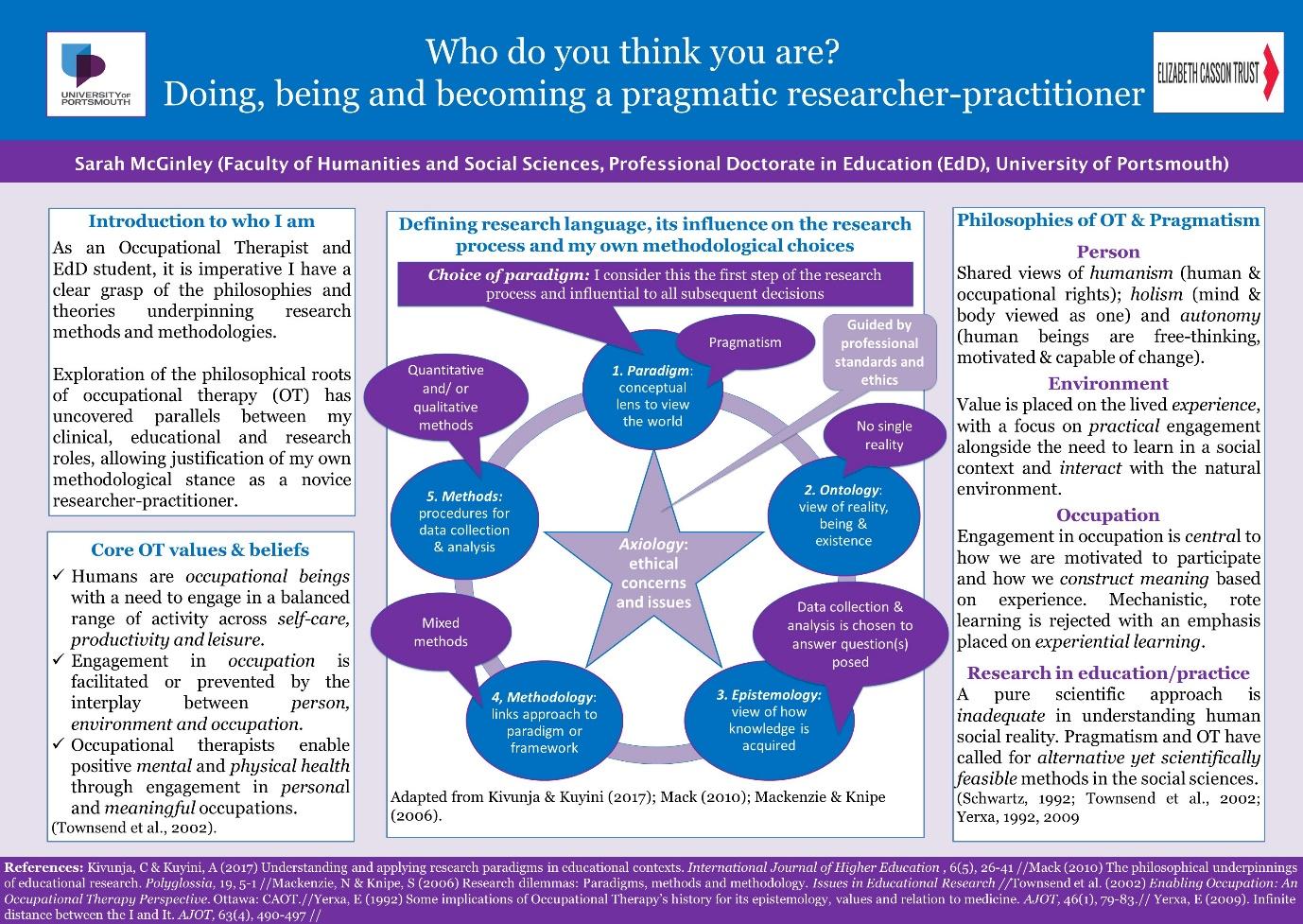
As occupational therapy students and therapists we are all aware of our personal and professional responsibility to acknowledge and examine our own values, beliefs, attitudes, assumptions, decisions and actions across clinical, educational and research contexts (Royal College of Occupational Therapists, 2021; Cunliffe 2016). Having worked in clinical practice for several decades between us, Rachel and I felt secure and firmly rooted in what we see as the underpinning philosophy of OT; the human right to engage in meaningful occupations to maintain and sustain positive physical and mental well-being (Townsend et al., 2002). However, when we entered the realms of education and research as novice researchers, we were challenged to consider our assumptions about how knowledge is generated and utilised, as well as our perception of what reality, being and existence is (Kinsella & Whiteford, 2009; Mack, 2010). Having never explicitly been asked to consider our own philosophical assumptions in clinical practice, this opened up a whole new world that was unfamiliar, overwhelming and somewhat intimidating.  Words such as epistemology, ontology and paradigmatic thinking were new to us (see attached poster for definitions of research language) and took us on a journey of ‘doing, being and becoming’ researcher-practitioners (Wilcock, 1998). 

The philosophical roots of OT demonstrate justified parallels with several philosophical paradigms (a lens through which we view the world). Using the poster as an illustration, we offer just one example of how the paradigm of pragmatism has helped us to understand who we are, what we do and how we view the world. Pragmatists argue that social reality cannot be understood through a singular world-view, suggesting a pluralistic approach that adopts mixed methods as a means of understanding human behaviour, beliefs and resultant consequences is needed (Kivunja & Kuyini, 2017). This quote from one of the founding educational philosophers of pragmatism – “it is through what we do in and with the world that we read its meaning and measure its value” (Dewey, 1959, p19) – demonstrates how pragmatism offers a shared view of the world that we feel aligns well with the core concepts of OT:

  • Person – shared views of humanism, holism and autonomy.
  • Environment – values the lived experience, focuses on practical engagement and the need to learn in a social context and interact with the natural environment.
  • Occupation – emphasises experiential learning and links occupation to meaningful and active participation. 
  • Research in education and practice – rejects a pure scientific approach and calls for alternative, yet scientifically feasible methods in the social sciences. 

(Schwartz, 1992; Townsend et al, 2002; Yerxa, 1992, 2009)

Literature suggests the profession struggles to succinctly describe OT in a uniform way, possibly connected to a lack of agreement around what constitutes its core values and connection with the founding philosophers  (Kinsella & Whiteford, 2009; Yerxa, 1992). This is unsurprising if as students, clinicians, educators and/or researchers we are not routinely encouraged to understand or make explicit our own philosophical assumptions at every stage of our personal and professional development.  If we are to be understood by registrants and the wider society, we feel it is imperative that philosophical language and paradigmatic thinking is introduced and made accessible to us as students, with critical reflection encouraged throughout all career pathways. We would love to know your views on this…….

Question 1: What do you understand by the term philosophical assumptions (and why is it important to consider them)?

Question 2: Do you feel comfortable debating the philosophies that underpin our profession? If not, why not?

Question 3: Have you ever been encouraged to consider your own philosophical position in practice, education or research?

Question 4: Can you share with us your philosophical position and how or why you came to this point?

Question 5: What would encourage you to explore your philosophical position in practice, education or research?

Question 6: Has your philosophical position changed or evolved over time? If so, how?
References:

Royal College of Occupational Therapists. (2021). Professional standards for occupational therapy practice, conduct and ethics. London: RCOT www.rcot.co.uk/publications/professional-standards-occupational-therapy-practice-conduct-and-ethics 

Cunliffe, A. L. (2016). “On Becoming a Critically Reflexive Practitioner” Redux: What Does It Mean to Be Reflexive? Journal of Management Education, 40(6), 740–746. https://doi.org/10.1177/1052562916668919

Dewey, J. (1959). The School and Society (4th editio). Chicago: The University of Chicago Press.

Kinsella, E. A., & Whiteford, G. E. (2009). Knowledge generation and utilisation in occupational therapy : Towards epistemic reflexivity. Australian Occupational Therapy Journal, 56, 249–258. https://doi.org/10.1111/j.1440-1630.2007.00726.x

Kivunja, C., & Kuyini, A. B. (2017). Understanding and Applying Research Paradigms in Educational Contexts. International Journal of Higher Education, 6(5), 26–41. https://doi.org/10.5430/ijhe.v6n5p26

Mack, L. (2010). The Philosophical Underpinnings of Educational Research. Polyglossia, 19, 5–11.

Schwartz, K. B. (1992). Occupational Therapy and education: A shared vision. American Journal of Occupational Therapy, 46(1), 12–18.

Townsend, E., Stanton, S., Law, M., Polatajko, H., Baptiste, S., Thompson-Franson, T., … Campanile, L. (2002). Enabling Occupation: An Occupational Therapy Perspective (Revised Ed). Ottawa: Canadian Association of Occupational Therapists.

Wilcock, A. (1998). Reflections on doing, being and becoming. Canadian Journal of Occupational Therapy, 65(5), 248–256.Yerxa, E. J. (1992). Some implications of Occupational Therapy’s history for its epistemology, values and relation to medicine. American Journal of Occupational Therapy, 46(1), 79–83.

POST CHAT

The Numbers

1.960MImpressions
431Tweets
73Participants
9Avg Tweets/Hour
6Avg Tweets/Participant

OTalk

#OTalk – 30 March 2021 – Exploring the purpose of OT in prisons

This chat will be hosted by Deborah Murphy @Murphlemurph 

When tasked with transforming a leisure-based day service in a prison to being an Occupational Therapy led therapeutic service in 2014, I searched for evidence to base my service design on. To my surprise there was almost nothing written about Occupational Therapy in prisons, and it was necessary to develop a ‘service model’ through trial and error. Although I had brought along over a decade’s clinical experience from forensic hospitals, it was evident that prisoners and OT’s within prisons had unique needs and aims. 

In contrast to the very slow turnover of men with ‘severe and enduring’ mental health needs within forensics, working in a remand prison demanded prioritising need within a rapidly changing population of 1300 prisoners.  It became apparent that our service needed to be responsive to men with multiple complex needs.  Alongside those with mental health issues, prisons have an over representation of men on the autistic spectrum, and other neurodevelopmental disorders, ADHD, personality disorder, and brain injuries.  We are much more likely to encounter those who are acutely suicidal and self-harming, and those with presentations related to acute emotional trauma.  Many have multiple complex social problems including family breakdown, immigration issues, problematic substance use, homelessness which are of immediate concern.

In 2017 the RCOT produced a factsheet related to OT in prisons, however none of the evidence presented related to the English prison context.  The research presented referred to 3 UK studies, but these were all examples from forensic services, a system very different to that of prisons, one was US prison and focussed specifically on an interdisciplinary substance use program from 13 years previously, with limited transferability to contemporary mental health practice in the UK, and one was from a Singaporean prison.  Closer to home (a fantastic) initiative of an OT setting up a choir in a prison in Belfast is mentioned, but such a niche example held little in the way of guiding our general practice.  I wondered how as OTs in prisons we might be able to build a more local relevant knowledge base?

Over the past 7 years I have assertively networked with OT’s across the UK and beyond in attempt to establish whether I am developing my service along principles consistent with other OT’s.  It has become increasingly evident that OT’s in prisons are a disparate bunch, with no coherent model of practice.  Although many are doing fantastic work in their own spheres, what we offer is largely subject to the trends of the geographical area, and the motivations of the service managers in that area.  

Against this backdrop we joined forces with the RCOT forensic special interest group in 2020 and the forum was renamed the #ForensicPrisonForum to acknowledge our diversity.  In recognition of our unique needs we also formed a ‘splinter’ group of OT’s who work in diverse areas of the justice system.  This justice-based OT forum #JBOT is not affiliated to our professional body and is open to anyone and everyone with an OT role related to the justice system.  Here we can consider how we develop our practice and create an evidence base in the numerous new and exciting roles which OT is expanding into within the justice system.  We hope to use our considerable shared practice experience to create guidance for others entering into these roles. 

We are keen to promote the diversity of our roles and to reach out to students and practitioners interested in this area of work.  I decided to bring some of the questions we commonly consider to this broader forum at #OTalk and look forward to hearing people’s thoughts and views.

Question 1. What interested you in coming along to tonight’s talk? What might you find appealing/unappealing about working in a prison setting and what made, or might make you consider working in this area? 

Question 2. What historical, social, psychological factors do you feel might impact people’s life ‘choices’ & contribute to their committing criminal offences? Do you have examples of approaches/ interventions OTs might use to increase the life chances of those in prison?

Question 3. Unconditional positive regard can be challenging when faced with those who perpetrate particular offences. How might we manage more difficult feelings in our practice, and how might such feelings influence the service we provide as OT’s? 

Question 4.  It is generally accepted in the Criminal Justice system that preventing reoffending is a poor measure of therapy outcomes, due to complex social factors motivating offending; So what outcomes might OTs look for to measure success? What might a good outcome look like?

Question 5.  Many people believe those in prison are unworthy of our time & attention. How might we persuade people (including prison personnel) that those in prison are worthy of healthcare generally & OT specifically? What might we say about the occupational needs we are meeting?

POST CHAT

The Numbers

2.116MImpressions
473Tweets
66Participants
10Avg Tweets/Hour
7Avg Tweets/Participant