OTalk

#OTalk Tuesday 29th March – Rough Sleeper Mental Health & Occupational Therapy.

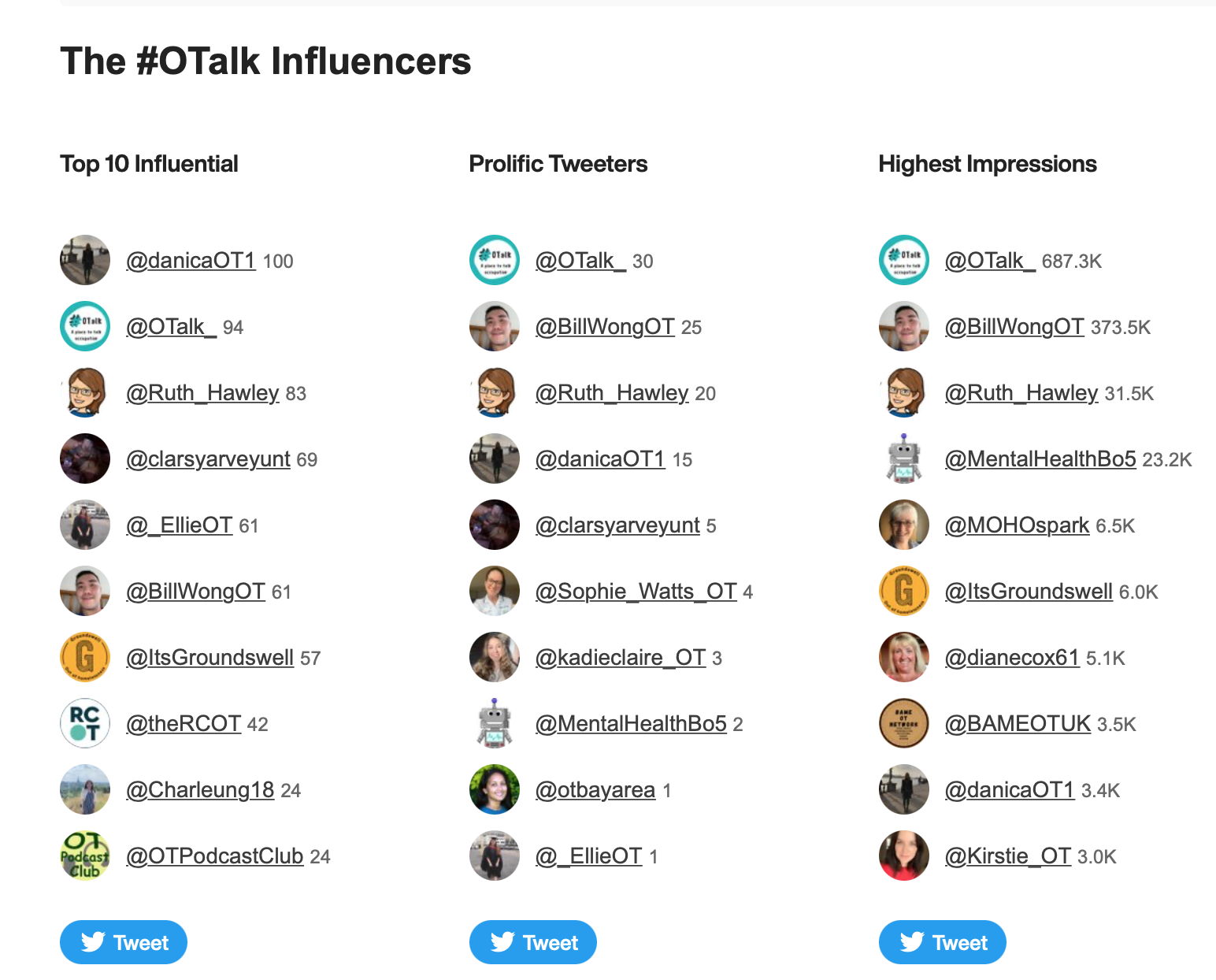
This chat will be hosted by Danica Moller (@DanicaOT1) with Carolina Cordero (@colourful_OT) supporting from the @OTalk_ account.

Danica is an occupational therapist working in a rough sleeper mental health team, in London. Through OTalk tonight, she aims to explore the role of occupational therapy when working with people who are sleeping rough. 

Statistics regarding people who are sleeping rough, in the United Kingdom clearly indicate severe health inequalities and much poorer health outcomes. People who sleep rough over a long period of time face a higher likelihood of dying prematurely, with the average life expectancy of a rough sleeper in the UK being 44 years for a male and 42 years for a female (Health matters: rough sleeping, 2022; Office for National Statistics, 2022). Many who sleep rough have co-occurring mental ill health and substance misuse needs, physical health needs and have experienced and continue to experience, significant trauma (Health matters: rough sleeping, 2022). 

There is often a view that the solution to the numbers of people sleeping rough, is just having better access to housing. Whilst this can certainly be the case for some, there is a population of people sleeping rough whose mental health has not only been a contributing factor to their circumstances but also a barrier to getting back into appropriate accommodation. This is further challenged by what an individual faces in trying to access appropriate mental health assessment, treatment and care. This could be to do with services not being set up adequately, prejudice and assumptions that are made about them, and also strict inclusion criteria (Health matters: rough sleeping, 2022).  This could also include barriers that result from an individual’s cognitive and physical health, financial hardship, lack of awareness and understanding of the impact of mental health on their wellbeing or environmental restrictions such as lack of suitable transport and location (Baker and Jones, 2021). If the individual experiences substance dependence, as a high portion of people sleeping rough do, then the barriers to accessing services are even greater (Health matters: rough sleeping, 2022).  

So considering that occupational therapists are trained to explore and address both physical and mental health, what is the role for an OT within this population? Are we as a profession doing enough to support, address and advocate for the needs of rough sleepers?   

To explore this topic, tonight we will discuss the following questions:  

  1. Do you have experience working as an OT with rough sleepers? What can OT offer to people sleeping rough who present with mental health needs?
  2. What are the barriers someone who is sleeping rough faces trying to access mental health care? How can services better support engagement?  
  3. What are examples of occupational injustice that someone who is rough sleeping faces?  
  4. What standardised or non-standardised occupational therapy assessments could be used to gain an understanding of functional difficulties an individual sleeping rough faces? Consider some of the creative ways an OT could work to try and complete a thorough OT assessment, without having access to a standard ‘home’ or ‘hospital’ environment?  

 References

 ‘Good work being undone’: 11,000 people slept rough in London during Covid-19. The Big Issue. (2022). Retrieved 9 March 2022, from https://www.bigissue.com/news/housing/good-work-is-being-undone-11000-people-rough-sleeping-in-london-in-covid-19/.

Baker, H., & Jones, G. (2021). Helping homeless people to reclaim and rebuild their lives. OTnews, (29(12), 18-21. 

Deaths of homeless people in England and Wales – Office for National Statistics. Ons.gov.uk. (2022). Retrieved 6 March 2022, from https://www.ons.gov.uk/peoplepopulationandcommunity/birthsdeathsandmarriages/deaths/bulletins/deathsofhomelesspeopleinenglandandwales/2019registrations#:~:text=The%20mean%20age%20at%20death%20for%20the%20identified%20homeless%20deaths,years%20and%2062.4%20years%20respectively.Health matters: rough sleeping. GOV.UK. (2022). Retrieved 12 March 2022, from https://www.gov.uk/government/publications/health-matters-rough-sleeping/health-matters-rough-sleeping

POST CHAT

Host:  Danica Moller (@DanicaOT1)

Support on OTalk Account: Carolina Cordero (@colourful_OT

Evidence your CPD. If you joined in this chat you can download the below transcript as evidence for your CPD, but remember the HCPC are interested in what you have learnt.  So why not complete one of our reflection logs to evidence your learning?

HCPC Standards for CPD.

  • Maintain a continuous, up-to-date and accurate record of their CPD activities.
  • Demonstrate that their CPD activities are a mixture of learning activities relevant to current or future practice.
  • Seek to ensure that their CPD has contributed to the quality of their practice and service delivery.
  • Seek to ensure that their CPD benefits the service user.
  • Upon request, present a written profile (which must be their own work and supported by evidence) explaining how they have met the Standards for CPD.

OTalk

#OTalk Tuesday 15th March – Attitudes towards psychosis

This chat will be hosted by Clara Harvey-Hunt (@clarsyarveyunt) with Helen (@Helen_OTUK) and Sam Pywell (@smileyfacehalo) supporting from the @OTalk_ account.

As part of a reflective project within the final practice placement of my Occupational Therapy training, I have been exploring the attitude towards psychosis, held by professionals within a multidisciplinary community mental health team. To increase the relevancy and strength of the findings regarding my future practice, I wanted to create an #OTalk that explores understanding and aids in informing Occupational Therapy approaches of working with clients experiencing psychosis.

The word ‘psychosis,’ can have very different connotations to the individual. By definition, experiencing psychosis involves holding a differing perception and interpretation of reality than those around us (Mind, 2020). Broadly speaking, this definition could perhaps also be used when referring to members of opposing political parties or holding strong religious beliefs, yet these differences are seen to facilitate occupational identity (Bryceson, 2010), rather than present barriers to engagement resultant of the existence of stigma (Colizzi, Ruggeri & Lasalvia, 2020).

To formulate a plan that is truly person-centred and respecting of our profession’s code of practice (Royal College of Occupational Therapists, 2022), we must understand the client and their experiences. Understanding relies on both intellectual and empathetic knowledge bases (Gilbert & Stickley, 2012) and as we can observe through service user feedback and the successful implementation of ‘peer-support worker’ roles within NHS trusts, individuals presenting with psychosis often find it easier to share openly and form a trusting and therapeutic relationship with others who have comparable experiences (Makdisi et al., 2013). With this being said, and the long-standing medical approach towards treating psychosis within healthcare (Pitt, Kilbride, Nothard, Welford & Morrison, 2007), how can we best collaborate with service users to live and function with psychotic experiences, as opposed to relying on an altered state of mind?

The questions that I will request you to answer are as follows:

  1. What do you believe to be one of the biggest misconceptions regarding psychosis?
  2. When working with people experiencing psychosis, have you noticed a difference in barriers to occupation resulting from negative Vs positive symptoms?
  3. Did your university training prepare you for working with people experiencing psychosis?
  4. Do you have a preference of delivering either group or individual interventions to individuals experiencing psychosis?
  5. Do you think it is ever necessary or appropriate for a professional to share personal experiences of psychosis with a client?

References

Bryceson, D. (2010). Africa at Work: Transforming Occupational Identity and Morality. In D. Bryceson, How Africa Works: Occupational Change, Identity and Morality (pp. 3-26). London: Practical Action Publishing.
Colizzi, M., Ruggeri, M., & Lasalvia, A. (2020). Should we be concerned about stigma and discrimination in people at risk for psychosis? A systematic review. Psychological Medicine, 50(5), 705-726. doi: 10.1017/s0033291720000148
Gilbert, P., & Stickley, T. (2012). “Wounded Healers”: the role of lived‐experience in mental health education and practice. The Journal Of Mental Health Training, Education And Practice, 7(1), 33-41. doi: 10.1108/17556221211230570
Makdisi, L., Blank, A., Bryant, W., Andrews, C., Franco, L., & Parsonage, J. (2013). Facilitators and Barriers to Living with Psychosis: An Exploratory Collaborative Study of the Perspectives of Mental Health Service Users. British Journal Of Occupational Therapy, 76(9), 418-426. doi: 10.4276/030802213×13782044946346
Mind, 2020. About Psychosis. [online] Mind.org.uk. Available at: <https://www.mind.org.uk/information-support/types-of-mental-health-
problems/psychosis/about-psychosis/> [Accessed 6 March 2022].
Pitt, L., Kilbride, M., Nothard, S., Welford, M., & Morrison, A. (2007). Researching recovery from psychosis: a user-led project. Psychiatric Bulletin, 31(2), 55-60. doi: 10.1192/pb.bp.105.008532
Royal College of Occupational Therapists. (2022). Professional standards for occupational therapy practice, conduct and ethics [Ebook]. London: The Royal College of Occupational Therapists.

Post Chat

Host:  Clara Harvey-Hunt (@clarsyarveyunt)

Support on OTalk Account: Helen (@Helen_OTUK) and Sam Pywell (@smileyfacehalo) supporting from the @OTalk_ account.

Evidence your CPD. If you joined in this chat you can download the below transcript as evidence for your CPD, but remember the HCPC are interested in what you have learnt.  So why not complete one of our reflection logs to evidence your learning?

HCPC Standards for CPD.

  • Maintain a continuous, up-to-date and accurate record of their CPD activities.
  • Demonstrate that their CPD activities are a mixture of learning activities relevant to current or future practice.
  • Seek to ensure that their CPD has contributed to the quality of their practice and service delivery.
  • Seek to ensure that their CPD benefits the service user.
  • Upon request, present a written profile (which must be their own work and supported by evidence) explaining how they have met the Standards for CPD.
OTalk

#OTalk Research – Tuesday 1st March – Ethics and Social Media

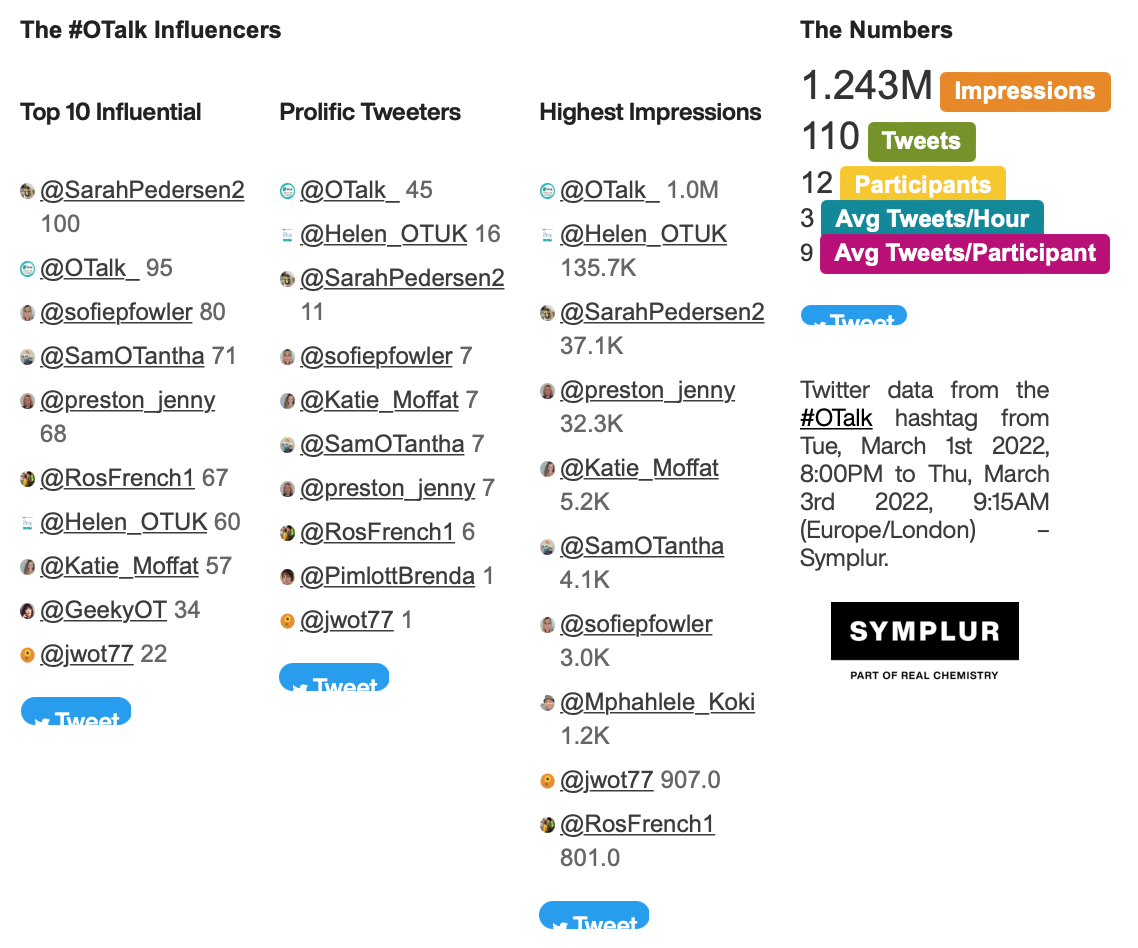
This month’s #OTalk Research will be hosted by Professor Sarah Pederson @SarahPedersen2, Robert Gordon University and will be supported by @preston_jenny and @SamOTantha on the @OTalk_ account.

Hello everyone and welcome to this week’s #OTalk on the ethical use of social media as research data. My name is Sarah Pedersen and I am Professor of Communication and Media at Robert Gordon University, Aberdeen.
Social media can be an amazing resource for researchers, really allowing us to access grassroots opinion and see how particular issues are discussed outside the classroom or more formal focus groups and interviews. It can also be used to engage participants in your research and to disseminate your findings beyond the usual suspects.

First do no harm

It can be a temptation to just leap in and collect lots of data from social media. However, we must remember that there are real people behind those posts and we must behave ethically. When I am assessing a student’s plans for engaging with social-media data, I want to see a thoughtful approach based on the practice of other scholars in the field and acknowledging the ethical tensions. A very good place to start are the ethical guidelines produced by the Association of Internet Researchers Ethics (aoir.org)

To some extent, your approach to social-media data will depend on where you are
collecting it. For example, I have an on-going relationship with the parenting forum Mumsnet. On occasion, Mumsnet has allowed me to run discussion threads about a project and I have encouraged forum users to chat with me and share their opinions. Here both Mumsnet and users are aware that their words may be used in my research and later publications so the ethical issues are less problematic. However, collecting data from social media when posters are not aware that this is happening is more problematic.

Is it publicly available?

One of the first questions we need to ask about social-media data is whether it is freely and publicly available. There is a clear difference between posts on Facebook, which you can mostly only see if you are a friend of the poster or member of a group, and posts on Twitter, for example. Unless the poster makes their tweets private, then it might be assumed that they are making use of Twitter to broadcast their thoughts to the world. We might therefore apply the same ethical standards to using this material as we would to any published material – acknowledging the source. However, of course we know that when people use social media they are not thinking about the rest of the world – just their friends. So I would tend to use Twitter as a data source but not Facebook. In the same way, I use Mumsnet because you don’t have to be a member to read the threads and because Mumsnetters are very aware that others make use of their words – Mumsnet itself has published books of baby advice taken from posts on the forums and journalists from the Daily Mail, etc, regularly run columns about a funny thread on the site. If I quote from blogs I will write to the blogger and ask for permission to quote. I usually receive an amazed response since the blogger has never been asked for permission before. But I consider this to be good practice.

Should I anonymise?

If you are using social-media data for qualitative research, you are going to want to quote from your corpus of texts. So should you try to anonymise your sources? Again, I would say that this depends on the particular source and your particular needs. I would expect you to discuss the reasons behind your decision in your methods section.
Over the years I have taken a number of different approaches here:

  1. Yes, completely anonymise. I have taken away all identifying features from the text and just quoted ‘a poster’, ‘a user’, ‘a tweeter’.
  2. When using source material from a tweeter/poster who is already using a pen name, I have quoted using that pen name. My thinking here is that they are already anonymised but deserve to have their authorship acknowledged. I often take this approach when using Mumsnet material, particularly when the name is relevant to my discussion. Thus two of my most recent works on Mumsnet have discussed users’ knowledge of the women’s suffrage campaign (so users with suffragette names are interesting) and users’ expression of anger during lockdown (some names demonstrated their anger very forcibly and so were an important part of the data). I am also aware that google can often find a quote on social media – so why not acknowledge its author?
    Sometimes I have demonstrated this when reviewing articles – googling the direct quotes used and showing the author that their attempts to anonymise the data have not worked.
  3. I have named the author outright. I have tended only to do this if they are public figure. MPs, celebrities and other public figures often make use of Twitter and Instagram to make direct statements to the public or the media. In these circumstances I think they an be identified.

Some questions to think about:

  1. Would you be comfortable with your social media posts being quoted by an academic researcher?
  2. Do you agree with the distinctions I make between the different social medias?
  3. Which sources would you be happy using and would you anonymise the data?
  4. Social media is great for engaging a wider public with your research, both to engage participants and to disseminate published work. How might you do that?

POST CHAT 

Host:  @SarahPedersen2

Support on OTalk Account: @preston_jenny and @SamOTantha

Evidence your CPD. If you joined in this chat you can download the below transcript as evidence for your CPD, but remember the HCPC are interested in what you have learnt.  So why not complete one of our reflection logs to evidence your learning?

HCPC Standards for CPD.

  • Maintain a continuous, up-to-date and accurate record of their CPD activities.
  • Demonstrate that their CPD activities are a mixture of learning activities relevant to current or future practice.
  • Seek to ensure that their CPD has contributed to the quality of their practice and service delivery.
  • Seek to ensure that their CPD benefits the service user.
  • Upon request, present a written profile (which must be their own work and supported by evidence) explaining how they have met the Standards for CPD.